
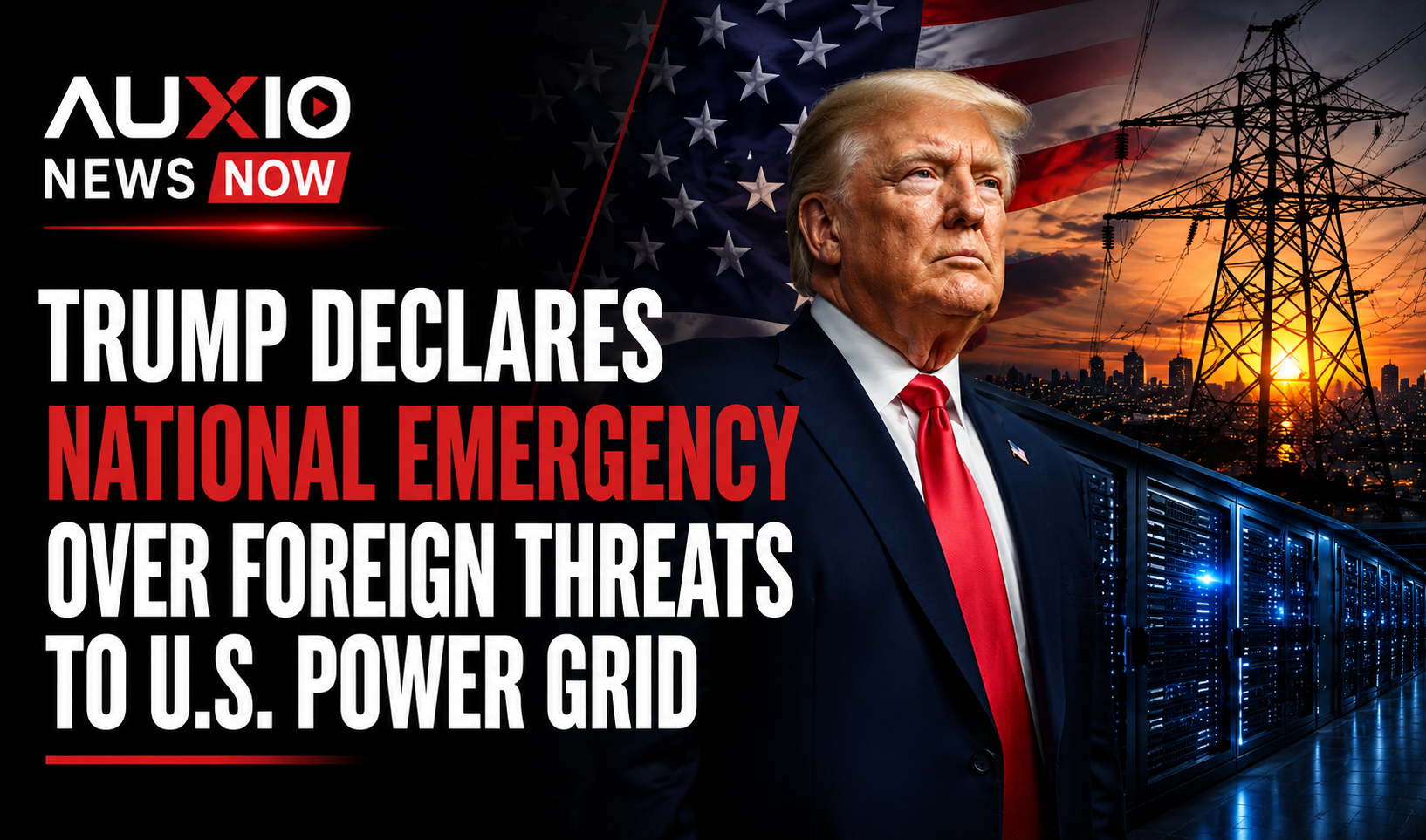
President Donald Trump has declared a national emergency aimed at protecting the United States bulk-power system from foreign-produced equipment and technology that the White House says could create cybersecurity and operational vulnerabilities. Hi
The executive order, signed Wednesday, authorizes restrictions on certain foreign-made equipment, software and digital capabilities used in the nation’s high-voltage electric grid when those products are determined to pose an unacceptable national-security risk. (The White House)
The White House says the concern is not hypothetical.
The bulk-power system supports military installations, hospitals, emergency services, communications networks, financial systems, data centers and virtually every other part of the modern economy. A successful attack or remotely triggered disruption could therefore create consequences far beyond a temporary power outage. (The White House)
The issue is bigger than electricity
Most Americans rarely think about where the equipment inside the electric grid was manufactured.
Transformers, control systems, software and other components generally become visible to the public only when something fails.
That invisibility can create a policy problem.
A lower-cost foreign component may save money when it is purchased. But if that component creates a cybersecurity vulnerability, dependence on an adversarial supplier or an inability to obtain replacement parts during a crisis, the original purchase price did not capture the full cost.
The Trump administration is effectively arguing that national-security risk must now be included in that calculation.
Under the new order, the Secretary of Energy is directed to identify foreign-produced bulk-power equipment that could present security risks and determine when purchases, transfers or installations should be prohibited or subjected to additional conditions. (The White House)
A national-security strategy with an economic cost
There is an obvious tradeoff.
Restricting foreign equipment can strengthen domestic supply chains and reduce dependence on potentially hostile governments.
It can also increase costs.
If American utilities have fewer suppliers to choose from, certain transformers, electrical components and digital systems may become more expensive or take longer to obtain.
That matters at a time when the electrical grid is already facing growing demand.
The Department of Energy has warned separately that regions of the country face increasing reliability challenges as electricity consumption rises, with data centers and other large industrial users contributing to significant load growth. DOE has also cited supply-chain constraints involving critical equipment such as large transformers and natural-gas turbines. (The Department of Energy’s Energy.gov)
The policy question is therefore not whether protecting the grid has a cost.
It does.
The relevant question is whether paying more for secure infrastructure today reduces the probability of paying a much larger price later.
The grid is becoming strategic infrastructure
The administration’s decision reflects a broader change in how electricity infrastructure is viewed.
For decades, the grid was primarily treated as an engineering and utility issue.
Today, electricity is inseparable from national security.
Artificial intelligence, cloud computing, military communications, advanced manufacturing, banking and telecommunications all depend on reliable power.
And as more of the grid becomes digitally connected, physical infrastructure and cybersecurity increasingly become the same issue.
Foreign access to software, control systems or critical components could potentially create vulnerabilities that did not exist when the electrical system was largely mechanical.
Trump’s order is intended to reduce that exposure.
The real test comes next
Declaring an emergency is relatively straightforward.
Replacing vulnerable equipment is not.
Transformers and other grid components can be expensive, specialized and difficult to manufacture quickly. Building more domestic production capacity takes capital, skilled workers and time.
If restrictions are imposed faster than alternative suppliers become available, utilities could face delays or higher costs.
If restrictions move too slowly, the security vulnerabilities identified by the administration could remain in place.
That is the balance policymakers now have to manage.
The success of this policy will not ultimately be measured by how aggressively Washington describes the foreign threat.
It will be measured by whether the United States ends up with a grid that is more secure, more reliable and less dependent on potentially hostile suppliers — without creating shortages that undermine the system the policy is intended to protect.
In critical infrastructure, the cheapest component is not always the least expensive one.
Sometimes the real cost only becomes visible when it fails.
Auxio.tv News Now