
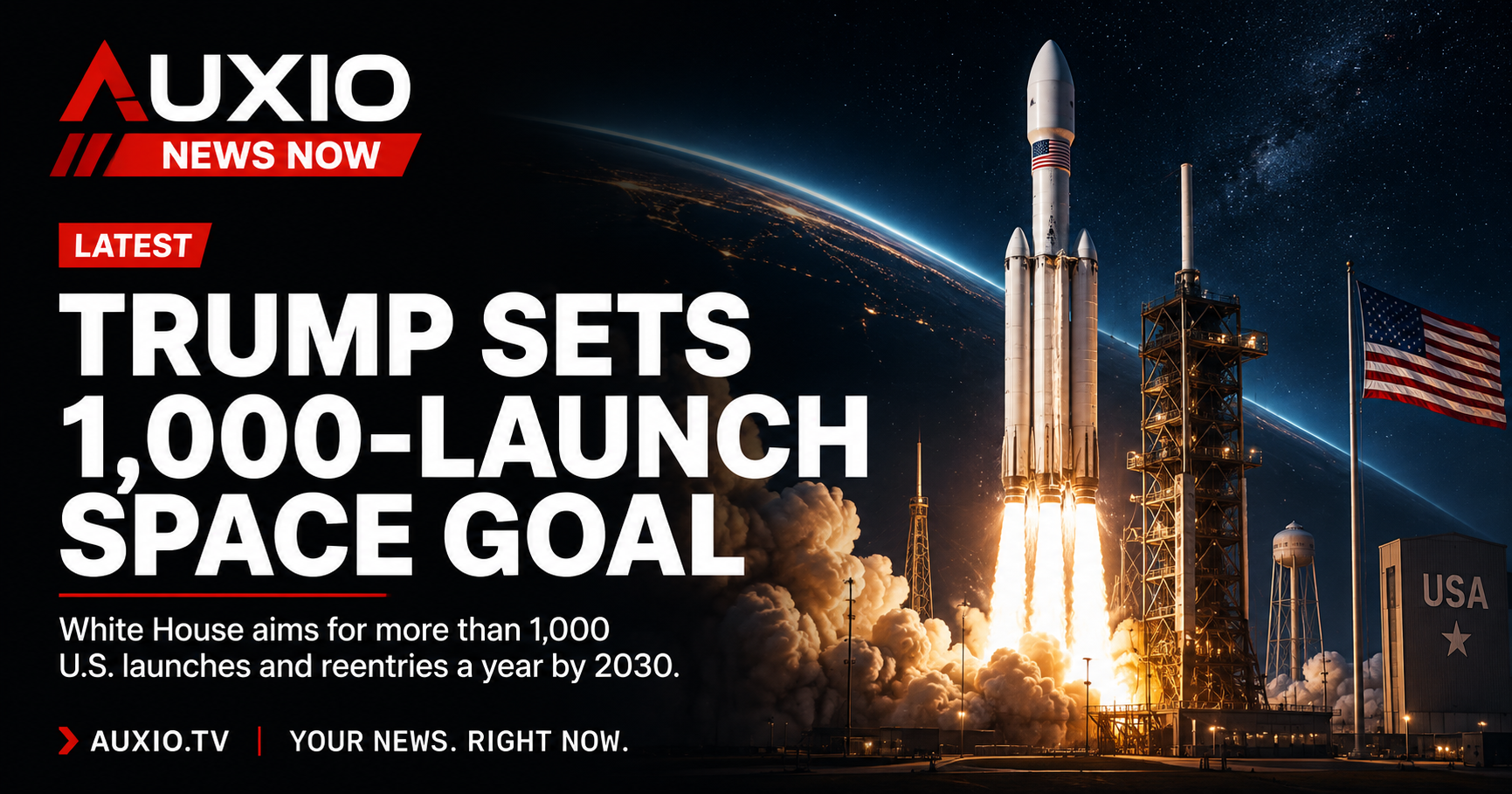
President Donald Trump has issued a new national space transportation policy directing the federal government to dramatically expand America’s ability to launch, recover and move spacecraft.
The centerpiece of the policy is an ambitious target: by 2030, U.S. space transportation ranges should be capable of supporting more than 1,000 launches and reentries every year.
The White House says access to space is now a matter of both economic and national security, arguing that commercial launch capacity has become essential to communications, defense, scientific research and the broader American economy. (The White House)
The policy directs NASA, the Department of Transportation, the Department of Commerce and other federal agencies to expand launch infrastructure, improve access to federal launch sites and encourage private investment in facilities on federal property.
It also calls for faster permitting and environmental reviews, new scheduling rules for federal launch ranges and greater coordination between the federal government and commercial space companies. (The White House)
But the significance of the policy goes beyond a larger number of rocket launches.
The administration is effectively treating space transportation as a form of national infrastructure.
That is an important distinction.
A country can design sophisticated satellites, build advanced spacecraft and develop ambitious lunar programs. None of those capabilities matter very much if it cannot reliably and affordably get those systems into orbit.
Transportation capacity creates the foundation on which everything else depends.
The White House is also directing the government to identify potential locations for additional launch facilities and to integrate space launches and reentries into future air-traffic-control modernization.
Federal agencies are being instructed to examine whether the United States could provide rapid access to space within 48 hours of need for certain civil and national-security missions. (The White House)
That requirement reveals another dimension of the policy.
Launch capacity is no longer being treated simply as a commercial question.
In a military or national-security crisis, the ability to quickly replace a damaged or disabled satellite could become strategically important.
A nation that requires months to replace critical space infrastructure may find itself at a disadvantage against a competitor capable of doing so in days.
The administration is therefore placing considerable emphasis on resilience, domestic manufacturing and multiple launch options.
The memorandum says U.S. government payloads should generally be transported on vehicles manufactured in the United States, while federal agencies are instructed to favor commercial space transportation services whenever practical.
The government is also directed to support a competitive domestic space transportation industry and strengthen American supply chains. (The White House)
That approach has an obvious economic logic.
Private companies have already transformed the launch market by reducing costs and increasing launch frequency. The administration is betting that removing additional regulatory and infrastructure constraints will allow that process to accelerate.
But deregulation is not the same thing as increased capacity.
The actual test will be whether companies invest enough capital, whether launch facilities can expand quickly enough, and whether federal agencies can coordinate increasingly crowded airspace and launch schedules without creating new bottlenecks elsewhere.
There are also costs that cannot simply be wished away.
New launch facilities require land. More launches require infrastructure. Reentry corridors affect airspace. Environmental reviews exist because launch operations can impose consequences on surrounding communities.
A serious economic policy therefore has to distinguish between unnecessary regulatory delay and legitimate costs that someone will ultimately bear.
The Trump administration has clearly decided that the greater risk is moving too slowly.
Its goal of more than 1,000 annual launches and reentries would represent a fundamental change in the scale of American space activity.
And that may be the most important part of the policy.
For decades, spaceflight was treated as an extraordinary event.
The administration is now trying to make it routine infrastructure.
If that happens, the competitive advantage may not belong simply to the country with the best rocket.
It may belong to the country that can launch most reliably, most frequently and at the lowest cost.
That is the economic bet behind Trump’s new space transportation policy.
And by 2030, we should know whether it worked.
Auxio.tv News Now