
By Auxio.tv News | August 29, 2026
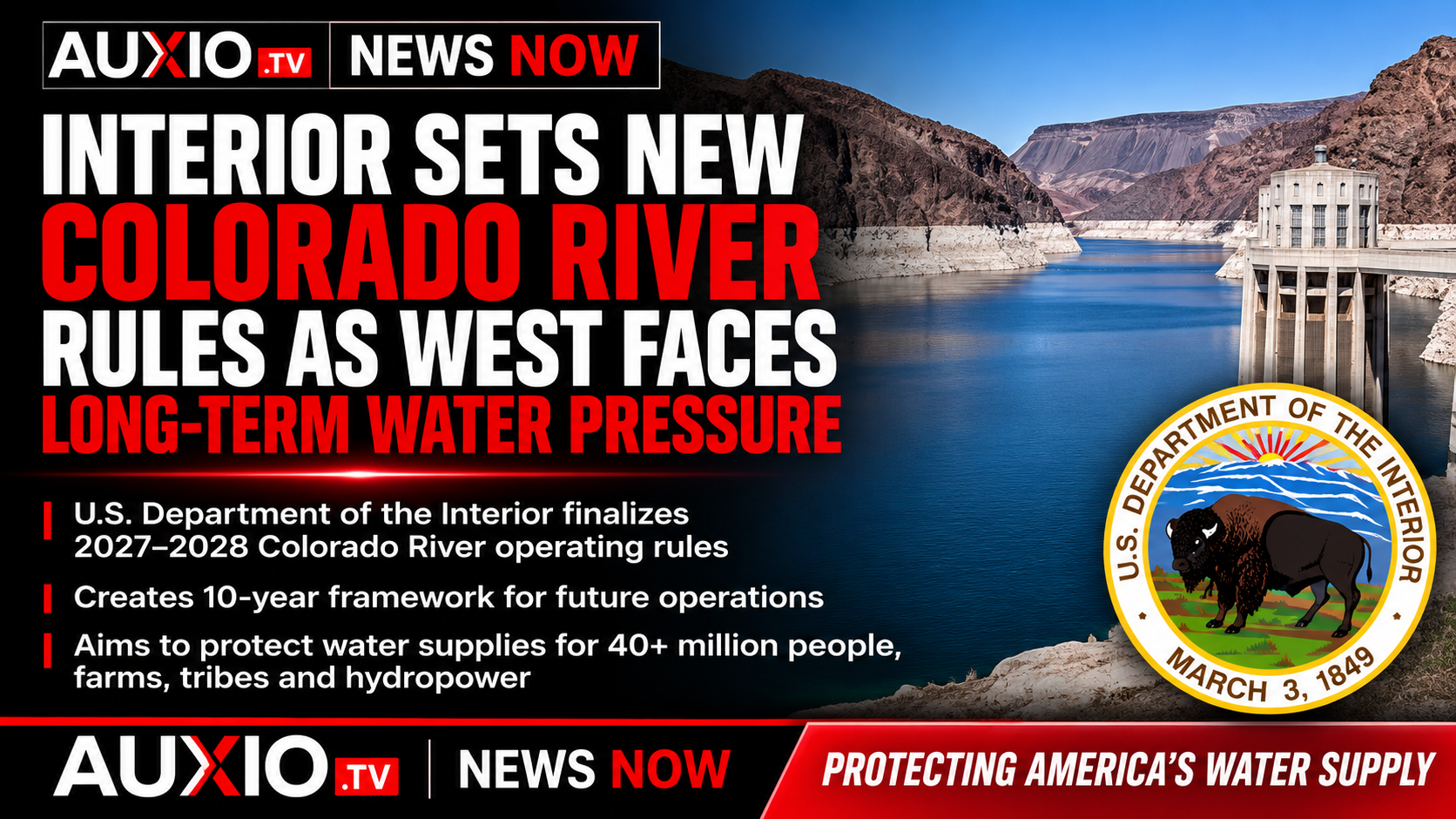
The U.S. Department of the Interior has finalized new operating rules for the Colorado River, setting the framework for how Lake Powell and Lake Mead will be managed through a period of historically low water levels.
The new 2027–2028 Operating Guidelines also establish a broader 10-year decision framework for future river operations. Interior says the goal is to protect critical infrastructure, preserve water deliveries and give the seven Colorado River Basin states more flexibility to respond to worsening drought conditions.
The need is obvious.
Interior says the combined contents of Lake Powell and Lake Mead are now at levels not seen since before Lake Powell began filling in the 1960s. The Colorado River serves more than 40 million people, supports 5.5 million acres of farmland, provides hydropower across seven states and remains vital to 30 tribes and two Mexican states.
Under the new rules, Lake Powell releases will be tied more closely to actual hydrology, with an effort to keep the reservoir at or above 3,510 feet to protect operations at Glen Canyon Dam.
For 2027, Lake Mead deliveries to Lower Basin states are expected to be reduced by 1.25 million acre-feet.
That is where the tradeoff becomes clear.
Water cannot be allocated by political preference alone when the river itself is producing less of it.
Every gallon preserved in one reservoir is a gallon that cannot be used somewhere else at the same time.
Agriculture, cities, tribes, hydropower and environmental needs are all competing for the same limited supply.
Interior’s new framework does not eliminate that conflict.
It creates a structure for managing it.
The department is emphasizing voluntary agreements, conservation, coordinated reservoir operations and additional flexibility for storing and moving conserved water. It also leaves room for the Basin states to continue negotiating longer-term agreements during the next several years.
That may be the most important part of the policy.
The federal government can set operating rules.
It cannot create water that is not there.
The success of the new framework will therefore depend on whether states, tribes and major water users can adapt faster than reservoir conditions deteriorate.
For the West, the real issue is no longer whether shortages are coming.
They are already here.
The question is how those shortages will be divided — and whether the system can remain reliable while doing it.

Auxio.tv News Now