By Auxio.tv News | August 28, 2026
House Republicans are preparing another high-profile vote condemning socialism, setting up a politically charged test for lawmakers just months before the 2026 midterm elections.
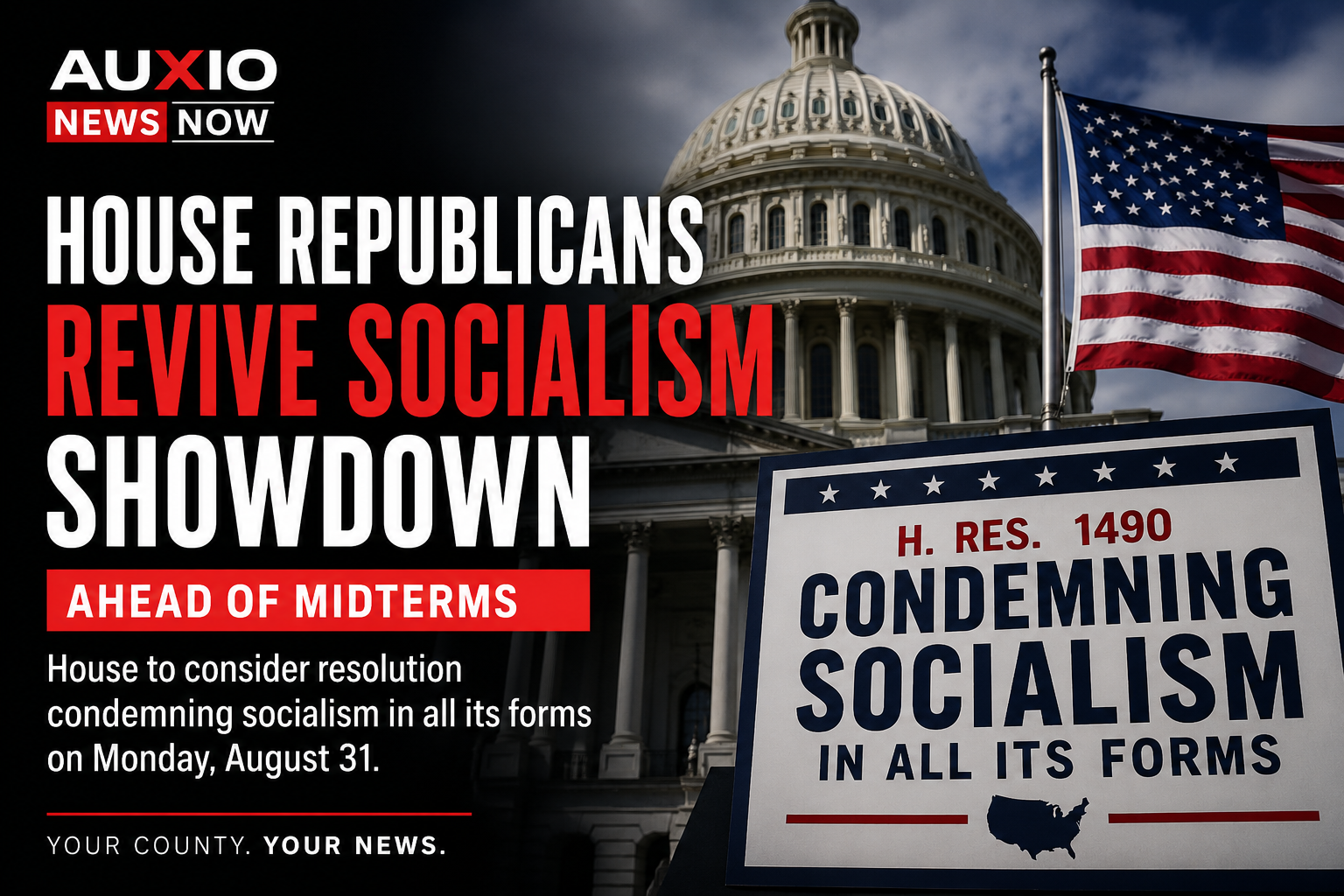
The House Rules Committee is scheduled to consider H. Res. 1490 on Monday, August 31. The resolution, introduced by Rep. Jeff Crank of Colorado, calls for the condemnation and denouncement of socialism “in all its forms.”
Crank’s office says the resolution also targets the Democratic Socialists of America and argues that some of the group’s positions are incompatible with secure elections and traditional American political norms. Those are the sponsor’s political claims, not independently established facts, and they should be understood as part of the resolution’s argument.
The timing is not accidental.
Congress has already voted on similar language before. In November 2025, the House passed a resolution titled “Denouncing the horrors of socialism” by a vote of 285 to 98, with two members voting present. All 199 Republicans who voted supported it, while Democrats split sharply: 86 voted yes, 98 voted no, and two voted present.
That history helps explain why another vote can be politically useful even though the resolution itself does not change federal law.
A vote designed to draw a line
Nonbinding resolutions are often dismissed because they do not alter tax policy, spending, regulations or criminal law.
But that does not mean they have no purpose.
A resolution like this creates a recorded vote on a broad ideological question.
That vote can then be used in campaign advertising, fundraising, debates and constituent messaging.
Republicans who support the measure can tell voters they formally rejected socialism.
Democrats who vote against it may then be asked to explain why.
That is the political leverage built into the vote.
The issue is not simply what the resolution says.
It is what the vote allows each side to say afterward.
Republicans are trying to define the choice before voters do
Crank’s resolution comes as Republicans increasingly try to frame the 2026 midterms around a broader ideological contrast between free-market capitalism and socialism.
That strategy is straightforward.
Rather than arguing separately about every spending proposal, tax plan, housing policy or government program, Republicans can try to place those debates under one larger label.
If voters view “socialism” negatively, then attaching that term to Democratic policies can be politically valuable.
The difficulty is that the word itself is used very broadly in American politics.
Some people use it to describe state ownership of major industries.
Others apply it to expansive social programs, public health care, rent regulation or higher taxes on wealthy households.
Those are not necessarily the same economic system.
So the value of the resolution may depend less on establishing a precise economic definition and more on creating a clear political dividing line.
The real question is what lawmakers are being asked to condemn
This is where the debate becomes more substantive.
Condemning authoritarian socialist regimes is one thing.
Condemning every policy that someone chooses to label socialist is another.
A serious economic discussion has to distinguish between systems that replace private ownership and market allocation, and ordinary government interventions that exist within market economies.
That distinction matters because nearly every modern economy combines private markets with some degree of taxation, regulation and public spending.
The argument should therefore be about which policies produce better incentives, lower costs, greater growth and more individual freedom — not merely which side can apply the most powerful label.
That does not make the House vote meaningless.
It makes the vote political rather than legislative.
What happens next
The Rules Committee has placed H. Res. 1490 on its August 31 agenda alongside several other measures. If the House proceeds to a floor vote, members could again be forced to take a public position on socialism before voters head into the midterm campaign.
The likely effect will not be a new federal program or change in law.
It will be a new set of recorded votes.
And in an election year, recorded votes are political assets.
That may be the most important thing to understand about the coming showdown.
Congress is not simply debating an economic philosophy.
It is also defining the argument voters may hear repeatedly between now and November.
Auxio.tv News Now