
Tag: Auxio News Now

  • Supreme Court Backs Trump Administration in White House Ballroom Fight

    Supreme Court Backs Trump Administration in White House Ballroom Fight

    WASHINGTON — The U.S. Supreme Court has cleared the way for construction of President Donald Trump’s White House ballroom project to continue, granting the administration’s request to stay a lower-court injunction while the broader legal fight proceeds.

    The Aug. 31 order came in National Park Service, et al. v. National Trust for Historic Preservation in the United States, placing the National Park Service — an agency within the Department of the Interior — directly at the center of the case. 

    The Court stayed an injunction issued by the U.S. District Court for the District of Columbia that had restricted portions of the East Wing project. The stay remains in effect while the government seeks Supreme Court review of the case. 

    The administration’s application was filed by the Solicitor General on behalf of the National Park Service and other federal applicants. The government argued that the lower-court order threatened to interrupt an integrated White House construction project and create security and operational consequences.

    The Department of the Interior’s role runs through the National Park Service, which manages President’s Park, including the White House grounds.

    NPS prepared the federal environmental assessment for the White House East Wing Modernization and State Ballroom project. According to the agency’s planning record, the selected action calls for replacing the existing East Wing with a new building that will house the White House State Ballroom and associated facilities. 

    The agency also completed a Finding of No Significant Impact, concluding that the selected project would not significantly impair park resources under the standards used by the National Park Service. 

    That makes Interior’s role more than administrative background. One of its agencies conducted the project review, manages the federal park property involved and is the lead named federal applicant before the Supreme Court.

    What the Supreme Court Decided

    The Court’s order is a significant procedural victory for the administration, but it does not constitute a final ruling that the ballroom project is lawful.

    The stay allows construction to continue while the litigation proceeds. 

    Chief Justice John Roberts dissented, joined by Justices Sonia Sotomayor, Elena Kagan and Ketanji Brown Jackson.

    Roberts argued that the construction is likely unlawful because federal law generally prohibits construction of a new building or structure on federal park grounds in Washington without express congressional authorization. He noted that the project sits within President’s Park. 

    That dispute remains unresolved.

    Why It Matters

    The case now involves more than a White House renovation.

    It raises questions about presidential authority over federal property, Congress’ role in authorizing construction in Washington and the extent to which Interior Department agencies can approve and manage major changes to historic federal property.

    For the Trump administration, however, the immediate result is straightforward: the lower-court restriction has been stayed, and construction can continue while the case moves forward.
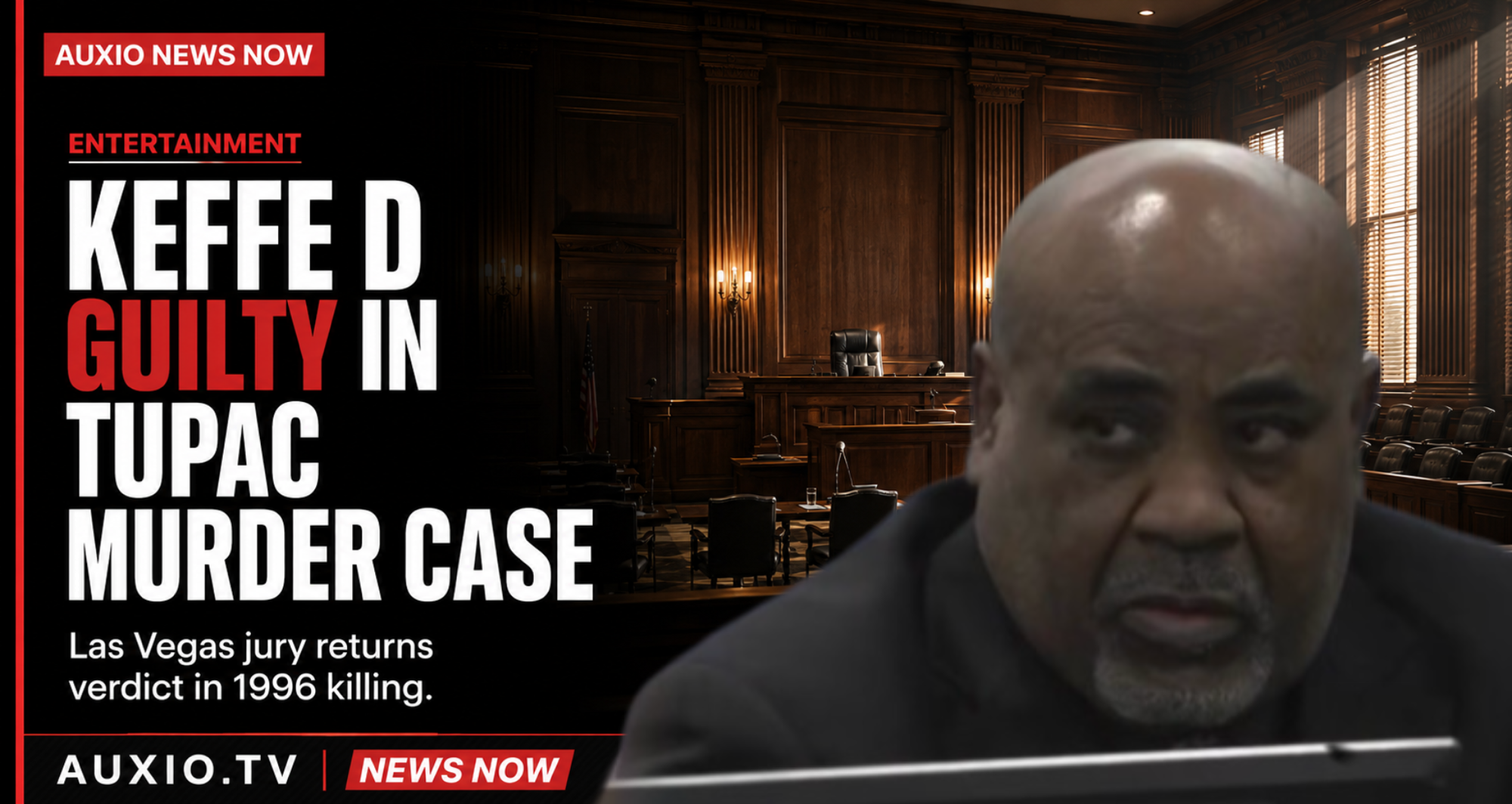
  • Duane “Keffe D” Davis Found Guilty in Tupac Shakur Murder Case

    Duane “Keffe D” Davis Found Guilty in Tupac Shakur Murder Case

    LAS VEGAS — A jury has found Duane “Keffe D” Davis guilty in connection with the 1996 killing of Tupac Shakur, bringing the trial phase of the decades-old case to a close.

    A Court TV courtroom graphic supplied to AUXIO reported that the jury reached its verdict after deliberating for less than three hours.

    Davis was prosecuted in Clark County, Nevada, in the case arising from the fatal shooting of Shakur in Las Vegas nearly 30 years ago.

    The verdict represents a conviction, rather than an allegation or pending charge. Any sentencing decision, post-trial motions or appeal will be separate stages of the case and should be reported as those developments become part of the official court record.

    The Eighth Judicial District Court in Clark County maintains the official records for felony criminal cases. The court says its Clerk of the Court maintains the official case files and that trial and hearing minutes are added to the court’s online records as they become available. 

    The court also warns that portions of its online case information can lag behind courtroom activity. Court minutes are entered after proceedings, while some filing information can take additional time to appear. The Clerk’s Office remains the controlling source for verification of the official case record. 

    Shakur’s killing has remained one of the most closely followed cases in music and hip-hop history. The rapper was 25 when he died following a shooting in Las Vegas in September 1996.

    Davis’ prosecution brought the case back into a courtroom decades later, generating renewed attention around the circumstances of Shakur’s death and the investigation that followed.

    With the jury now returning a guilty verdict, attention turns to the next stage of the criminal case.

  • Blakeman Takes Local-Control Fight With Hochul Statewide

    Blakeman Takes Local-Control Fight With Hochul Statewide

    By Auxio News Now | Auxio.tv News

    Nassau County Executive Bruce Blakeman is taking a dispute over immigration enforcement and turning it into a broader argument about state power, public safety and local control.

    The immediate fight centers on New York’s move to block local law-enforcement agencies from maintaining certain formal cooperation agreements with U.S. Immigration and Customs Enforcement.

    Nassau County had participated in a federal 287(g) arrangement, which allows designated local officers to perform limited immigration-enforcement functions under federal supervision. After New York enacted restrictions on those agreements, Blakeman ended Nassau’s participation rather than defy state law.

    But he did not abandon the issue.

    Instead, Nassau has moved into the legal and political fight over whether Albany should be able to prevent counties from choosing that kind of cooperation with federal authorities.

    That gives Blakeman a useful campaign argument as he runs for governor.

    His case is straightforward: counties are responsible for public safety on the ground, yet Albany is increasingly setting limits on how those counties can work with federal law enforcement.

    Supporters of the state law see the issue differently.

    They argue local police should focus on criminal enforcement rather than civil immigration matters, and that close cooperation with ICE can discourage some immigrants from reporting crimes or cooperating with police.

    That is the policy divide.

    But Blakeman is trying to make the dispute about more than immigration.

    For him, the larger question is whether Albany should continue expanding its authority over decisions traditionally handled by counties and municipalities.

    That argument has resonance beyond Nassau County.

    Long Island officials regularly clash with the state over policing, housing, zoning, energy projects and other policies where local governments argue that statewide rules do not always reflect local conditions.

    Blakeman is positioning himself as the candidate willing to push back.

    His record in Nassau helps him make that case. He has emphasized police hiring, opposition to tax increases and a more aggressive approach to public safety while presenting county government as an alternative to Albany’s governing philosophy.

    The ICE dispute gives that message a specific example.

    Rather than simply arguing that New York’s immigration policy is too permissive, Blakeman can point to a situation in which a county chose one enforcement approach and the state government effectively took that option away.

    Whether the courts agree with that argument is a separate question.

    State government has broad authority to regulate municipalities, and home rule in New York has never meant that counties can disregard general state laws.

    Still, the political issue remains.

    How much discretion should local governments have when the people running those governments believe a statewide policy makes their communities less safe?

    Governor Kathy Hochul and Democratic lawmakers have taken the position that some rules should apply consistently across New York.

    Blakeman is arguing that greater local discretion is itself a form of accountability.

    If a county executive or sheriff makes the wrong call, local voters can respond.

    If the decision is made in Albany, responsibility becomes more distant.

    That is the contrast Blakeman is taking into the governor’s race.

    The fight may have started with ICE.

    It is becoming a much larger argument over who gets the final say in New York government.

    Auxio News Now | Auxio.tv News

  • Farrell Secures $49M for Florida Luxury Project as Investor Lawsuits Hang Over Development

    Farrell Secures $49M for Florida Luxury Project as Investor Lawsuits Hang Over Development

    By East End Now | Auxio.tv News

    Hamptons developer Joe Farrell has secured substantial new financing for his luxury residential development in Wellington, Florida, even as legal disputes involving investors continue around the project.

    Farrell reportedly drew a $49 million mortgage from Maxim Credit Group for Farrell Estates, a residential community being developed inside Wellington’s Palm Beach Polo & Country Club. The financing facility reportedly provides access to as much as $98 million. 

    The development itself is well documented in official Village of Wellington records.

    Farrell Florida Wellington Owner LLC is developing approximately 23 acres into 27 single-family residential lots. Wellington approved the subdivision plat in 2024, finding that it complied with village codes and regulations. The plans also include access, stormwater-management and utility easements for the community. 

    The ownership entity maintains a direct connection to the East End.

    Florida corporate records list Farrell Florida Wellington Owner LLC as an active company with a principal address at 2331 Montauk Highway in Bridgehampton. Joseph G. Farrell Jr. is listed as an authorized person for the company. 

    But the development is moving ahead against the backdrop of litigation involving Farrell-affiliated entities and project investors.

    Investors have filed lawsuits making allegations about the handling of money connected to the Wellington venture. Farrell has disputed claims of wrongdoing. The existence of those lawsuits does not, by itself, establish that investor funds were improperly used.

    That distinction is important.

    Business litigation can involve competing allegations, contract disputes and disagreements over how investments were managed. Those claims ultimately have to be established through the legal process rather than assumed from the filing of a lawsuit.

    At the same time, securing major financing while litigation remains active is notable.

    The $49 million loan indicates that the Wellington project is continuing to attract capital despite the unresolved disputes surrounding it. It also gives Farrell additional financial capacity to move forward with a development that has already cleared significant local approval hurdles.

    For East End readers, the story has a familiar name at its center.

    Farrell built his reputation through luxury residential development in the Hamptons before expanding his business into Florida and other markets. His Wellington ownership company continues to list Bridgehampton as its principal address. 

    For now, two developments are unfolding at the same time: Farrell Estates continues moving forward, while the investor litigation remains unresolved.

    Neither should be confused with the other.

    A large new loan is not a resolution of the lawsuits, just as the filing of lawsuits is not proof of wrongdoing.

    East End Now — Your East End. Your News.

  • New York Sheriffs Take Hochul to Court Over ICE Cooperation Ban

    New York Sheriffs Take Hochul to Court Over ICE Cooperation Ban

    By Auxio.tv News | August 29, 2026

    Fifteen New York county sheriffs are challenging a new state law that blocks local law-enforcement agencies from maintaining formal 287(g) agreements with U.S. Immigration and Customs Enforcement.

    The law, known as the Local Cops, Local Crimes Act, was signed by Gov. Kathy Hochul in May. It prohibits state and local agencies from entering into or remaining in agreements that allow local officers to perform certain federal civil immigration-enforcement functions. Existing agreements had to be terminated by August 25. 

    The sheriffs filed suit on August 25, arguing that Albany should not be able to prevent locally elected law-enforcement officials from cooperating with federal immigration authorities. Hochul and Attorney General Letitia James have defended the law and say local police resources should remain focused on local crime rather than federal civil immigration enforcement. 

    That disagreement gets to a larger issue than immigration alone.

    The question is who gets to decide how local law enforcement uses its authority.

    Sheriffs are elected locally. Albany writes state law. Immigration enforcement is primarily a federal responsibility.

    When those three levels of government disagree, the dispute quickly becomes one of institutional power.

    New York has already begun enforcing the law. On August 27, James and Hochul sued the Rensselaer County Sheriff’s Office, saying it failed to terminate its 287(g) agreement by the deadline. The state says Rensselaer was the only one of the 12 agencies with preexisting agreements that had not indicated it would comply. 

    The state also won an early court victory earlier this month. On August 3, a federal judge declined to issue a preliminary injunction blocking New York’s 287(g) ban in a separate challenge brought by the federal government. 

    That does not end the current sheriffs’ lawsuit.

    It does show that the legal fight has already moved beyond political rhetoric.

    For Hochul, the argument is that local police should not be diverted into federal immigration work.

    For the sheriffs, the issue is whether the state can prevent elected local law-enforcement officials from voluntarily assisting federal authorities.

    Both sides are now asking the courts to decide where that authority begins and ends.

    The practical question is just as important as the constitutional one:

    If local agencies believe cooperation with ICE makes their communities safer, should Albany be able to stop them?

    Or does allowing each county to set its own immigration-enforcement policy create a patchwork the state has a legitimate interest in controlling?

    That is the dispute now moving through the courts.

    Auxio.tv News Now

  • House Republicans Revive Socialism Showdown Ahead of Midterms

    House Republicans Revive Socialism Showdown Ahead of Midterms

    By Auxio.tv News | August 28, 2026

    House Republicans are preparing another high-profile vote condemning socialism, setting up a politically charged test for lawmakers just months before the 2026 midterm elections.

    The House Rules Committee is scheduled to consider H. Res. 1490 on Monday, August 31. The resolution, introduced by Rep. Jeff Crank of Colorado, calls for the condemnation and denouncement of socialism “in all its forms.” 

    Crank’s office says the resolution also targets the Democratic Socialists of America and argues that some of the group’s positions are incompatible with secure elections and traditional American political norms. Those are the sponsor’s political claims, not independently established facts, and they should be understood as part of the resolution’s argument. 

    The timing is not accidental.

    Congress has already voted on similar language before. In November 2025, the House passed a resolution titled “Denouncing the horrors of socialism” by a vote of 285 to 98, with two members voting present. All 199 Republicans who voted supported it, while Democrats split sharply: 86 voted yes, 98 voted no, and two voted present. 

    That history helps explain why another vote can be politically useful even though the resolution itself does not change federal law.

    A vote designed to draw a line

    Nonbinding resolutions are often dismissed because they do not alter tax policy, spending, regulations or criminal law.

    But that does not mean they have no purpose.

    A resolution like this creates a recorded vote on a broad ideological question.

    That vote can then be used in campaign advertising, fundraising, debates and constituent messaging.

    Republicans who support the measure can tell voters they formally rejected socialism.

    Democrats who vote against it may then be asked to explain why.

    That is the political leverage built into the vote.

    The issue is not simply what the resolution says.

    It is what the vote allows each side to say afterward.

    Republicans are trying to define the choice before voters do

    Crank’s resolution comes as Republicans increasingly try to frame the 2026 midterms around a broader ideological contrast between free-market capitalism and socialism.

    That strategy is straightforward.

    Rather than arguing separately about every spending proposal, tax plan, housing policy or government program, Republicans can try to place those debates under one larger label.

    If voters view “socialism” negatively, then attaching that term to Democratic policies can be politically valuable.

    The difficulty is that the word itself is used very broadly in American politics.

    Some people use it to describe state ownership of major industries.

    Others apply it to expansive social programs, public health care, rent regulation or higher taxes on wealthy households.

    Those are not necessarily the same economic system.

    So the value of the resolution may depend less on establishing a precise economic definition and more on creating a clear political dividing line.

    The real question is what lawmakers are being asked to condemn

    This is where the debate becomes more substantive.

    Condemning authoritarian socialist regimes is one thing.

    Condemning every policy that someone chooses to label socialist is another.

    A serious economic discussion has to distinguish between systems that replace private ownership and market allocation, and ordinary government interventions that exist within market economies.

    That distinction matters because nearly every modern economy combines private markets with some degree of taxation, regulation and public spending.

    The argument should therefore be about which policies produce better incentives, lower costs, greater growth and more individual freedom — not merely which side can apply the most powerful label.

    That does not make the House vote meaningless.

    It makes the vote political rather than legislative.

    What happens next

    The Rules Committee has placed H. Res. 1490 on its August 31 agenda alongside several other measures. If the House proceeds to a floor vote, members could again be forced to take a public position on socialism before voters head into the midterm campaign. 

    The likely effect will not be a new federal program or change in law.

    It will be a new set of recorded votes.

    And in an election year, recorded votes are political assets.

    That may be the most important thing to understand about the coming showdown.

    Congress is not simply debating an economic philosophy.

    It is also defining the argument voters may hear repeatedly between now and November.

    Auxio.tv News Now