Tag: Bay Shore

  • Bay Shore High School Teacher Arrested on Stalking Charge Involving Former Student

    Bay Shore High School Teacher Arrested on Stalking Charge Involving Former Student

    SUFFOLK COUNTY, N.Y. — A Bay Shore High School teacher has been arrested on a stalking charge after Suffolk County Police say an 18-year-old former student reported that he followed her from her home to Selden.

    Police identified the teacher as John Kennedy, 53, of St. James.

    According to Suffolk County Police, the woman noticed Kennedy following her on the morning of Sept. 3 as she traveled from her home to Selden. Police were called at approximately 10:40 a.m. after she reached her destination. 

    Kennedy was arrested later that afternoon at his St. James residence.

    During the investigation, Sixth Precinct Crime Unit officers determined that Kennedy allegedly had a sexual relationship with the student when she was 17 and a senior at Bay Shore High School. Police also said Kennedy had been seen driving past her home multiple times in recent weeks. 

    Kennedy was charged with Stalking in the Fourth Degree.

    Police said he was held overnight at the Sixth Precinct and scheduled for arraignment in First District Court in Central Islip on Sept. 4. 

    Detectives are asking anyone with information about the case — or anyone who believes they may also have been victimized by Kennedy — to contact the Sixth Precinct Crime Unit at 631-854-8626. 

    The allegations remain under investigation.

    A criminal charge is an accusation, and Kennedy is presumed innocent unless and until proven guilty.
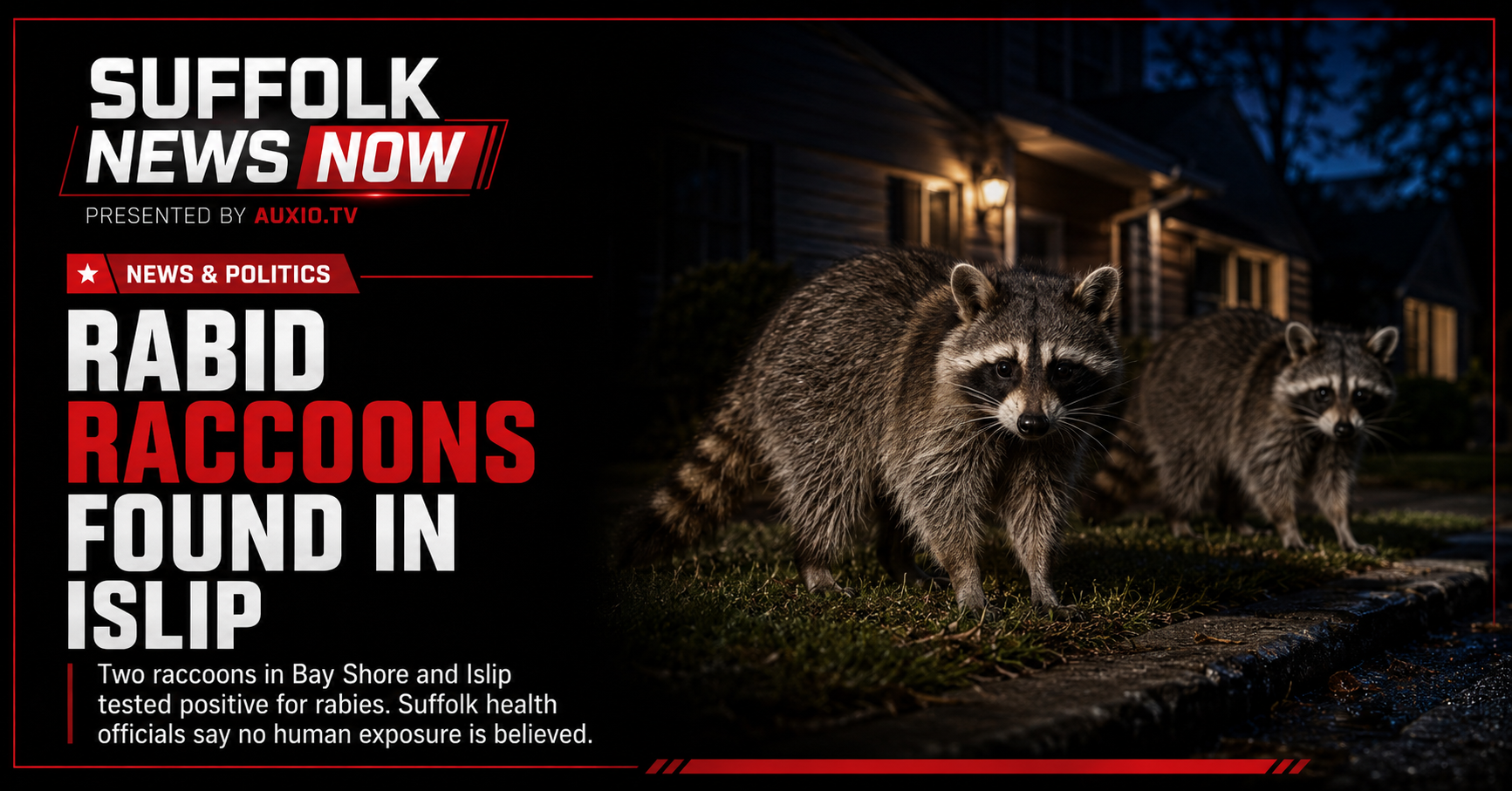
  • Two More Rabid Raccoons Found in Islip as Suffolk Warns Residents

    Two More Rabid Raccoons Found in Islip as Suffolk Warns Residents

    ISLIP, N.Y. — Suffolk County health officials are warning residents to avoid contact with wild animals after two additional raccoons found in the Town of Islip tested positive for rabies.

    The Suffolk County Department of Health Services said one raccoon was found dead on a street in Bay Shore and another was found dead in Islip earlier in August. The animals were retrieved by the Islip Animal Shelter and submitted for rabies testing.

    The county said the Wadsworth Center at the New York State Department of Health confirmed the positive results on Aug. 19. At the time of the announcement, county health officials said they did not believe there had been any human exposure. 

    The two cases were identified as Suffolk County’s 38th and 39th positive terrestrial rabies confirmations since Feb. 7, 2025, according to the county. 

    They followed another confirmed case in Islip earlier in August. In that case, a member of the public reported a raccoon that appeared ill. Suffolk County Police Emergency Service officers responded, and testing later confirmed rabies. County officials reported no human or pet exposure in that incident. 

    The latest cases are part of a broader return of terrestrial rabies to Suffolk County after years without locally acquired cases. Suffolk reported its first locally acquired terrestrial rabies case of 2026 in January, when a dead raccoon found in Wyandanch tested positive. At that point, officials said nearly all of the county’s recent terrestrial cases involved raccoons. 

    Rabies is a viral disease that attacks the central nervous system and can infect mammals, including raccoons, bats, skunks and foxes. Human infection most commonly occurs when saliva or nervous tissue from an infected animal enters the body through a bite, scratch or open wound. 

    Suffolk County is urging residents not to touch or transport wild animals. Anyone who sees a raccoon behaving abnormally can contact Suffolk County Police at 631-852-COPS or the New York State Department of Environmental Conservation at 631-444-0250. 

    Residents should also keep pets’ rabies vaccinations current and report possible animal bites or wildlife exposures to county health officials.

    Why It Matters

    The new Islip cases show that Suffolk County’s terrestrial rabies activity has not disappeared. Residents who encounter sick, unusually aggressive, disoriented or dead wildlife should avoid direct contact and allow animal-control or public-health professionals to handle the animal.