Tag: east Hampton

  • East Hampton Updates Residents on PFAS Investigation, Says Public Water Meets Standards

    East Hampton Updates Residents on PFAS Investigation, Says Public Water Meets Standards

    EAST HAMPTON, NY — East Hampton Town has issued an updated drinking-water advisory as state and county agencies continue investigating PFAS contamination near the Suffolk County Water Authority’s Buckskill Road wellfield.

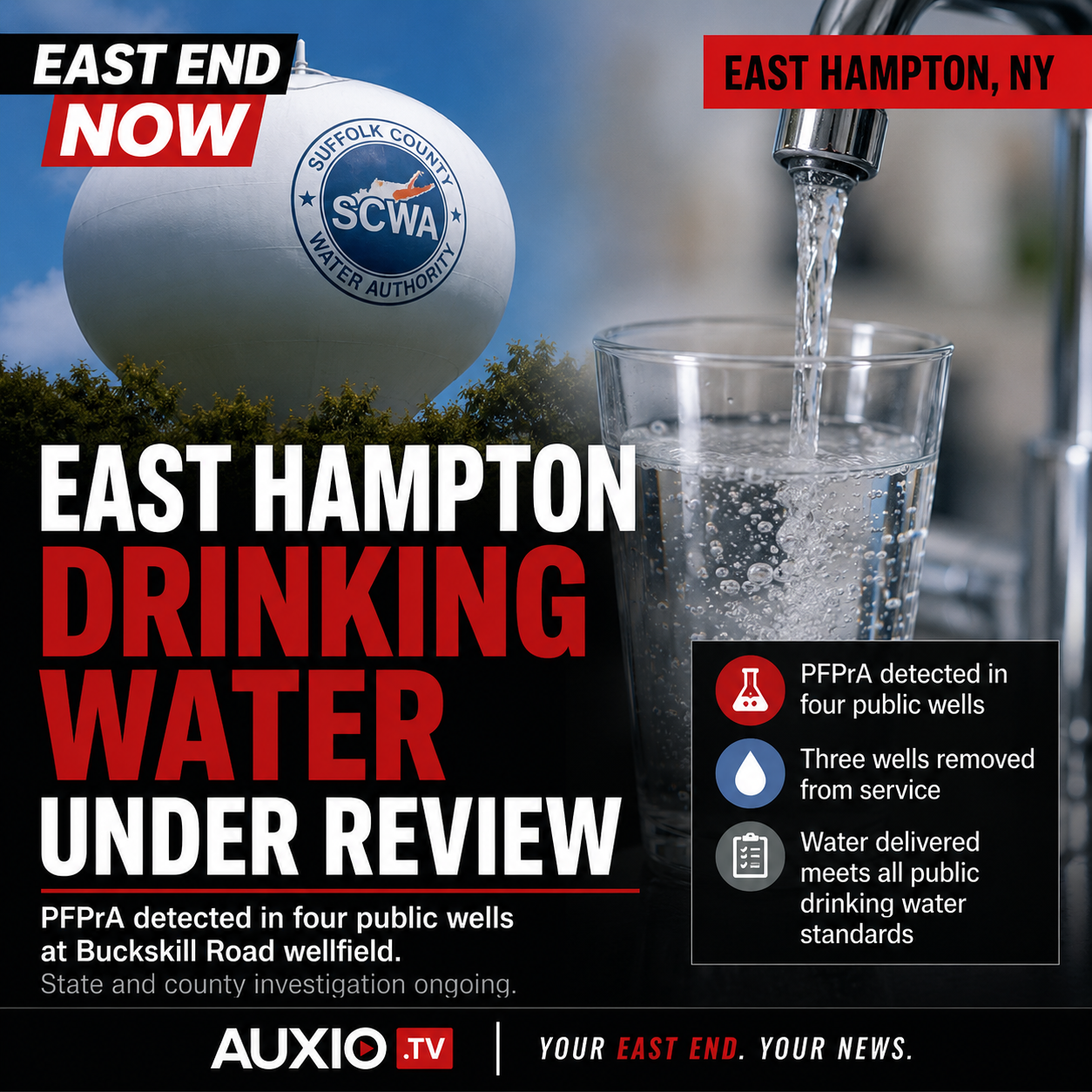
    The Town’s latest update, revised September 21, says PFPrA, an ultra-short-chain PFAS compound, was detected in four SCWA public-water wells earlier this year. Three of those wells were removed from service, while the fourth is restricted to emergency use only. The Town says the water currently being delivered to SCWA customers continues to meet public drinking-water standards. 

    According to the Town, the affected wells had supplied roughly 7% of the water provided to customers in the area. SCWA is now supplying customers from other unaffected public-water wells. 

    The ongoing investigation has increasingly focused on the 2023 fire at the East Hampton Energy Storage Center. In a September community update, the New York State Department of Environmental Conservation said its preliminary analysis points to the facility’s use of Novec 1230 fire-suppression material in combination with water during the fire response as the likely source of the PFPrA contamination. DEC said the evidence does not currently point to the battery materials themselves as the source. 

    DEC has detected PFPrA at concentrations as high as 10,000 parts per billion in groundwater and 600 parts per billion in soil at the battery-storage property, according to the Town’s summary of the state investigation. 

    Suffolk County Department of Health Services is also testing private wells in the surrounding area. The Town says testing conducted so far has not found contamination above New York State drinking-water standards or the state health department’s 3-parts-per-billion PFPrA screening level in the private wells sampled. 

    The investigation is not limited to PFPrA. County groundwater testing also detected PFOS and other PFAS compounds, and state and county agencies are continuing to investigate those sources. No source for the PFOS detections has yet been identified. 

    East Hampton Supervisor Kathee Burke-Gonzalez has called for continued coordination among the Town, NYSDEC, state health officials, Suffolk County and SCWA. The Town has also demanded that the battery-storage operator remove remaining Novec 1230 material from its East Hampton and Montauk facilities. 

    Residents with private wells who believe they may be within the affected area can contact the Suffolk County Bureau of Drinking Water at 631-852-5810. SCWA customers with water-quality questions can call 631-698-9500. 

  • Supreme Court Gives Trump Opening on California Mail Ballots — But the Legal Fight Is Far From Over

    Supreme Court Gives Trump Opening on California Mail Ballots — But the Legal Fight Is Far From Over

    The U.S. Supreme Court has given the Trump administration a significant procedural victory in its effort to impose new federal requirements on mail-in voting, including in California — but the Court did not decide that President Donald Trump’s policy is constitutional.

    That distinction matters.

    On August 24, the Supreme Court granted the administration’s request to temporarily lift a lower-court injunction that had blocked key portions of Trump’s election executive order from taking effect ahead of the 2026 midterm elections. (Supreme Court)

    The order stems from Trump’s March 31 executive action directing federal agencies to create new citizenship-verification procedures and requiring the U.S. Postal Service to develop nationwide standards for transmitting mail-in and absentee ballots. (The White House)

    Among other provisions, the order directed USPS to develop rules requiring official election-mail markings, unique tracking barcodes and state-specific lists identifying voters who would receive ballots through the mail. (The White House)

    For California, the stakes are substantial.

    Mail voting is not a minor part of the state’s election system. It is central to how California conducts elections, with active registered voters generally receiving ballots through the mail.

    California Attorney General Rob Bonta and a coalition of other states challenged Trump’s order, arguing that the Constitution gives states — subject to congressional authority — primary responsibility for administering federal elections.

    The Supreme Court’s August 24 decision did not resolve that argument.

    Instead, the Court concluded that the states’ earlier lawsuit was premature because the administration had not yet completed the steps necessary to implement the executive order when the case was brought. (California Attorney General)

    That is an important legal difference.

    The Court did not say Trump unquestionably possesses the authority to redesign the country’s mail-voting system.

    It said the challengers had gone to court too early.

    California immediately returned to court

    Once USPS issued its final rule implementing portions of Trump’s order, California and a coalition of other states filed a new lawsuit on August 26.

    The states argue that USPS is attempting to exercise powers Congress never gave it by requiring election officials to redesign ballot envelopes, submit voter information and comply with new federal procedures before ballots can move through the postal system. (California Attorney General)

    One day later, a federal district court temporarily blocked core portions of that rule for 14 days while it considers whether a longer preliminary injunction should be issued. (California Attorney General)

    So despite the Supreme Court victory for Trump earlier in the week, the practical status of the policy remains unsettled.

    That may sound contradictory.

    It is not.

    The Supreme Court addressed whether an earlier injunction should remain in place.

    The newest lawsuit challenges the actual USPS rule that now exists.

    Those are different legal questions.

    The larger issue is who controls elections

    The political debate is predictable.

    The Trump administration says the measures are designed to strengthen voter eligibility verification, improve ballot tracking and protect the integrity of federal elections. (The White House)

    California argues that the federal executive branch is attempting to take powers traditionally exercised by the states.

    The deeper constitutional question is not simply whether stricter election procedures are desirable.

    It is who has the lawful authority to impose them.

    The Constitution gives state legislatures responsibility for setting the “Times, Places and Manner” of congressional elections, while also giving Congress authority to alter those regulations.

    The President is not separately assigned that power.

    That is why this case matters beyond California.

    A policy can have an appealing objective and still raise legitimate questions about which branch of government has authority to accomplish it.

    Election integrity is important.

    So is constitutional structure.

    The two should not be confused.

    There is also a practical cost to changing election rules late

    Even if the administration ultimately prevails legally, another question remains: how quickly can a national election system be changed without creating new problems?

    California and other states are already deep into preparations for the November midterms.

    Changing envelope designs, voter-data procedures and postal requirements shortly before ballots are mailed can create administrative costs and potential voter confusion.

    On the other hand, the administration’s argument is that delaying security reforms simply because elections are approaching can become an excuse for never implementing them.

    Both concerns deserve to be measured by results.

    If new procedures improve ballot security while allowing eligible voters to cast ballots reliably, the administration will have strengthened its case.

    If the rules create widespread administrative disruption without producing measurable improvements in election integrity, the policy will be harder to defend.

    What the Supreme Court actually decided

    The most important point for voters is also the simplest:

    The Supreme Court has not ruled that Trump’s mail-ballot restrictions are constitutional.

    It allowed the administration to move forward after finding the states’ first challenge premature.

    California then challenged the actual USPS rule, and a federal court has temporarily blocked key parts of that rule while the case continues. (California Attorney General)

    The legal fight is therefore entering a new phase rather than ending.

    And as November approaches, the dispute may ultimately force the courts to answer a much larger question:

    How far can a president go in restructuring the mechanics of an election that the Constitution primarily places in the hands of states and Congress?

    That answer could matter long after the 2026 midterms are over.

    Auxio.tv News Now

  • East Hampton Drinking Water Investigation Continues After PFPrA Detected in Public Wells

    East Hampton Drinking Water Investigation Continues After PFPrA Detected in Public Wells

    East Hampton residents are being given updated guidance as state, county and local officials continue investigating detections of perfluoropropionic acid, or PFPrA, in public drinking water wells operated by the Suffolk County Water Authority.

    The Town of East Hampton’s latest update, dated August 24, 2026, says PFPrA was detected in four public water supply wells at the Buckskill Road wellfield. Three of those wells have been removed from service, while the fourth is available only for emergency use. (East Hampton Town)

    Town officials say the water currently being delivered to Suffolk County Water Authority customers meets all public drinking water standards because water is now being supplied from other unaffected wells. (East Hampton Town)

    The investigation is being coordinated among the Town of East Hampton, the New York State Department of Environmental Conservation, the New York State Department of Health, Suffolk County and the Suffolk County Water Authority.

    The Town says the source of the PFPrA contamination may be related to a 2023 battery energy storage system fire, although the investigation remains ongoing and no final determination has been announced. (East Hampton Town)

    What is PFPrA?

    PFPrA is an ultra-short-chain member of the broader family of chemicals known as PFAS.

    Unlike PFOA and PFOS, PFPrA does not currently have its own specific New York drinking water standard. The Town says state health officials are recommending a site-specific screening level of 3 parts per billion while the health effects of PFPrA continue to be studied. (East Hampton Town)

    That distinction matters.

    The absence of a specific drinking water standard does not mean a contaminant is automatically harmless. It means regulators are still evaluating how it should be measured and what level, if any, should trigger additional action.

    Private wells are also being tested

    Suffolk County health officials are testing private wells within the area under investigation.

    According to the Town, households identified within the investigation area have been contacted by the Suffolk County Department of Health Services and are being offered free private-well testing. (East Hampton Town)

    Residents who believe they may be within the affected area, or who have questions about private-well testing, can contact the Suffolk County Bureau of Drinking Water at 631-852-5810.

    Residents who receive a water bill from the Suffolk County Water Authority are connected to the public water system. Those with questions about public water service or water quality can contact SCWA at 631-698-9500. (East Hampton Town)

    Why the issue is getting additional scrutiny

    SCWA began testing for ultra-short-chain PFAS compounds in early 2026 using specialized laboratory methods that had not previously been routinely available.

    The Town says the affected Buckskill Road wells had supplied roughly 7% of the water used by customers in the area before they were removed from regular service. (East Hampton Town)

    East Hampton officials say they are continuing to press state, county and water authority officials for information about when the contamination developed, where it came from and what additional remediation or treatment may be required.

    The Town has also requested coordinated public presentations from the agencies involved and has called for continued testing and groundwater protection measures. (East Hampton Town)

    For residents, the most important distinction is between what is known and what is still being investigated.

    The public water currently being delivered meets existing drinking water standards.

    At the same time, four wells showed PFPrA contamination significant enough that three were taken out of service and the fourth was restricted to emergency use.

    Those two facts are not contradictory.

    They illustrate why continued testing and transparency matter.

    The real question now is not whether officials should investigate further.

    It is how quickly they can determine the source, define the actual health risk and make sure residents receive clear information as the science develops.

    East End Now — Your East End. Your News.