Perspective | Auxio.tv News
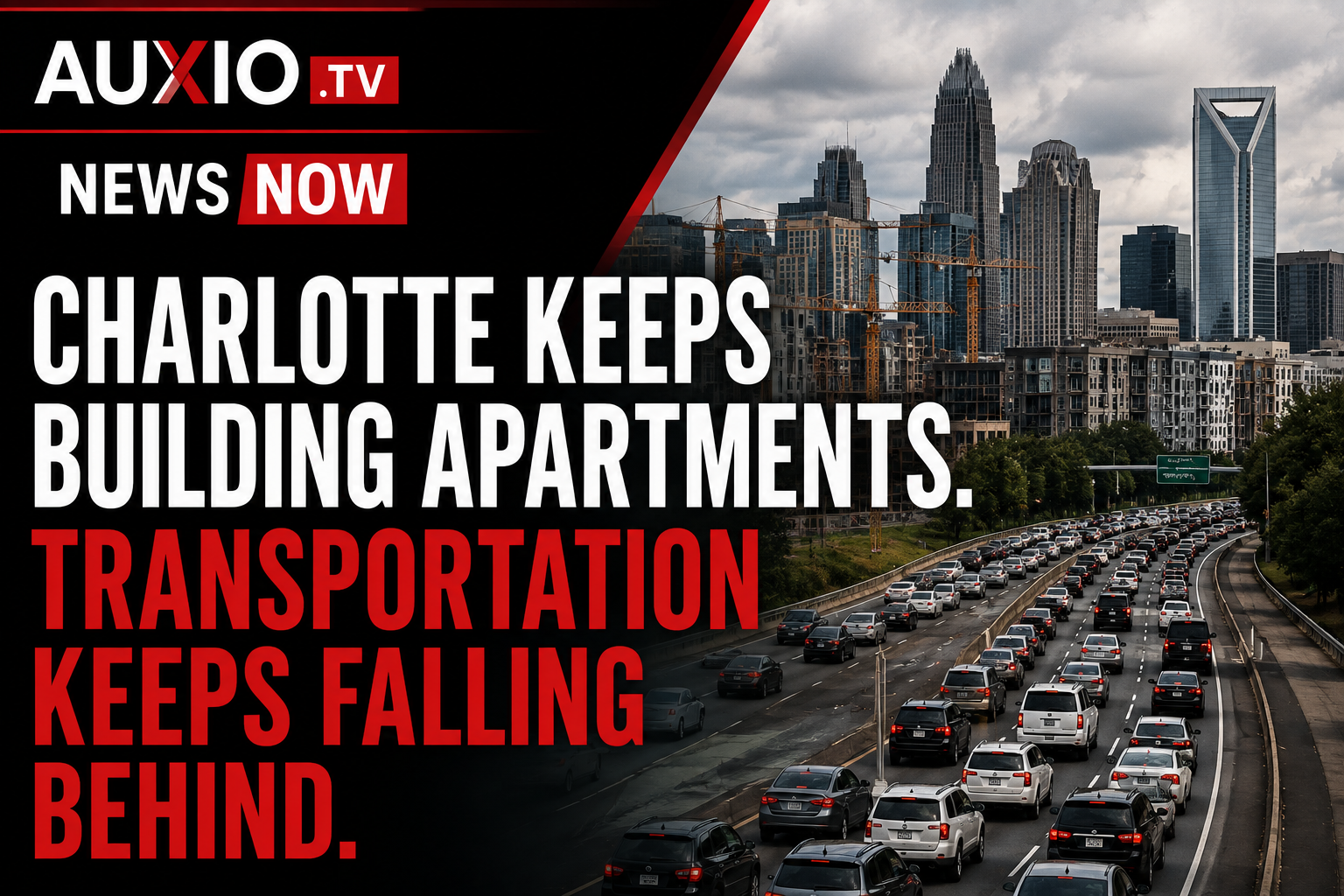
Charlotte has spent years encouraging growth, approving density and celebrating new development.
What it has not done nearly as well is build the transportation system needed to support that growth.
That failure is becoming harder to ignore.
Across Charlotte, multifamily housing continues to expand. City rezoning records show projects ranging from dozens of units to hundreds at a time, including a recently approved 330-unit development near Shopton Road and a proposal for up to 1,200 multifamily units near West Arrowood Road.
The problem is not that Charlotte is building apartments.
A growing city needs housing.
The problem is that housing policy and transportation policy have too often operated on different clocks.
Apartments can be approved, financed and built in a few years. Rail lines, major road projects and meaningful transit expansion can take decades.
That gap has consequences.
Growth without mobility is not planning
Charlotte’s own data showed thousands of previously permitted housing units coming online even as new permits slowed in 2025. Multifamily projects typically take 18 to 23 months from permit to occupancy, which means the effects of prior approvals continue long after the rezoning vote is over.
Every one of those new households has to move.
People drive to work. They take children to school. They go to grocery stores, medical appointments and restaurants.
Yet much of Charlotte still functions as a car-dependent city.
That means adding density without adding transportation capacity often means adding traffic.
City leaders like to use terms such as “walkability,” “mobility” and “transit-oriented development.” Those are worthwhile goals.
But a development is not transit-oriented simply because planners would like residents to use transit.
There has to be useful transit there.
Charlotte is finally spending more — but much of it is late
It would be unfair to say Charlotte is doing nothing.
Mecklenburg voters approved a one-cent transportation sales tax in 2025. The city projects that the tax, together with expected federal funding, could produce roughly $25.3 billion over 30 years for roads, buses, microtransit and rail.
CATS also adopted a FY2027 budget containing $225 million in capital spending and $314 million in operations, including additional bus service hours and improvements to several high-frequency routes.
Those are real investments.
But they also reveal the larger failure.
Charlotte is now trying to build transportation infrastructure after much of the growth has already arrived.
That is not the same as planning ahead.
It is catching up.
City Council keeps repeating the pattern
The current City Council has not fundamentally changed the development model.
It continues approving projects that place hundreds of additional households into areas where the transportation network remains heavily dependent on cars.
At the same time, the city’s own FY2027 budget points to another $300 million transportation and neighborhood bond and future mobility projects as part of its answer to growth.
Again, those investments are welcome.
But residents should ask a basic question:
Why does infrastructure so often arrive after the density?
Private developers understandably want to build where there is demand.
Their job is to build housing and earn a return.
City government has a different responsibility.
Its job is to consider what happens when thousands of individual development decisions accumulate into a transportation problem.
Approving each project in isolation may make sense on paper.
The combined effect can be something very different.
Mecklenburg County deserves criticism too
This is not solely a Charlotte City Council problem.
Mecklenburg County spent years benefiting from rapid population and tax-base growth while the region’s transportation needs became increasingly obvious.
The 2025 transportation referendum was significant, but voters were essentially being asked to pay more now because local government had allowed the region’s infrastructure needs to compound for years.
That is an expensive way to govern.
Infrastructure is usually cheaper and less disruptive when it is built before congestion becomes severe, rights-of-way become more expensive and developed land becomes harder to acquire.
Growth creates revenue.
It also creates obligations.
Too often local government celebrated the first and postponed the second.
Housing and transportation should be one decision
The debate should not become “apartments versus no apartments.”
That misses the point.
Charlotte needs housing.
It also needs roads, buses, rail, sidewalks and transportation options capable of supporting that housing.
Those decisions should be connected.
When City Council considers another 300-, 500- or 1,000-unit development, the question should not stop at zoning compliance.
Council members should be able to explain how the people living there are expected to move through the city five, ten and twenty years later.
If the answer is simply that transportation improvements are planned someday, then the plan is incomplete.
Charlotte’s growth is not the problem.
The failure to build infrastructure at the same pace is.
And unless the current City Council changes the sequence — transportation first, density alongside it — Charlotte will continue solving yesterday’s growth problems with tomorrow’s tax dollars.
Auxio.tv News Now | Perspective