
Tag: New York State Assembly

  • DeStefano Pushes for More State Funding to Repair Local Roads and Infrastructure

    DeStefano Pushes for More State Funding to Repair Local Roads and Infrastructure

    SUFFOLK COUNTY — New York State Assemblyman Joe DeStefano is backing increased state investment in local roads, bridges and transportation infrastructure, arguing that communities across Long Island need more help keeping aging infrastructure safe and reliable.

    DeStefano joined lawmakers from both the Assembly and Senate in supporting additional funding for the Consolidated Local Street and Highway Improvement Program, known as CHIPS, which provides state money directly to municipalities for road and highway projects. 

    For Suffolk County communities, CHIPS funding can help local governments repair deteriorating roads, address potholes, improve bridges and complete transportation projects without placing the entire financial burden on local taxpayers.

    DeStefano has framed the issue as more than routine road maintenance.

    “The CHIPS program is vital to maintaining our roads, bridges and transportation networks,” DeStefano said in announcing his support for increased funding. He also tied infrastructure investment to stronger communities, job creation and public safety. 

    Local Roads, Local Impact

    Infrastructure funding can have an immediate effect on residents because many of the roads people use every day are maintained by towns, villages and other local governments rather than directly by the state.

    Those municipalities face rising construction, labor and material costs while still being expected to maintain miles of roadway.

    Additional CHIPS funding allows more of those costs to be supported through the state budget.

    For DeStefano, who represents New York’s 3rd Assembly District in Suffolk County, that makes infrastructure funding an affordability issue as well as a transportation issue.

    More state support can reduce pressure on local governments to fund major road projects entirely through local revenue.

    Public Safety Connection

    Road conditions also have a direct connection to public safety.

    Deteriorated pavement, damaged shoulders and aging infrastructure can create hazards for motorists, pedestrians, emergency vehicles and school transportation.

    DeStefano has argued that investment in roads and bridges should therefore be viewed as part of the state’s broader responsibility to keep communities safe.

    His support for CHIPS also fits into a broader legislative agenda focused on public safety, affordability and local government needs. His official Assembly page shows that those themes have remained central to his work throughout the 2025–26 legislative session. 

    Bringing State Dollars Back to Local Communities

    The importance of programs such as CHIPS is ultimately straightforward: state tax dollars return to local communities for projects residents can see and use every day.

    For Suffolk residents, that means repaired roads, stronger bridges and infrastructure improvements that can otherwise be difficult for municipalities to finance on their own.

    DeStefano’s position is that Albany should continue increasing those investments rather than forcing local governments to absorb more of the cost.

    For a district where residents depend heavily on automobiles and local road networks, that is a tangible issue with an immediate impact on quality of life.
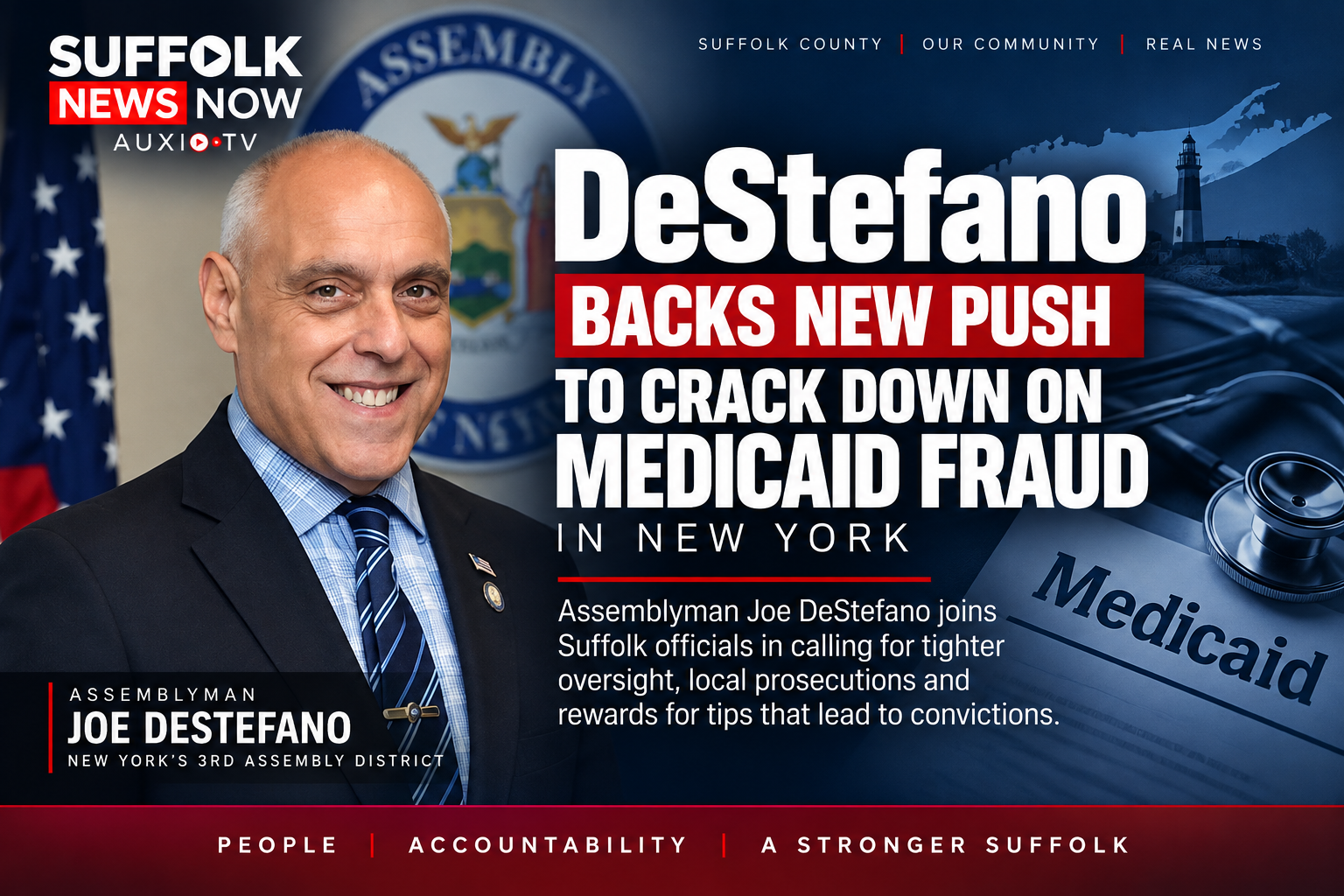
  • DeStefano Backs New Push to Crack Down on Medicaid Fraud in New York

    DeStefano Backs New Push to Crack Down on Medicaid Fraud in New York

    HAUPPAUGE — New York State Assemblyman Joe DeStefano is backing a new legislative push aimed at tightening Medicaid fraud enforcement, increasing local prosecutorial involvement and creating financial rewards for credible tips that lead to successful cases.

    DeStefano joined Suffolk County Executive Ed Romaine, Suffolk County District Attorney Ray Tierney, state Sen. Dean Murray, Sen. Anthony Palumbo and Sen. Mario Mattera in Hauppauge to support a two-bill package targeting fraud within New York’s Medicaid system. 

    The first proposal would formally designate the Office of the Medicaid Inspector General, or OMIG, as the statewide clearinghouse for Medicaid fraud tips submitted through the 1-877-87-FRAUD hotline. Credible allegations would then be referred to both the New York Attorney General’s Medicaid Fraud Unit and the appropriate local district attorney. 

    Under the proposal, authorities would have 30 days after receiving a tip to determine whether an investigation will move forward and which agency will lead it. OMIG would also receive the outcome of completed investigations and issue annual reports showing how many tips were received, referred, investigated and resolved. 

    A second bill would create a Medicaid Fraud Tip Reward Program funded with 1% of money recovered through Medicaid fraud investigations, seizures and forfeitures. People whose documented information directly leads to a guilty plea or criminal conviction could qualify for a financial reward. 

    DeStefano: Fraud Takes Money From People Who Need Care

    DeStefano framed the issue as both a taxpayer concern and a threat to people who rely on Medicaid.

    “Every dollar stolen from that system is a dollar taken away from someone who genuinely needs care.”

    He said the program exists to support seniors, people with disabilities, low-income families and children, while arguing that New York does not have enough oversight to deal with waste, fraud and abuse. 

    The Medford Republican represents New York’s 3rd Assembly District and has previously supported legislation involving Medicaid fraud detection, including a proposal that would reimburse counties for fraud, waste and abuse detection software. 

    Suffolk Officials Want More Local Enforcement

    Tierney argued that local prosecutors need greater access to Medicaid fraud complaints.

    Under the proposed legislation, credible tips would no longer remain solely within the state-level enforcement structure. Local district attorneys with jurisdiction would receive the information and could take part in investigating and prosecuting cases. 

    Tierney said the additional authority could help Suffolk investigators pursue cases that might otherwise fall through the cracks.

    Romaine also backed the package, saying stronger Medicaid fraud enforcement could protect money intended for people who depend on the health-care program. 

    Fraud Fight Tied to Affordability

    Supporters are also framing the proposals as an affordability issue.

    Palumbo argued that waste and fraud ultimately increase pressure on taxpayers and reduce resources available for legitimate public programs. The lawmakers backing the package say stronger oversight and more aggressive prosecution could help recover taxpayer money while protecting the integrity of Medicaid. 

    The legislation has not yet become law. It would still need approval from the Legislature and the governor before the proposed referral and reward systems could take effect.

    For DeStefano, the argument is straightforward: Medicaid should remain available for the residents who genuinely need it, while those who exploit the system should face greater scrutiny and prosecution.

  • Kiely Puts Home Rule at the Center of East End Assembly Campaign

    Kiely Puts Home Rule at the Center of East End Assembly Campaign

    By East End Now | Auxio.tv News

    Stephen Kiely is making home rule one of the clearest themes in his campaign for New York State Assembly.

    Kiely, the Republican candidate for the 1st Assembly District, argues that East End towns should keep control over major land-use decisions instead of having Albany impose one-size-fits-all housing policies.

    That position is tied closely to how he defines the problem.

    Kiely has not described the East End simply as having a housing shortage. His argument is that the region has an affordability problem — one that will not be solved by adding high-density development without regard for water, traffic, infrastructure and community character.

    That distinction matters on the East End.

    Southampton, Southold, Riverhead, East Hampton and Shelter Island all face different constraints. Some areas have limited wastewater capacity. Others face groundwater concerns, seasonal traffic, expensive land and roads that were never designed for major population growth.

    Albany can set a statewide housing goal.

    Local communities still have to live with the result.

    Kiely’s position is not that housing should stop being built.

    He has supported more targeted approaches, including accessory dwelling units, adaptive reuse of existing buildings and smaller-scale housing that fits the character and infrastructure of individual communities.

    The theme running through those ideas is local control.

    Kiely has made a similar argument on battery-storage projects, where he has opposed shifting more siting authority away from towns and toward the state.

    The principle is consistent: statewide policy should not erase local knowledge.

    That does not mean every local decision is automatically a good one. Towns can make mistakes too. But when development creates pressure on water, roads, emergency services and surrounding neighborhoods, the people closest to those consequences should have a meaningful role in deciding what gets approved.

    That is especially important on the East End, where land-use decisions can have long-term effects on groundwater and community character.

    Kiely’s campaign is therefore framing housing less as a race to produce the highest number of units and more as a question of what kind of housing fits the region, where it should go and who should make that decision.

    For voters in the 1st Assembly District, home rule may sound like a technical phrase.

    In practice, it is about something much simpler:

    Who gets the final say over how the East End grows?

    Kiely’s answer is clear. He believes those decisions should stay as close as possible to the communities that will live with them.

    Learn more about Stephen Kiely’s campaign:
    https://www.facebook.com/share/1Br8ZkgrrK/?mibextid=wwXIfr

    East End Now — Your East End. Your News.