Tag: public health

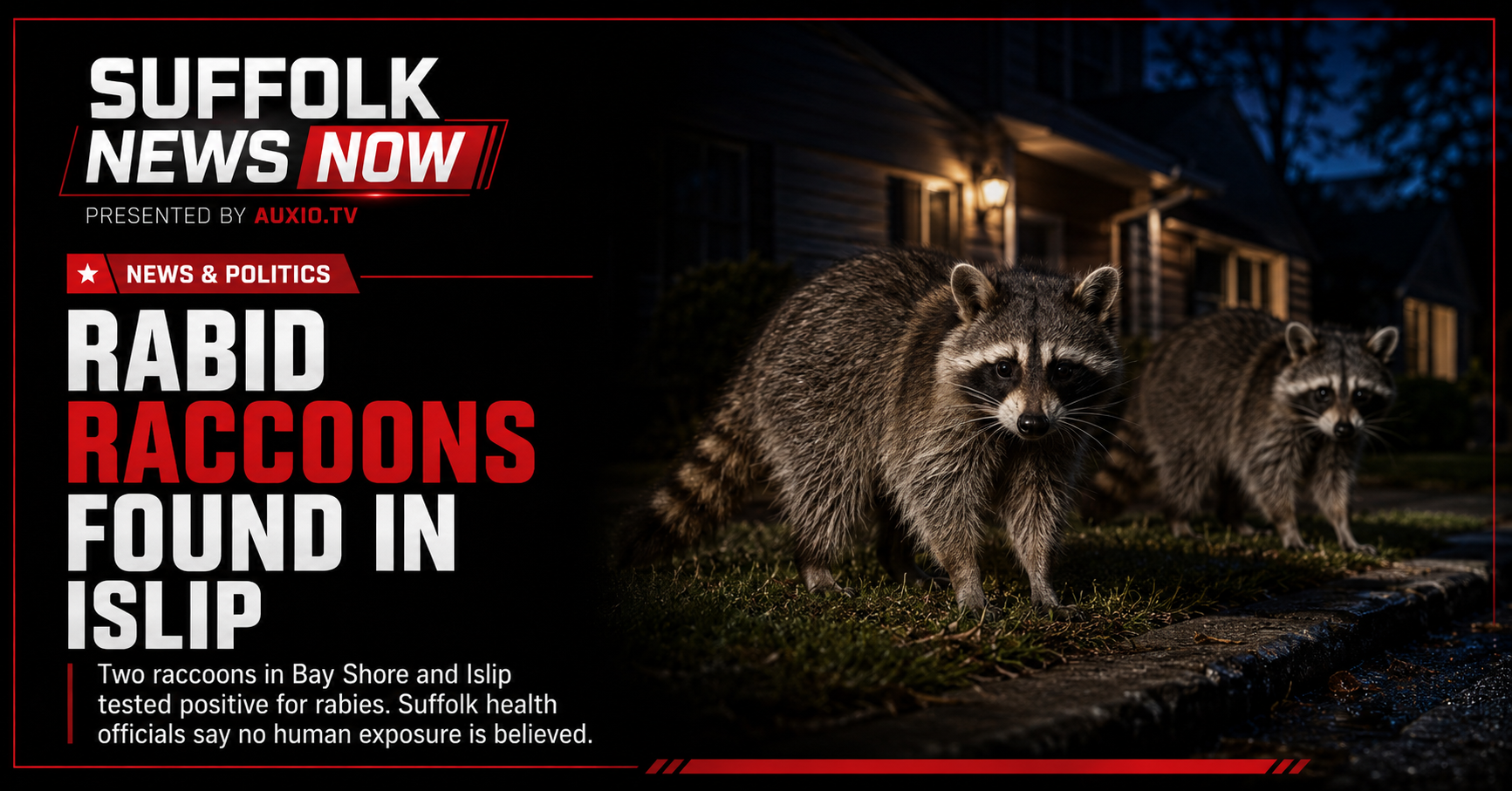
  • Two More Rabid Raccoons Found in Islip as Suffolk Warns Residents

    Two More Rabid Raccoons Found in Islip as Suffolk Warns Residents

    ISLIP, N.Y. — Suffolk County health officials are warning residents to avoid contact with wild animals after two additional raccoons found in the Town of Islip tested positive for rabies.

    The Suffolk County Department of Health Services said one raccoon was found dead on a street in Bay Shore and another was found dead in Islip earlier in August. The animals were retrieved by the Islip Animal Shelter and submitted for rabies testing.

    The county said the Wadsworth Center at the New York State Department of Health confirmed the positive results on Aug. 19. At the time of the announcement, county health officials said they did not believe there had been any human exposure. 

    The two cases were identified as Suffolk County’s 38th and 39th positive terrestrial rabies confirmations since Feb. 7, 2025, according to the county. 

    They followed another confirmed case in Islip earlier in August. In that case, a member of the public reported a raccoon that appeared ill. Suffolk County Police Emergency Service officers responded, and testing later confirmed rabies. County officials reported no human or pet exposure in that incident. 

    The latest cases are part of a broader return of terrestrial rabies to Suffolk County after years without locally acquired cases. Suffolk reported its first locally acquired terrestrial rabies case of 2026 in January, when a dead raccoon found in Wyandanch tested positive. At that point, officials said nearly all of the county’s recent terrestrial cases involved raccoons. 

    Rabies is a viral disease that attacks the central nervous system and can infect mammals, including raccoons, bats, skunks and foxes. Human infection most commonly occurs when saliva or nervous tissue from an infected animal enters the body through a bite, scratch or open wound. 

    Suffolk County is urging residents not to touch or transport wild animals. Anyone who sees a raccoon behaving abnormally can contact Suffolk County Police at 631-852-COPS or the New York State Department of Environmental Conservation at 631-444-0250. 

    Residents should also keep pets’ rabies vaccinations current and report possible animal bites or wildlife exposures to county health officials.

    Why It Matters

    The new Islip cases show that Suffolk County’s terrestrial rabies activity has not disappeared. Residents who encounter sick, unusually aggressive, disoriented or dead wildlife should avoid direct contact and allow animal-control or public-health professionals to handle the animal.
  • West Nile Activity Climbs Across Suffolk County as 85 Mosquito Samples Test Positive

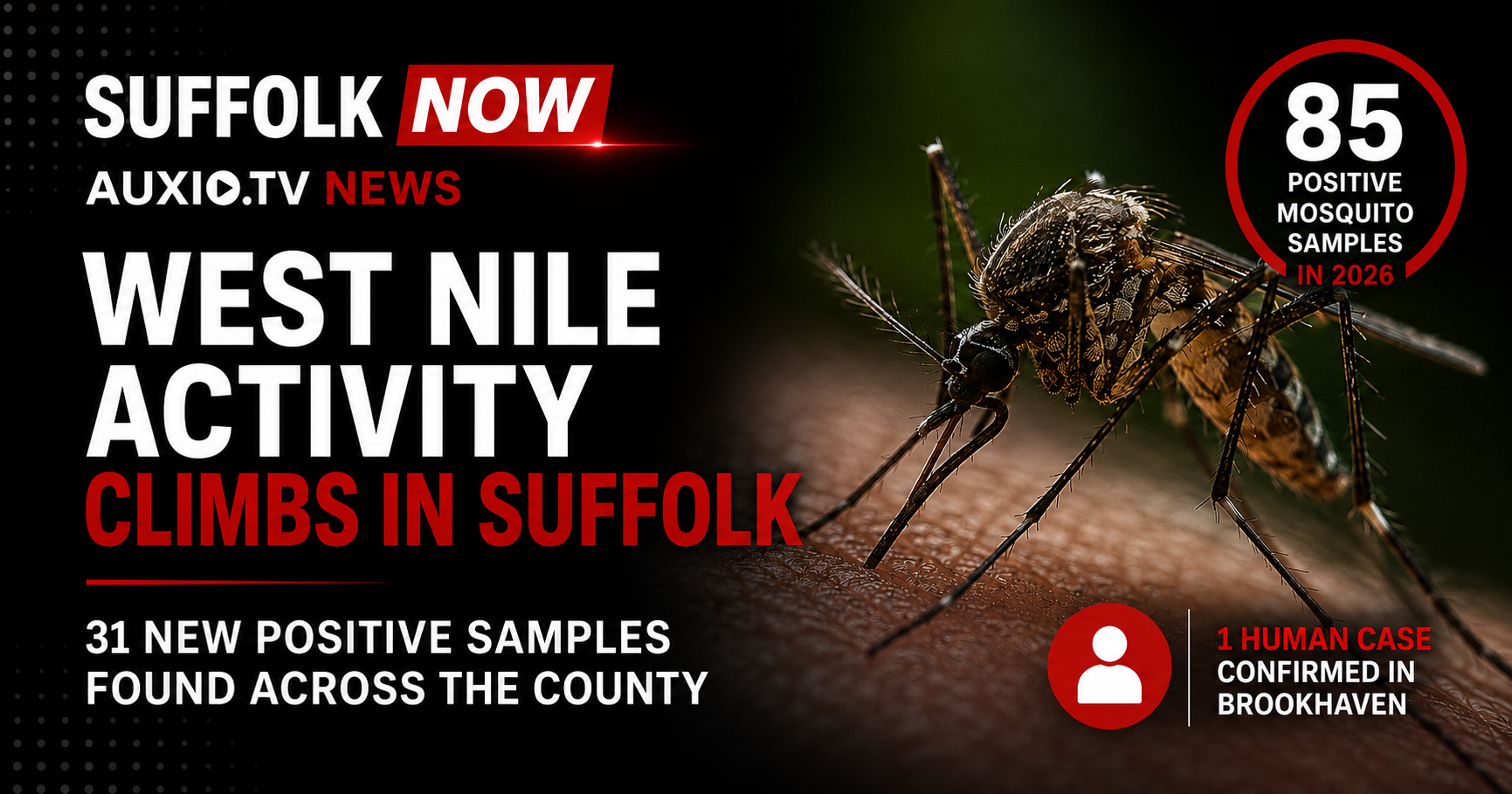
    West Nile Activity Climbs Across Suffolk County as 85 Mosquito Samples Test Positive

    By Suffolk Now | Auxio.tv News

    Suffolk County health officials are urging residents to take mosquito precautions after the number of West Nile virus-positive mosquito samples reached 85 for the 2026 season.

    The Suffolk County Department of Health Services announced that 31 additional mosquito samples tested positive in its latest round of surveillance. The new positives were collected from communities across the county, including Riverhead, Aquebogue, Southold and Bridgehampton on the East End. (Suffolk County Government)

    Other positive samples were found in communities including Cold Spring Harbor, Northport, Greenlawn, Dix Hills, Melville, Bay Shore, West Islip, Islip, Smithtown, Sayville, Setauket, Farmingville, Mount Sinai, Rocky Point, North Patchogue and Mastic Beach. (Suffolk County Government)

    The county has also confirmed one human case of West Nile virus this season. The infected person is an adult who lives in the Town of Brookhaven. (Suffolk County Government)

    Three mosquito samples have additionally tested positive for Jamestown Canyon virus, another mosquito-borne illness monitored by county health officials. Three dead crows — two found in Ronkonkoma and one in Nesconset — have also tested positive for West Nile virus. (Suffolk County Government)

    What residents should know

    West Nile virus spreads primarily through the bite of an infected mosquito.

    Most people who become infected develop either no symptoms or relatively mild illness. But the virus can cause more serious neurological complications in some people, including high fever, severe headache, confusion, muscle weakness, paralysis and, in rare cases, death. (Suffolk County Government)

    County health officials are especially urging people over age 50 and those with compromised immune systems to take precautions against mosquito bites. (Suffolk County Government)

    The increasing number of positive mosquito samples does not mean every mosquito in Suffolk is carrying West Nile virus. It does, however, show that the virus is circulating in multiple areas of the county.

    That makes ordinary prevention measures more important.

    Residents can reduce mosquito exposure by removing standing water from items such as buckets, flowerpots, gutters and outdoor containers; using insect repellent when appropriate; and limiting exposed skin during periods of high mosquito activity.

    County continues mosquito-control efforts

    Suffolk County’s Division of Vector Control continues mosquito surveillance and treatment operations as officials track virus activity throughout the season. The county posted an additional mosquito-treatment notice on August 24. (Suffolk County Government)

    Residents who find a dead bird on their property can report it to the Suffolk County Department of Health Services Bureau of Public Health Protection at 631-852-5999 during weekday business hours.

    Mosquito problems can be reported to the Department of Public Works Division of Vector Control at 631-852-4270. (Suffolk County Government)

    The numbers are worth watching because public-health risk is not determined by headlines alone. What matters is the extent of virus activity, where it is occurring and whether residents respond to the information with reasonable precautions.

    With positive mosquito samples now identified from western Suffolk to the East End, West Nile is not isolated to one neighborhood or town.

    For Suffolk residents, the practical message is simple: mosquito season is still active, and prevention remains the first line of defense.

    Suffolk Now — Your County. Your News.