
Tag: public_health

  • Suffolk Town Leaders Join Forces Over Rising Costs, Waste Challenges and State Mandates

    Suffolk Town Leaders Join Forces Over Rising Costs, Waste Challenges and State Mandates

    FARMINGVILLE, NY — Leaders from several Suffolk County towns met at Brookhaven Town Hall to discuss rising costs, solid-waste challenges and state policies they say are putting additional pressure on local governments and taxpayers.

    Brookhaven Town Supervisor Daniel J. Panico hosted the September 18 meeting with Southampton Town Supervisor Maria Moore, Smithtown Town Supervisor Ed Wehrheim, Smithtown Councilman Thomas W. Lohmann, Southold Town Supervisor Albert J. Krupski Jr., Babylon Deputy Supervisor Tony Martinez, Brookhaven Councilman Neil A. Manzella and representatives from the New York Association of Towns. 

    According to the Town of Brookhaven, the discussion focused on several issues affecting municipalities across Long Island, including rising health-insurance and pension contributions, higher fuel and equipment costs, state funding opportunities through the Environmental Bond Act and the effect of unfunded state mandates on local taxpayers. 

    Solid-waste disposal was also a major topic. Brookhaven officials have previously warned that Long Island faces a growing waste-management challenge as disposal options become more limited, particularly with the planned closure of the Brookhaven Town Landfill. Town officials have argued that expanding rail capacity could be part of a longer-term regional solution. 

    Panico also raised concerns about state legislation that he said can diminish local control and impose policies that do not always reflect conditions on Long Island.

    “Too often, we see a city-centric State Legislature advancing policies that may work for New York City but simply do not reflect the needs or realities of Long Island and towns throughout New York State,” Panico said. 

    He added that local officials need to work together on issues including unfunded mandates, rising municipal costs and home-rule authority. 

    The meeting also included discussion of a possible Long Island conference that would bring town officials together to address shared concerns and coordinate regional advocacy. No formal date or structure for that conference was announced. 

    The gathering reflects a broader effort among Suffolk municipalities to coordinate on issues that cross town boundaries, particularly waste disposal, infrastructure costs and state-local government relations.
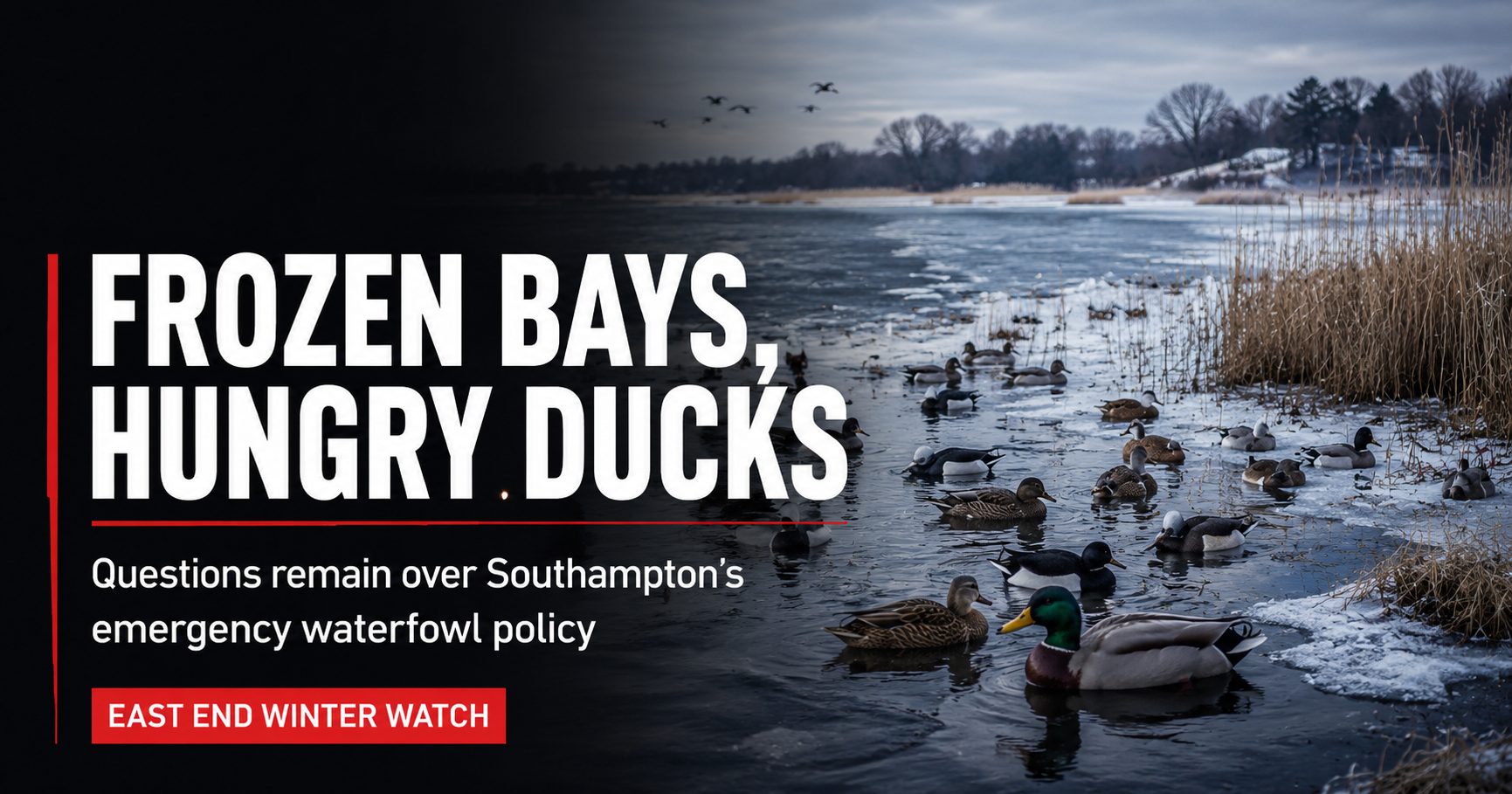
  • Before Winter Returns: Questions Remain Over Southampton’s Emergency Waterfowl Policy

    Before Winter Returns: Questions Remain Over Southampton’s Emergency Waterfowl Policy

    By East End Now | Auxio.tv News

    Another East End winter is approaching, and last season left behind a question Southampton may have to answer again if the bays freeze hard: when should the Town Trustees step in to help waterfowl struggling to survive?

    The issue is more complicated than simply telling residents to feed ducks.

    Southampton’s Trustee regulations generally prohibit distributing food along Trustee-controlled shorelines and waters during migratory waterfowl season. But those same rules contain an important exception: the Board of Trustees may authorize emergency feeding when unusual weather is causing undue losses or suffering among waterfowl. 

    Southampton has used that authority before.

    During the severe winter of 2015, after local bays had remained frozen for roughly seven weeks, the Trustees launched a public “Come Feed the Ducks” program. Residents were invited to pick up feed from the Trustee maintenance facility and help black ducks that officials said were struggling to get enough nutrition before their spring migration. 

    Last winter brought severe ice again.

    On February 18, 2026, the Trustees formally declared an ice emergency in Town waters, citing severe winter weather and significant ice conditions. The declaration focused primarily on damaged docks, pilings and other marine structures and created an expedited permitting process for repairs. 

    What does not appear in the Trustees’ published notices from that period is a comparable public emergency-feeding program for waterfowl.

    That difference became a point of local concern as residents reported seeing distressed or dead birds during the winter.

    But there was another factor that makes the comparison with 2015 less straightforward.

    By March, the Trustees were responding to an increase in dead waterfowl and seabirds associated with Highly Pathogenic Avian Influenza, or HPAI. The Trustees warned residents not to handle dead birds or allow pets near them and hired a licensed wildlife-control operator to collect and remove carcasses under state protocols. 

    That creates a difficult policy problem.

    Emergency feeding can help birds when ice cuts them off from natural food. But concentrating large numbers of ducks and geese in one location can also create conditions that make disease transmission easier.

    Southampton’s own rules recognize both sides of that problem.

    The Town generally restricts feeding wild waterfowl on public property because concentrated feeding can contribute to pathogens and other environmental problems. At the same time, the Trustees retain specific authority to make an exception when unusual weather causes serious suffering. 

    The unanswered question heading into the next winter is therefore not simply whether people should feed ducks.

    It is what threshold the Trustees will use before activating their emergency authority.

    How much ice is enough? How many distressed birds would trigger action? Would concerns about avian influenza prevent an emergency feeding program entirely? And if traditional feeding is considered too risky, are there other measures wildlife officials could use?

    Those are questions better answered before another prolonged freeze arrives.

    The Trustees demonstrated in 2015 that Southampton can act when winter conditions become severe enough to threaten local waterfowl. Last winter demonstrated that modern wildlife management also has to account for disease.

    The East End cannot control the weather.

    But Southampton can decide in advance what its response will be when frozen bays, hungry birds and disease concerns collide again.

    East End Now — Your East End. Your News.