Tag: Republican_Party

  • Attack on Michael Whatley Over Harvey West Relies on a Misleading “Hired” Claim

    Attack on Michael Whatley Over Harvey West Relies on a Misleading “Hired” Claim

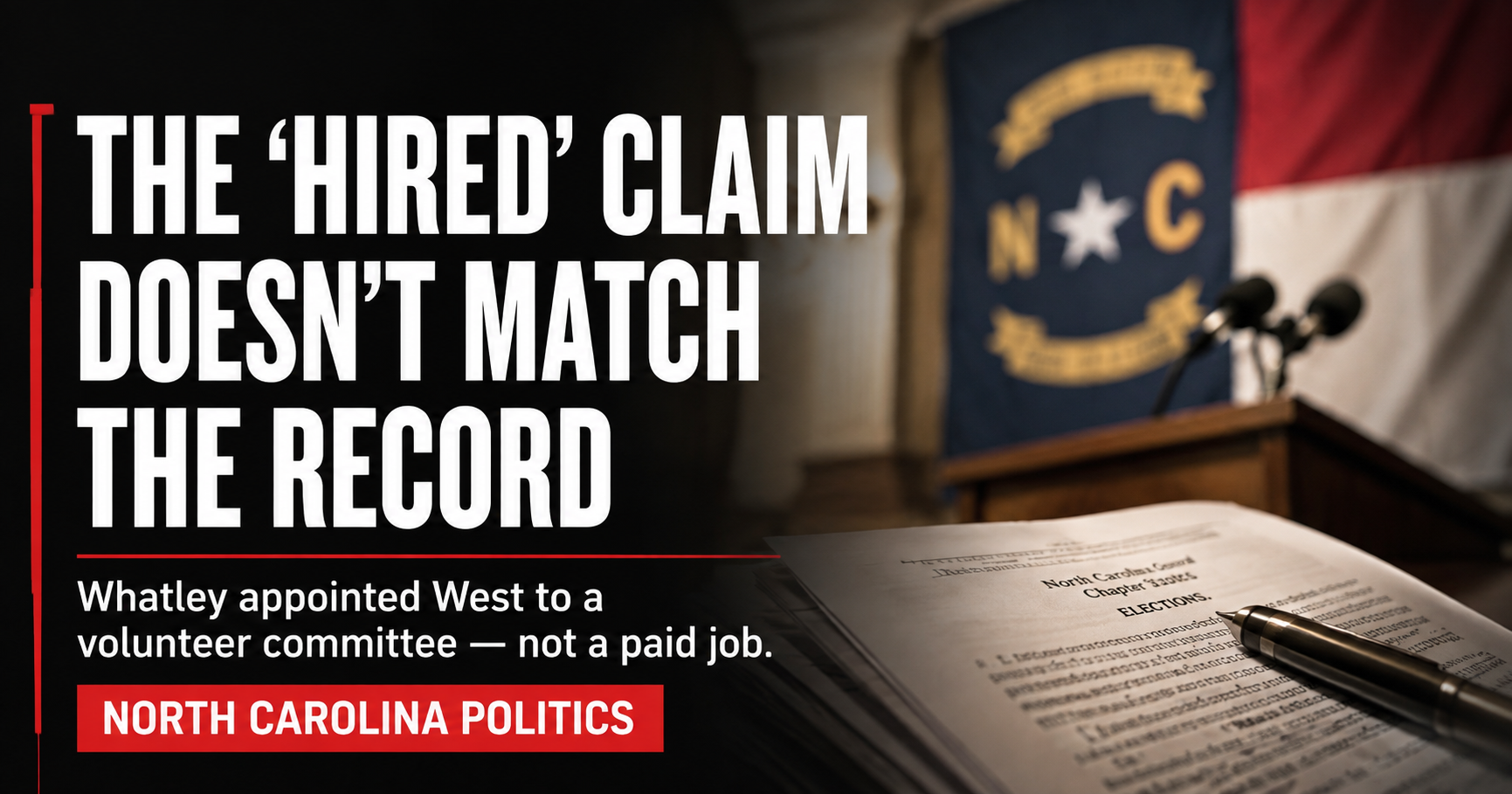
    NORTH CAROLINA — A political attack circulating against Republican U.S. Senate nominee Michael Whatley claims he “hired” Harvey West, a convicted sex offender, while leading the North Carolina Republican Party.

    The available record does not support that characterization.

    West did serve in Republican Party positions during Whatley’s tenure, including an appointment to the NCGOP’s Plan of Organization Committee. But reporting on the matter describes those positions as volunteer party roles, not paid employment.

    That distinction is important because “hired” suggests Whatley recruited West as an employee, placed him on a payroll or brought him into Republican politics himself.

    The evidence shows something different.

    West had already been active in North Carolina Republican politics for years before Whatley became state chairman in 2019. His involvement with the party dates back at least to 2011, and his criminal history had already become a public issue during the 2012 Republican National Convention cycle.

    Whatley therefore did not introduce West to the Republican Party.

    A previous claim about Whatley was already corrected

    Early reporting on the controversy also claimed Whatley appointed West chairman of the Republican Party’s 1st Congressional District.

    That claim was later shown to be inaccurate.

    PolitiFact reported that West became district chairman after members of the district executive committee elected him following the resignation of the previous chairman. The reporter behind the original account later acknowledged that describing Whatley as having appointed West to that position was incorrect.

    That correction matters because it changes the picture considerably.

    West’s rise within the district organization was the result of an internal election by Republican activists, not a unilateral decision by Whatley.

    Whatley did appoint West to a committee

    There is still a legitimate issue for voters to consider.

    West said Whatley appointed him to the NCGOP’s Plan of Organization Committee during Whatley’s chairmanship, and the state party did not dispute that account.

    But that committee position was a volunteer party role.

    Calling that a “hire” blurs the difference between an internal political appointment and paid employment.

    There has been no public evidence showing that Whatley placed West on his campaign payroll, gave him a salaried state party job or entered into an employment agreement with him.

    The accurate description is narrower: Whatley appointed West to a volunteer party committee.

    West’s involvement predates Whatley

    The broader timeline also weakens the suggestion that West was somehow a Whatley creation.

    West told PolitiFact that he had served on the Plan of Organization Committee repeatedly beginning years before Whatley took control of the state party. Former Republican chairmen had appointed him as well.

    By the time Whatley became chairman, West was already an established participant in internal Republican Party politics.

    That does not remove responsibility from any party leader who chose to keep him involved. But it does make the claim that Whatley simply “hired” him misleading.

    The facts do not need embellishment

    West’s criminal history is serious and should not be minimized. He pleaded guilty in 2000 to multiple counts of taking indecent liberties with a child and served prison time.

    It is fair to ask why Republican officials continued allowing him to participate in party organizations.

    It is also fair to ask Whatley specifically why he approved West for a volunteer committee position.

    But those questions are stronger when they are based on what actually happened.

    The documented record shows that West was involved with the North Carolina Republican Party long before Whatley became chairman, that West was elected to at least one major party position rather than appointed by Whatley, and that the role Whatley did appoint him to was a volunteer committee position.

    That is substantially different from the political shorthand now being circulated that “Michael Whatley hired Harvey West.”

    Voters can decide whether Whatley exercised good judgment.

    They should at least be given an accurate account of what he actually did.
  • Whatley Makes Border Security Central to North Carolina Senate Bid

    Whatley Makes Border Security Central to North Carolina Senate Bid

    By Auxio.tv News | August 28, 2026

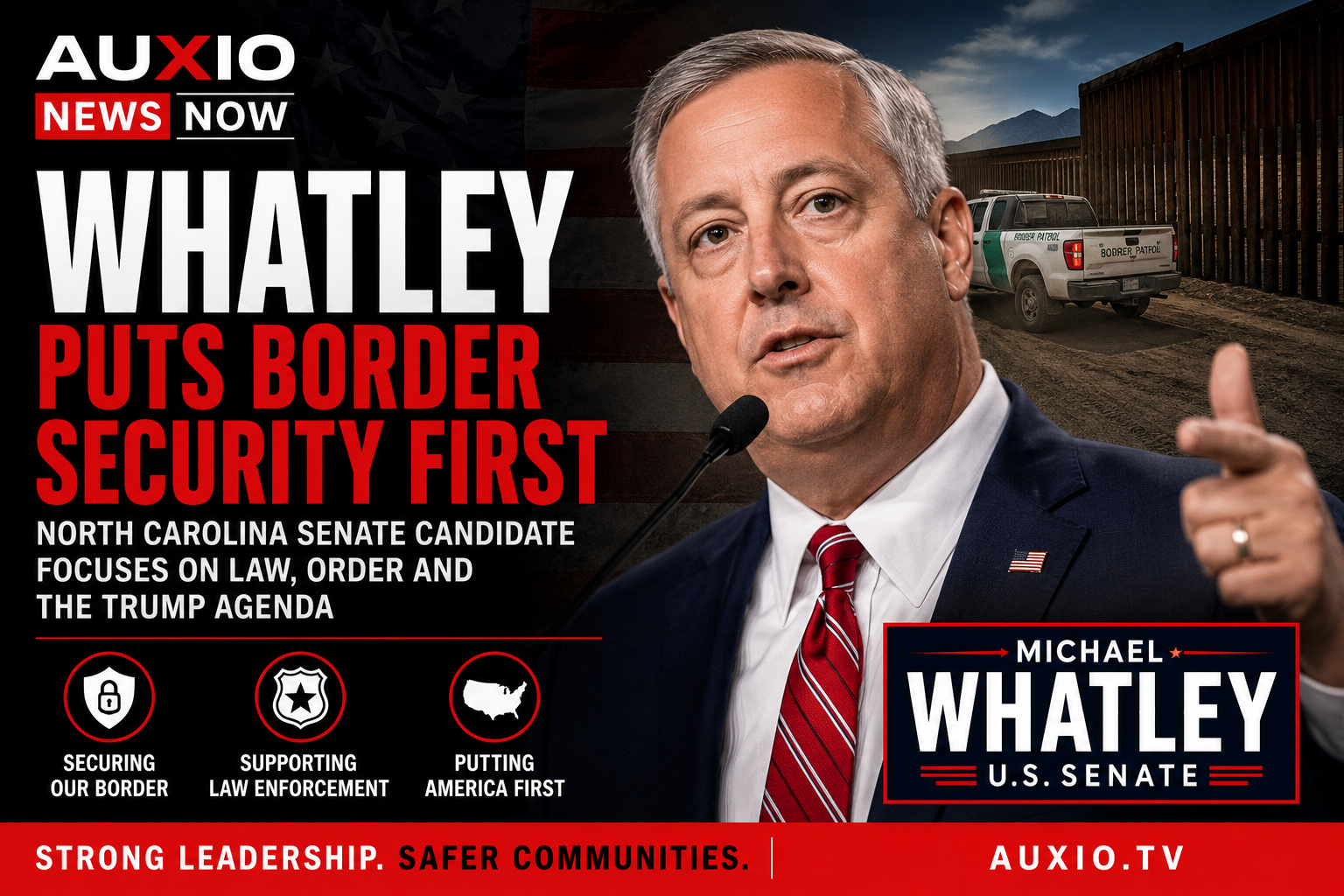
    Michael Whatley is sharpening his U.S. Senate campaign around border security, public safety and support for President Donald Trump’s agenda as he works to close the gap against former Democratic Gov. Roy Cooper.

    Whatley, the Republican nominee for North Carolina’s open Senate seat, has made immigration enforcement a central part of his campaign message, arguing that Washington needs stronger border controls and tougher enforcement policies.

    That approach fits the broader strategy of his campaign: make the race a choice between continuing Trump-era policies on immigration, energy and public safety or returning North Carolina to Democratic leadership in the Senate.

    The political challenge for Whatley is straightforward.

    He is running against one of the best-known political figures in the state.

    An Elon University poll released August 12 found Cooper leading Whatley 53% to 42% among likely voters. The same poll also showed a major familiarity gap: 84% of registered voters said they had heard at least some about Cooper, compared with 53% for Whatley. 

    That means Whatley does not simply need to persuade voters.

    He also needs more voters to know who he is.

    Border security gives him an issue that is easy to understand, closely associated with Trump and likely to energize Republican voters.

    For Whatley, the argument is that immigration policy is not an abstract national debate. It affects crime, labor markets, public spending and confidence in whether government is enforcing its own laws.

    That message also gives him a clear contrast with Cooper without requiring voters to know every detail of the Senate race.

    Whatley has the money to compete

    The campaign also has meaningful financial resources.

    Federal Election Commission records show Whatley’s authorized committees reported roughly $11.27 million in receipts through June 30, with about $3.46 million cash on hand at the end of the reporting period. 

    That does not erase an 11-point polling deficit.

    But it gives Whatley the ability to advertise, organize and introduce himself to voters who may know Cooper far better.

    The Elon poll itself suggested that the race becomes significantly more competitive among voters who are already familiar with Whatley. 

    That may be the most important number for his campaign.

    If Whatley’s problem is partly one of name recognition rather than simple rejection, then a focused message on border security and the Trump agenda could give him a path to tighten the race.

    The election may come down to definition

    Cooper enters the general election with the advantage of statewide name recognition after serving as governor and attorney general.

    Whatley enters with something different: a national Republican profile, Trump’s backing and a campaign that can tie itself closely to issues already motivating the GOP base.

    The question is whether that is enough to expand beyond committed Republicans.

    A Senate candidate does not win North Carolina by appealing only to the party base.

    Independent voters matter.

    Suburban voters matter.

    Turnout matters.

    And the candidate who successfully defines the race usually gains an advantage before voters start paying close attention in the final weeks.

    Whatley is now trying to define it around security, enforcement and whether Washington has lost control of the border.

    That is a politically favorable battlefield for Republicans.

    The challenge is converting that issue advantage into enough support to overcome Cooper’s substantial head start in familiarity.

    With the general election approaching, Whatley’s strategy is becoming clearer:

    Make the race less about who voters already know — and more about what they believe Washington should do next.

    Auxio.tv News Now