Tag: safety

  • Red Creek Park Skate Park Set to Reopen in Hampton Bays This Fall

    Red Creek Park Skate Park Set to Reopen in Hampton Bays This Fall

    By East End Now | Auxio.tv News

    Southampton Town says the skate park at Red Creek Park in Hampton Bays is expected to reopen in late fall 2026 following a major renovation project.

    The Town has awarded the construction contract to Laser Industries, Inc., with California Skateparks serving as the skate park subcontractor. Southampton officials say the renovated facility is anticipated to reopen later this year. 

    The project matters because public recreation facilities are easy to overlook until they disappear.

    For young people in particular, a skate park provides something local government often struggles to create: a place to gather, exercise and spend time that does not require buying something.

    That makes the quality of the facility important.

    A neglected park can become an expense that produces little value. A well-used park can justify the investment by serving residents year after year.

    Red Creek Park already functions as one of Hampton Bays’ major recreation hubs. The skate park renovation is an opportunity to make that public space more useful to a generation of residents who may not be drawn to traditional athletic fields.

    The real test will come after construction ends.

    If the renovated skate park is safe, durable and heavily used, the Town will have turned a capital project into a practical community asset.

    Southampton says reopening is currently targeted for late fall 2026.

    East End Now — Your East End. Your News.

  • Supreme Court Gives Trump Opening on California Mail Ballots — But the Legal Fight Is Far From Over

    Supreme Court Gives Trump Opening on California Mail Ballots — But the Legal Fight Is Far From Over

    The U.S. Supreme Court has given the Trump administration a significant procedural victory in its effort to impose new federal requirements on mail-in voting, including in California — but the Court did not decide that President Donald Trump’s policy is constitutional.

    That distinction matters.

    On August 24, the Supreme Court granted the administration’s request to temporarily lift a lower-court injunction that had blocked key portions of Trump’s election executive order from taking effect ahead of the 2026 midterm elections. (Supreme Court)

    The order stems from Trump’s March 31 executive action directing federal agencies to create new citizenship-verification procedures and requiring the U.S. Postal Service to develop nationwide standards for transmitting mail-in and absentee ballots. (The White House)

    Among other provisions, the order directed USPS to develop rules requiring official election-mail markings, unique tracking barcodes and state-specific lists identifying voters who would receive ballots through the mail. (The White House)

    For California, the stakes are substantial.

    Mail voting is not a minor part of the state’s election system. It is central to how California conducts elections, with active registered voters generally receiving ballots through the mail.

    California Attorney General Rob Bonta and a coalition of other states challenged Trump’s order, arguing that the Constitution gives states — subject to congressional authority — primary responsibility for administering federal elections.

    The Supreme Court’s August 24 decision did not resolve that argument.

    Instead, the Court concluded that the states’ earlier lawsuit was premature because the administration had not yet completed the steps necessary to implement the executive order when the case was brought. (California Attorney General)

    That is an important legal difference.

    The Court did not say Trump unquestionably possesses the authority to redesign the country’s mail-voting system.

    It said the challengers had gone to court too early.

    California immediately returned to court

    Once USPS issued its final rule implementing portions of Trump’s order, California and a coalition of other states filed a new lawsuit on August 26.

    The states argue that USPS is attempting to exercise powers Congress never gave it by requiring election officials to redesign ballot envelopes, submit voter information and comply with new federal procedures before ballots can move through the postal system. (California Attorney General)

    One day later, a federal district court temporarily blocked core portions of that rule for 14 days while it considers whether a longer preliminary injunction should be issued. (California Attorney General)

    So despite the Supreme Court victory for Trump earlier in the week, the practical status of the policy remains unsettled.

    That may sound contradictory.

    It is not.

    The Supreme Court addressed whether an earlier injunction should remain in place.

    The newest lawsuit challenges the actual USPS rule that now exists.

    Those are different legal questions.

    The larger issue is who controls elections

    The political debate is predictable.

    The Trump administration says the measures are designed to strengthen voter eligibility verification, improve ballot tracking and protect the integrity of federal elections. (The White House)

    California argues that the federal executive branch is attempting to take powers traditionally exercised by the states.

    The deeper constitutional question is not simply whether stricter election procedures are desirable.

    It is who has the lawful authority to impose them.

    The Constitution gives state legislatures responsibility for setting the “Times, Places and Manner” of congressional elections, while also giving Congress authority to alter those regulations.

    The President is not separately assigned that power.

    That is why this case matters beyond California.

    A policy can have an appealing objective and still raise legitimate questions about which branch of government has authority to accomplish it.

    Election integrity is important.

    So is constitutional structure.

    The two should not be confused.

    There is also a practical cost to changing election rules late

    Even if the administration ultimately prevails legally, another question remains: how quickly can a national election system be changed without creating new problems?

    California and other states are already deep into preparations for the November midterms.

    Changing envelope designs, voter-data procedures and postal requirements shortly before ballots are mailed can create administrative costs and potential voter confusion.

    On the other hand, the administration’s argument is that delaying security reforms simply because elections are approaching can become an excuse for never implementing them.

    Both concerns deserve to be measured by results.

    If new procedures improve ballot security while allowing eligible voters to cast ballots reliably, the administration will have strengthened its case.

    If the rules create widespread administrative disruption without producing measurable improvements in election integrity, the policy will be harder to defend.

    What the Supreme Court actually decided

    The most important point for voters is also the simplest:

    The Supreme Court has not ruled that Trump’s mail-ballot restrictions are constitutional.

    It allowed the administration to move forward after finding the states’ first challenge premature.

    California then challenged the actual USPS rule, and a federal court has temporarily blocked key parts of that rule while the case continues. (California Attorney General)

    The legal fight is therefore entering a new phase rather than ending.

    And as November approaches, the dispute may ultimately force the courts to answer a much larger question:

    How far can a president go in restructuring the mechanics of an election that the Constitution primarily places in the hands of states and Congress?

    That answer could matter long after the 2026 midterms are over.

    Auxio.tv News Now

  • Suffolk Man Killed After Vehicle Falls From Jack in Driveway

    Suffolk Man Killed After Vehicle Falls From Jack in Driveway

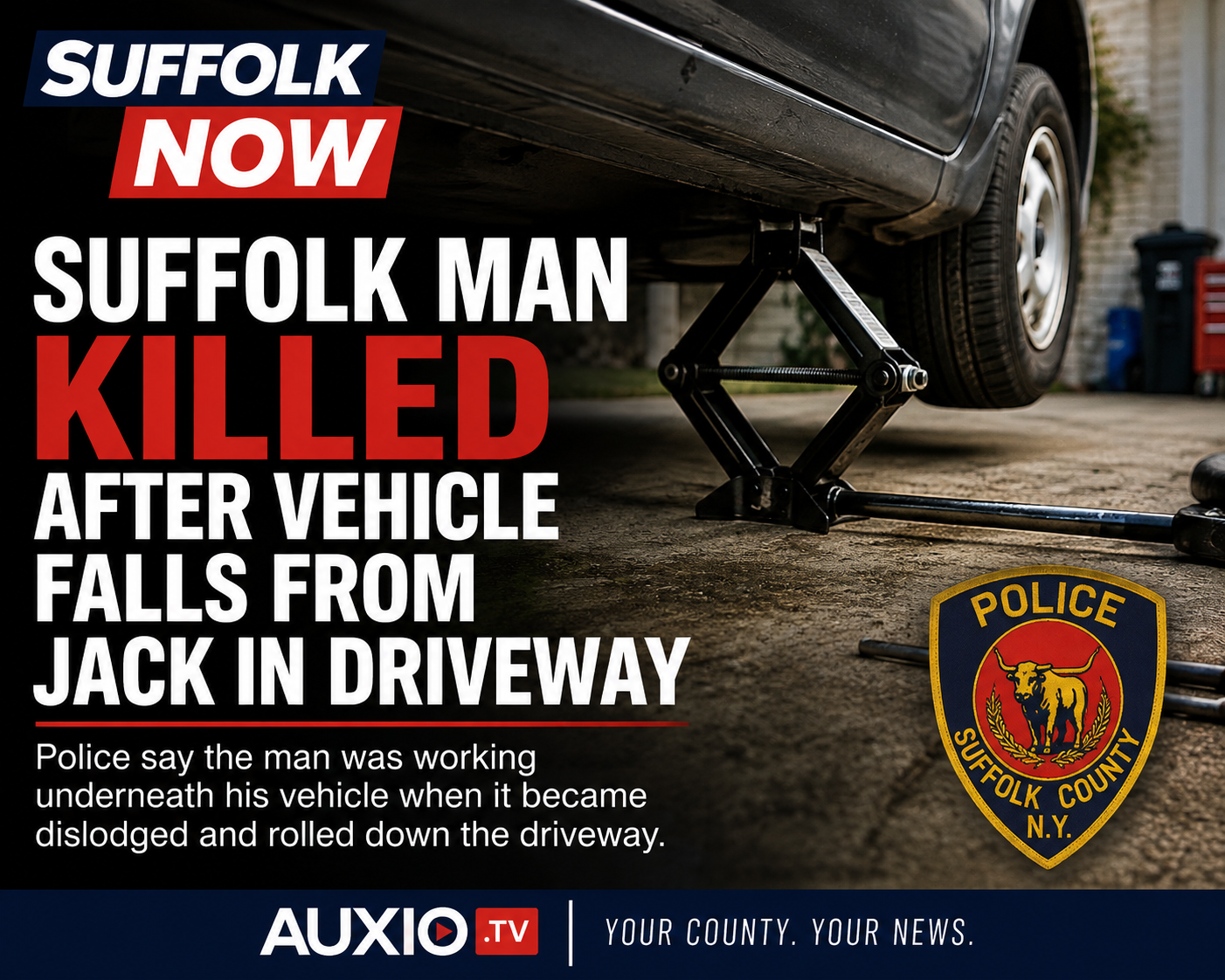
    Suffolk County Police are investigating after a 50-year-old man was killed Wednesday morning while working underneath a vehicle in the driveway of his home.

    Police identified the victim as Nadeem Ahmad.

    According to the Suffolk County Police Department, Ahmad was working beneath a 2002 Toyota Camry at his home on Tuscala Street when the vehicle became dislodged from the jack and rolled down the driveway at approximately 8:15 a.m. Wednesday. (Suffolk Police Department)

    Police said Ahmad became trapped underneath the vehicle.

    He was transported to Stony Brook University Hospital, where he was pronounced dead. (Suffolk Police Department)

    The Suffolk County Police Homicide Squad is investigating the circumstances surrounding the incident.

    Police have not released additional details about what caused the vehicle to come off the jack.

    The incident is a stark reminder of the risks involved when working underneath a raised vehicle.

    A jack is designed to lift a vehicle, but it should not be relied upon as the sole means of supporting one while someone is underneath it. Proper jack stands, stable ground and wheel chocks are among the basic safeguards commonly used when performing vehicle maintenance.

    For families across Suffolk County, what began as routine work at home ended in a fatal accident within seconds.

    The investigation remains ongoing.

    Suffolk Now — Your County. Your News.

  • West Nile Activity Climbs Across Suffolk County as 85 Mosquito Samples Test Positive

    West Nile Activity Climbs Across Suffolk County as 85 Mosquito Samples Test Positive

    By Suffolk Now | Auxio.tv News

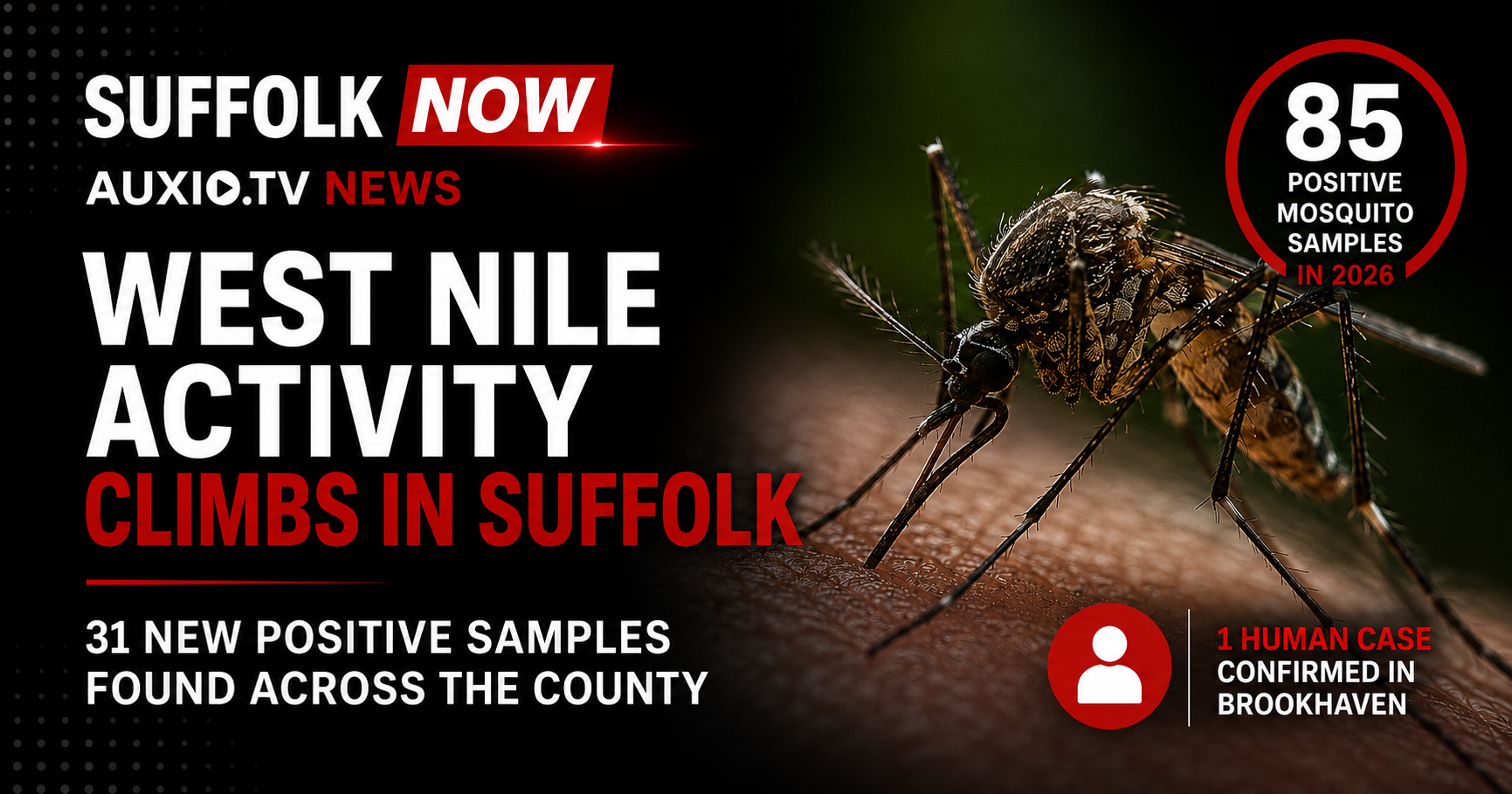
    Suffolk County health officials are urging residents to take mosquito precautions after the number of West Nile virus-positive mosquito samples reached 85 for the 2026 season.

    The Suffolk County Department of Health Services announced that 31 additional mosquito samples tested positive in its latest round of surveillance. The new positives were collected from communities across the county, including Riverhead, Aquebogue, Southold and Bridgehampton on the East End. (Suffolk County Government)

    Other positive samples were found in communities including Cold Spring Harbor, Northport, Greenlawn, Dix Hills, Melville, Bay Shore, West Islip, Islip, Smithtown, Sayville, Setauket, Farmingville, Mount Sinai, Rocky Point, North Patchogue and Mastic Beach. (Suffolk County Government)

    The county has also confirmed one human case of West Nile virus this season. The infected person is an adult who lives in the Town of Brookhaven. (Suffolk County Government)

    Three mosquito samples have additionally tested positive for Jamestown Canyon virus, another mosquito-borne illness monitored by county health officials. Three dead crows — two found in Ronkonkoma and one in Nesconset — have also tested positive for West Nile virus. (Suffolk County Government)

    What residents should know

    West Nile virus spreads primarily through the bite of an infected mosquito.

    Most people who become infected develop either no symptoms or relatively mild illness. But the virus can cause more serious neurological complications in some people, including high fever, severe headache, confusion, muscle weakness, paralysis and, in rare cases, death. (Suffolk County Government)

    County health officials are especially urging people over age 50 and those with compromised immune systems to take precautions against mosquito bites. (Suffolk County Government)

    The increasing number of positive mosquito samples does not mean every mosquito in Suffolk is carrying West Nile virus. It does, however, show that the virus is circulating in multiple areas of the county.

    That makes ordinary prevention measures more important.

    Residents can reduce mosquito exposure by removing standing water from items such as buckets, flowerpots, gutters and outdoor containers; using insect repellent when appropriate; and limiting exposed skin during periods of high mosquito activity.

    County continues mosquito-control efforts

    Suffolk County’s Division of Vector Control continues mosquito surveillance and treatment operations as officials track virus activity throughout the season. The county posted an additional mosquito-treatment notice on August 24. (Suffolk County Government)

    Residents who find a dead bird on their property can report it to the Suffolk County Department of Health Services Bureau of Public Health Protection at 631-852-5999 during weekday business hours.

    Mosquito problems can be reported to the Department of Public Works Division of Vector Control at 631-852-4270. (Suffolk County Government)

    The numbers are worth watching because public-health risk is not determined by headlines alone. What matters is the extent of virus activity, where it is occurring and whether residents respond to the information with reasonable precautions.

    With positive mosquito samples now identified from western Suffolk to the East End, West Nile is not isolated to one neighborhood or town.

    For Suffolk residents, the practical message is simple: mosquito season is still active, and prevention remains the first line of defense.

    Suffolk Now — Your County. Your News.