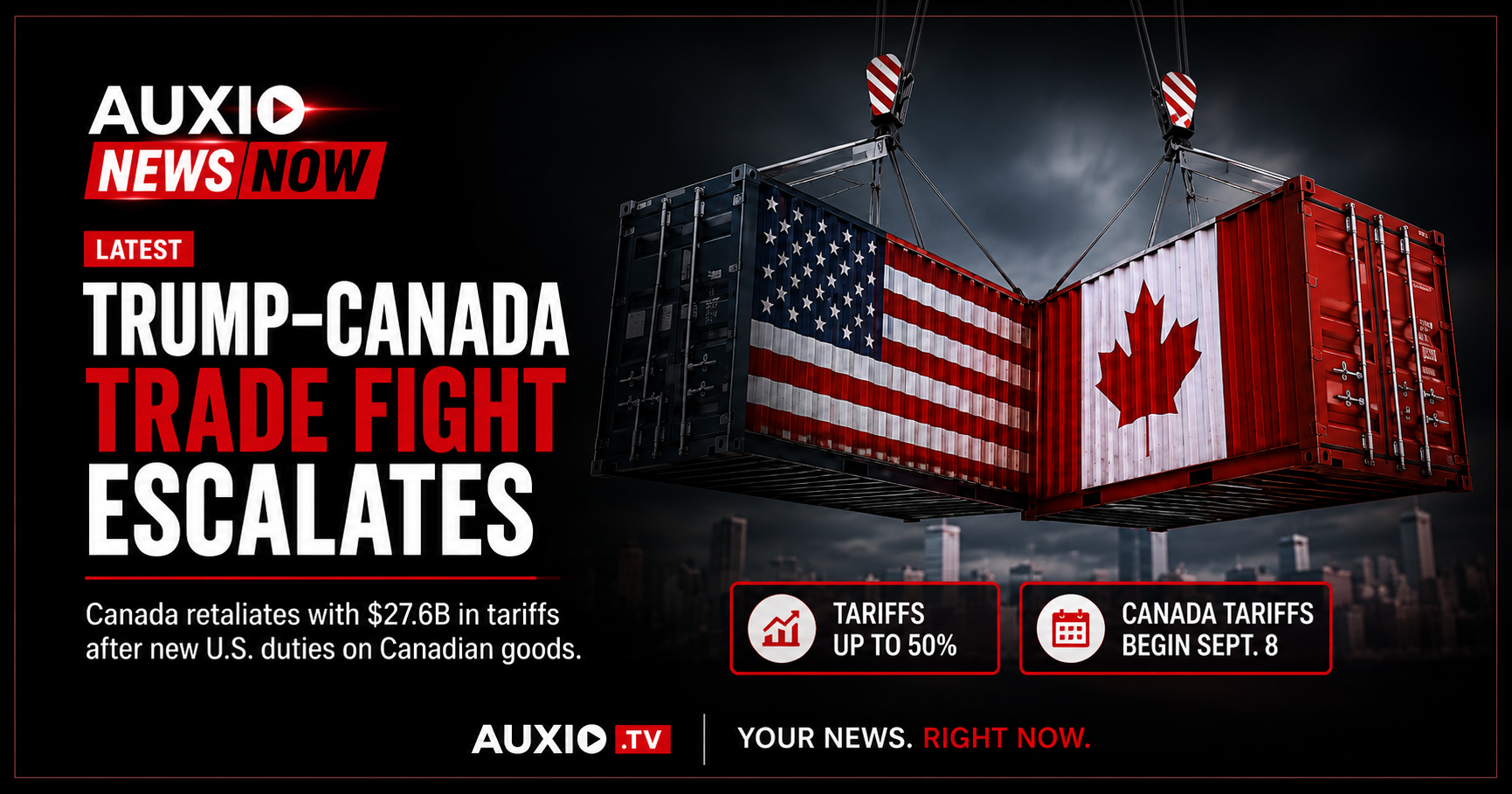
The trade dispute between the United States and Canada has entered a more serious phase.
President Donald Trump’s administration has imposed additional tariffs of up to 50% on certain Canadian goods, arguing that Canada has imposed discriminatory trade barriers against American products, including dairy and motor vehicles. The White House says the tariffs are intended to offset what it considers unfair treatment of U.S. commerce and create greater opportunities for American producers. (The White House)
Canada responded Tuesday by announcing that it will impose its own tariffs on $27.6 billion worth of U.S. goods, matching the new American measures dollar for dollar.
Beginning September 8, Canada says it will apply tariffs of 15%, 25% and 50% to products including steel, dairy, appliances, agricultural equipment, pulp and paper, and electronics. (Canada)
The political argument is straightforward.
The Trump administration says Canada has enjoyed favorable access to the American market while maintaining barriers that disadvantage U.S. businesses. The White House argues that higher tariffs give the United States leverage to force a more balanced trading relationship. (The White House)
Canada sees the dispute differently.
The Canadian government says negotiations broke down after the United States demanded terms Ottawa considered unacceptable. Rather than agree, Canada suspended negotiations and chose retaliation. (Canada)
But beneath the political language is a more important economic question:
Who actually pays?
A tariff is imposed on an imported product when it enters a country.
That means the immediate cost is paid by the importer.
What happens next depends on the market.
A business can absorb the added expense. It can seek a cheaper supplier. It can reduce another cost. Or it can raise the price charged to customers.
That distinction matters because tariffs are often discussed as though the exporting country simply sends money to the government imposing them.
The actual economics are more complicated.
The Trump administration is betting that access to the enormous U.S. consumer market gives Washington enough leverage to force Canada to change its policies.
That strategy could work.
If Canadian companies cannot easily replace American customers, the pressure may eventually become strong enough to produce concessions.
But there is another side to the equation.
American companies that rely on Canadian materials or products may also face higher costs.
And now that Canada is retaliating, American exporters could face the same problem when attempting to sell into the Canadian market.
Canada’s response illustrates that trade conflicts rarely remain confined to the industries governments initially intend to protect.
Steel producers may benefit from less foreign competition while companies that use steel face more expensive inputs.
A domestic dairy producer may gain protection from Canadian competition while another American business loses access to Canadian customers because of retaliation.
Both outcomes can occur simultaneously.
That is why the success of the Trump strategy cannot ultimately be measured by the size of the tariff itself.
It has to be measured by what the United States receives in return.
If the pressure produces better access for American producers, greater domestic investment and meaningful changes in Canadian trade policy, the administration will have a strong case that the short-term disruption produced a long-term economic benefit.
If the result is simply higher costs on both sides of the border and a prolonged cycle of retaliation, then the appearance of economic toughness will matter considerably less.
Canada’s own actions demonstrate that it expects the dispute to carry domestic costs. Ottawa has announced billions of dollars in support for Canadian workers and businesses affected by the trade confrontation. (Canada)
That is an important reminder.
Governments can impose tariffs.
They cannot eliminate the economic consequences of doing so.
The real test of Trump’s Canada strategy is therefore not whether the policy sounds tough.
It is whether the eventual benefits exceed the costs required to obtain them.
That answer will come from results, not rhetoric.