Tag: Washington DC

  • Mic Mountain Serves Up Latin Hip-Hop Concept Album Recetas

    Mic Mountain Serves Up Latin Hip-Hop Concept Album Recetas

    WASHINGTON, D.C. — Mic Mountain is turning recipes into records with Recetas, a 13-track Latin hip-hop concept album that uses food, family and cultural references as the framework for an underground rap project packed with collaborations.

    Running approximately 38 minutes, Recetas takes its concept seriously from the opening track through the finale. The album’s titles read almost like a menu, moving through dishes and drinks including “Pastelitos,” “Dulce De Leche,” “Café Con Leche,” “Mofongo,” “Sancocho,” “Pollo Frito,” “Bacalaitos,” “Sangría” and “Arroz Con Pollo.”

    Rather than treating the food theme as a novelty, Mic Mountain uses it as connective tissue for a project rooted in Latin identity and traditional hip-hop collaboration.

    The album opens with “Recetas (Intro)” before moving into “Pastelitos,” featuring Krook Rock and Jay David. La Bori Dee joins Mic Mountain on “Dulce De Leche,” while “Café Con Leche” brings in Duendy and The Microphone Prince.

    The guest list continues throughout the project.

    DJ Exes appears on “Pineapple Pique,” Powerule joins “Pollo Frito,” and underground hip-hop veteran Thirstin Howl the 3rd appears on “Bacalaitos.” Other contributors include Cynical Minded, Sacx One and Paco Loco, who appears on both the “Hill Billy” skit and closing track “Arroz Con Pollo.”

    That collaborative approach gives Recetas the feel of a curated table rather than a solo showcase. Mic Mountain remains at the center, but the rotating voices allow each record to carry its own personality while staying connected to the broader concept.

    Even the cover artwork reinforces the idea: Mic Mountain seated in front of a spread of dishes with a massive mountain backdrop, visually combining his artist identity with the album’s culinary theme.

    For listeners drawn to independent hip-hop that still values full-album concepts, sequencing and features, Recetas offers something increasingly uncommon — a project designed to be experienced as a complete body of work rather than simply a collection of singles.

    The album is currently available through Mic Mountain’s Bandcamp, where listeners can stream the project and view purchase options.

    For AUXIO Music, Recetas stands out because Mic Mountain isn’t simply naming songs after food. He has built an entire project around the idea of culture being passed down, mixed together and served through hip-hop.

    Tracklist

    1. Recetas (Intro)
    2. Pastelitos feat. Krook Rock & Jay David
    3. Dulce De Leche feat. La Bori Dee
    4. Café Con Leche feat. Duendy & The Microphone Prince
    5. Pineapple Pique feat. DJ Exes
    6. Mofongo
    7. Sancocho feat. CrDnlSn
    8. Pollo Frito feat. Powerule
    9. Bacalaitos feat. Thirstin Howl the 3rd
    10. Morir Sonando feat. Cynical Minded
    11. Sangría feat. Sacx One
    12. Hill Billy (Skit) feat. Paco Loco
    13. Arroz Con Pollo feat. Paco Loco

    https://micmountain.bandcamp.com/album/recetas

  • Supreme Court Backs Trump Administration in White House Ballroom Fight

    Supreme Court Backs Trump Administration in White House Ballroom Fight

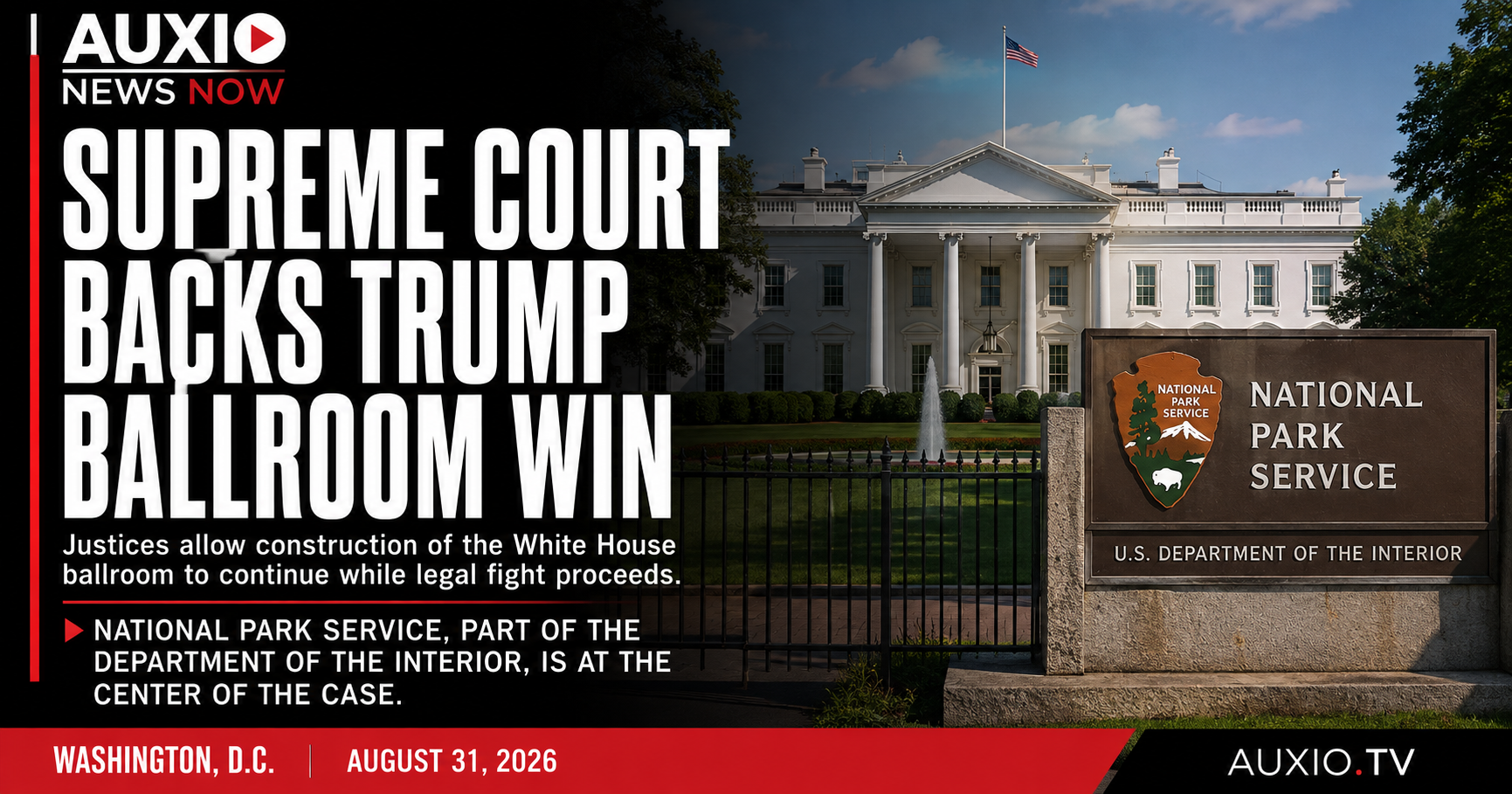
    WASHINGTON — The U.S. Supreme Court has cleared the way for construction of President Donald Trump’s White House ballroom project to continue, granting the administration’s request to stay a lower-court injunction while the broader legal fight proceeds.

    The Aug. 31 order came in National Park Service, et al. v. National Trust for Historic Preservation in the United States, placing the National Park Service — an agency within the Department of the Interior — directly at the center of the case. 

    The Court stayed an injunction issued by the U.S. District Court for the District of Columbia that had restricted portions of the East Wing project. The stay remains in effect while the government seeks Supreme Court review of the case. 

    The administration’s application was filed by the Solicitor General on behalf of the National Park Service and other federal applicants. The government argued that the lower-court order threatened to interrupt an integrated White House construction project and create security and operational consequences.

    The Department of the Interior’s role runs through the National Park Service, which manages President’s Park, including the White House grounds.

    NPS prepared the federal environmental assessment for the White House East Wing Modernization and State Ballroom project. According to the agency’s planning record, the selected action calls for replacing the existing East Wing with a new building that will house the White House State Ballroom and associated facilities. 

    The agency also completed a Finding of No Significant Impact, concluding that the selected project would not significantly impair park resources under the standards used by the National Park Service. 

    That makes Interior’s role more than administrative background. One of its agencies conducted the project review, manages the federal park property involved and is the lead named federal applicant before the Supreme Court.

    What the Supreme Court Decided

    The Court’s order is a significant procedural victory for the administration, but it does not constitute a final ruling that the ballroom project is lawful.

    The stay allows construction to continue while the litigation proceeds. 

    Chief Justice John Roberts dissented, joined by Justices Sonia Sotomayor, Elena Kagan and Ketanji Brown Jackson.

    Roberts argued that the construction is likely unlawful because federal law generally prohibits construction of a new building or structure on federal park grounds in Washington without express congressional authorization. He noted that the project sits within President’s Park. 

    That dispute remains unresolved.

    Why It Matters

    The case now involves more than a White House renovation.

    It raises questions about presidential authority over federal property, Congress’ role in authorizing construction in Washington and the extent to which Interior Department agencies can approve and manage major changes to historic federal property.

    For the Trump administration, however, the immediate result is straightforward: the lower-court restriction has been stayed, and construction can continue while the case moves forward.

  • Supreme Court Allows White House Ballroom Construction to Continue

    Supreme Court Allows White House Ballroom Construction to Continue

    WASHINGTON — The U.S. Supreme Court on Monday allowed construction of the Trump administration’s White House ballroom project to continue, lifting a lower-court order that had halted portions of the work.

    The case, National Park Service v. National Trust for Historic Preservation in the United States, centers on the administration’s redevelopment of the White House East Wing. The project includes a new above-ground ballroom and a below-ground military installation. 

    The National Trust for Historic Preservation sued to stop the project, arguing that the administration lacked the congressional authorization required for new construction on federal grounds in Washington.

    A federal district judge previously agreed that the organization was likely to succeed on the merits and issued a preliminary injunction blocking construction until Congress authorized the project. 

    The Supreme Court’s Aug. 31 order effectively removes that obstacle for now. The majority concluded that the preservation group had not shown the type of concrete and particularized injury necessary to establish legal standing.

    The ruling does not amount to a final determination that the ballroom itself is lawful. Instead, it allows construction to proceed while resolving the immediate dispute over whether the National Trust could maintain its challenge. 

    Chief Justice John Roberts dissented, joined by Justices Sonia Sotomayor, Elena Kagan and Ketanji Brown Jackson. Roberts wrote that the construction was “likely unlawful,” pointing to federal law barring construction of buildings or structures on federal public grounds in Washington without express congressional authority. 

    The government has defended the project in part on national-security grounds, describing it in Supreme Court filings as an integrated complex that includes secure facilities in addition to the ballroom. 

    The dispute has become about more than architecture. It raises broader questions about presidential authority over the White House complex, Congress’s control over federal property and who has standing to challenge major alterations to historically significant government sites.

    For now, the practical result is clear: construction can continue.

  • House Republicans Revive Socialism Showdown Ahead of Midterms

    House Republicans Revive Socialism Showdown Ahead of Midterms

    By Auxio.tv News | August 28, 2026

    House Republicans are preparing another high-profile vote condemning socialism, setting up a politically charged test for lawmakers just months before the 2026 midterm elections.

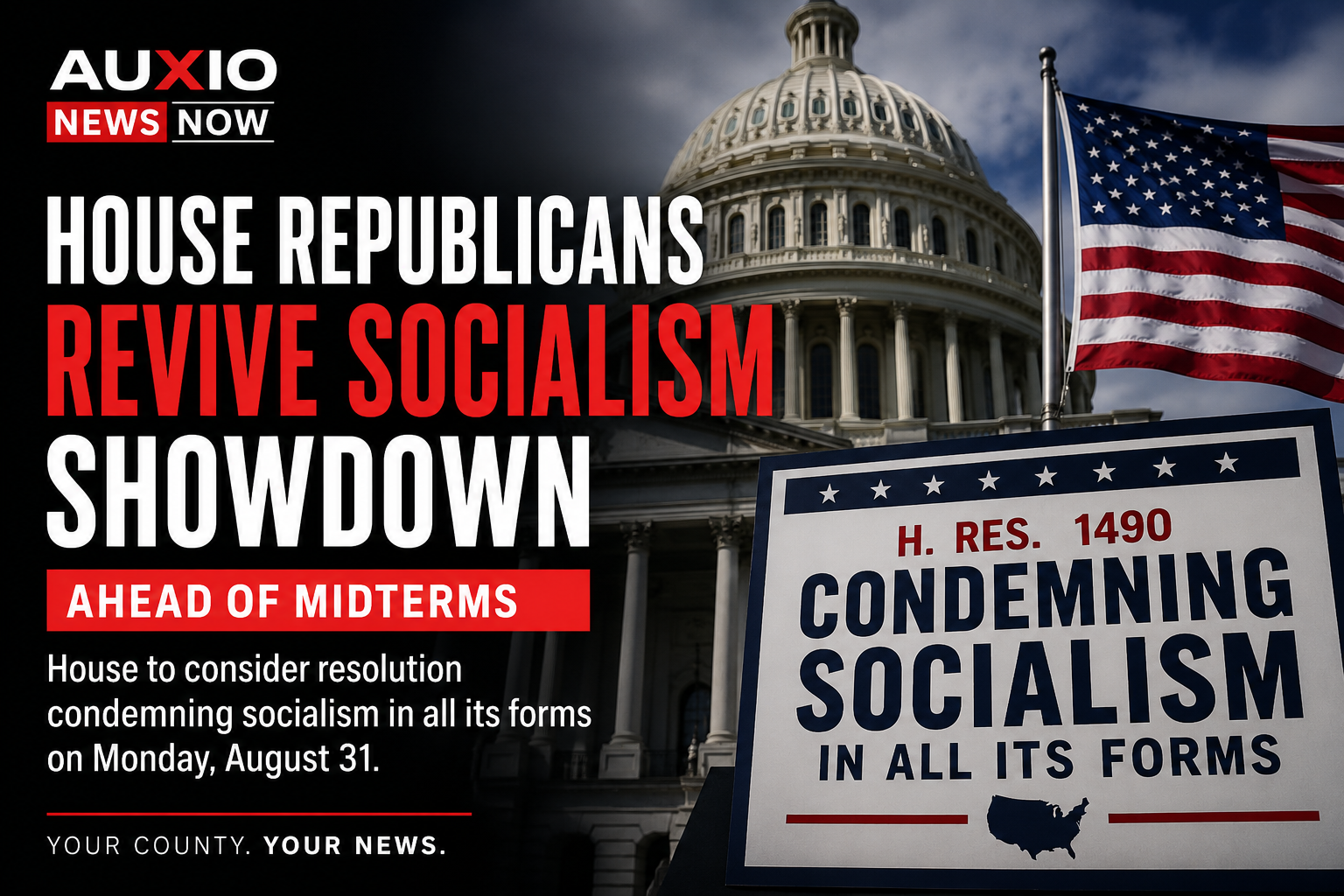
    The House Rules Committee is scheduled to consider H. Res. 1490 on Monday, August 31. The resolution, introduced by Rep. Jeff Crank of Colorado, calls for the condemnation and denouncement of socialism “in all its forms.” 

    Crank’s office says the resolution also targets the Democratic Socialists of America and argues that some of the group’s positions are incompatible with secure elections and traditional American political norms. Those are the sponsor’s political claims, not independently established facts, and they should be understood as part of the resolution’s argument. 

    The timing is not accidental.

    Congress has already voted on similar language before. In November 2025, the House passed a resolution titled “Denouncing the horrors of socialism” by a vote of 285 to 98, with two members voting present. All 199 Republicans who voted supported it, while Democrats split sharply: 86 voted yes, 98 voted no, and two voted present. 

    That history helps explain why another vote can be politically useful even though the resolution itself does not change federal law.

    A vote designed to draw a line

    Nonbinding resolutions are often dismissed because they do not alter tax policy, spending, regulations or criminal law.

    But that does not mean they have no purpose.

    A resolution like this creates a recorded vote on a broad ideological question.

    That vote can then be used in campaign advertising, fundraising, debates and constituent messaging.

    Republicans who support the measure can tell voters they formally rejected socialism.

    Democrats who vote against it may then be asked to explain why.

    That is the political leverage built into the vote.

    The issue is not simply what the resolution says.

    It is what the vote allows each side to say afterward.

    Republicans are trying to define the choice before voters do

    Crank’s resolution comes as Republicans increasingly try to frame the 2026 midterms around a broader ideological contrast between free-market capitalism and socialism.

    That strategy is straightforward.

    Rather than arguing separately about every spending proposal, tax plan, housing policy or government program, Republicans can try to place those debates under one larger label.

    If voters view “socialism” negatively, then attaching that term to Democratic policies can be politically valuable.

    The difficulty is that the word itself is used very broadly in American politics.

    Some people use it to describe state ownership of major industries.

    Others apply it to expansive social programs, public health care, rent regulation or higher taxes on wealthy households.

    Those are not necessarily the same economic system.

    So the value of the resolution may depend less on establishing a precise economic definition and more on creating a clear political dividing line.

    The real question is what lawmakers are being asked to condemn

    This is where the debate becomes more substantive.

    Condemning authoritarian socialist regimes is one thing.

    Condemning every policy that someone chooses to label socialist is another.

    A serious economic discussion has to distinguish between systems that replace private ownership and market allocation, and ordinary government interventions that exist within market economies.

    That distinction matters because nearly every modern economy combines private markets with some degree of taxation, regulation and public spending.

    The argument should therefore be about which policies produce better incentives, lower costs, greater growth and more individual freedom — not merely which side can apply the most powerful label.

    That does not make the House vote meaningless.

    It makes the vote political rather than legislative.

    What happens next

    The Rules Committee has placed H. Res. 1490 on its August 31 agenda alongside several other measures. If the House proceeds to a floor vote, members could again be forced to take a public position on socialism before voters head into the midterm campaign. 

    The likely effect will not be a new federal program or change in law.

    It will be a new set of recorded votes.

    And in an election year, recorded votes are political assets.

    That may be the most important thing to understand about the coming showdown.

    Congress is not simply debating an economic philosophy.

    It is also defining the argument voters may hear repeatedly between now and November.

    Auxio.tv News Now