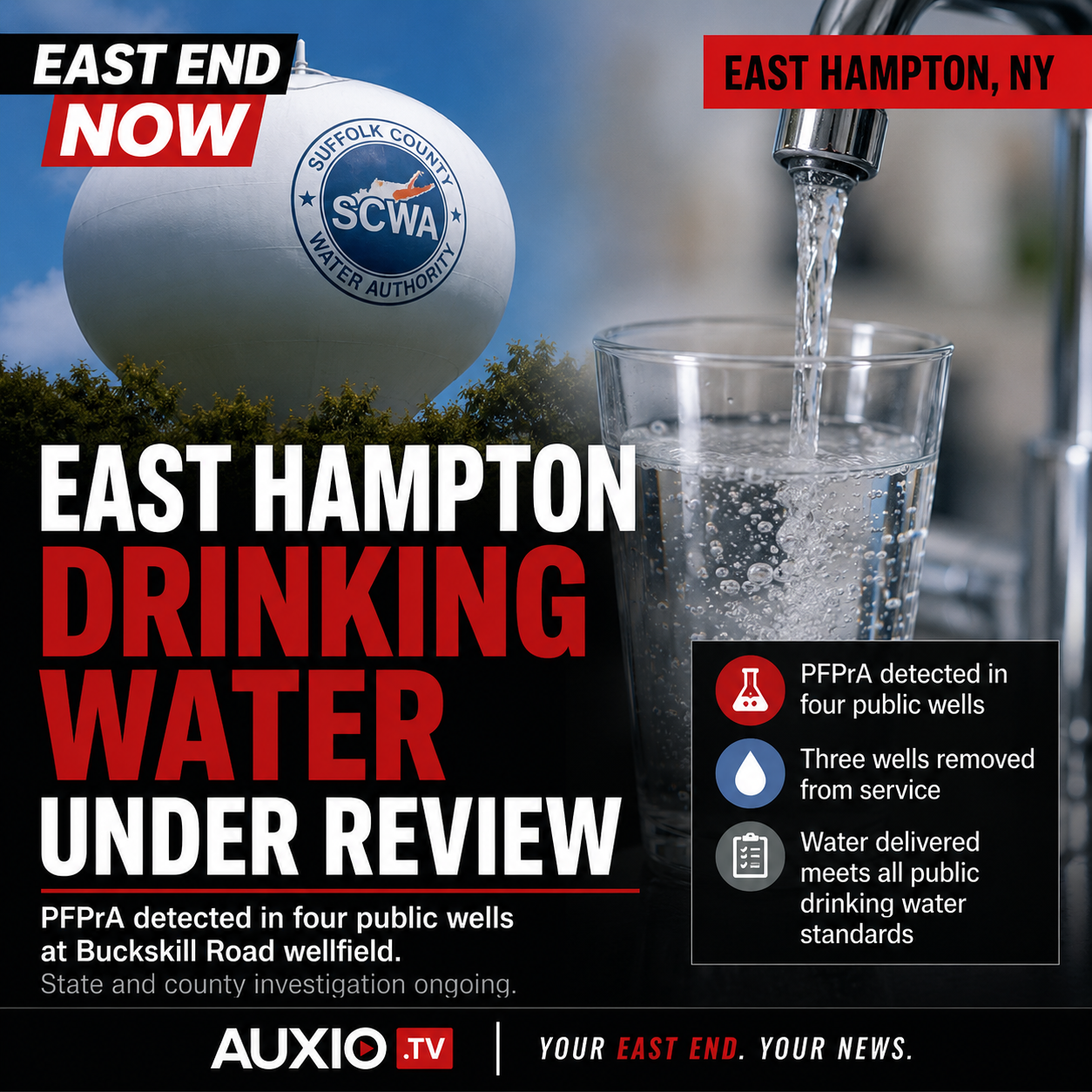
East Hampton residents are being given updated guidance as state, county and local officials continue investigating detections of perfluoropropionic acid, or PFPrA, in public drinking water wells operated by the Suffolk County Water Authority.
The Town of East Hampton’s latest update, dated August 24, 2026, says PFPrA was detected in four public water supply wells at the Buckskill Road wellfield. Three of those wells have been removed from service, while the fourth is available only for emergency use. (East Hampton Town)
Town officials say the water currently being delivered to Suffolk County Water Authority customers meets all public drinking water standards because water is now being supplied from other unaffected wells. (East Hampton Town)
The investigation is being coordinated among the Town of East Hampton, the New York State Department of Environmental Conservation, the New York State Department of Health, Suffolk County and the Suffolk County Water Authority.
The Town says the source of the PFPrA contamination may be related to a 2023 battery energy storage system fire, although the investigation remains ongoing and no final determination has been announced. (East Hampton Town)
What is PFPrA?
PFPrA is an ultra-short-chain member of the broader family of chemicals known as PFAS.
Unlike PFOA and PFOS, PFPrA does not currently have its own specific New York drinking water standard. The Town says state health officials are recommending a site-specific screening level of 3 parts per billion while the health effects of PFPrA continue to be studied. (East Hampton Town)
That distinction matters.
The absence of a specific drinking water standard does not mean a contaminant is automatically harmless. It means regulators are still evaluating how it should be measured and what level, if any, should trigger additional action.
Private wells are also being tested
Suffolk County health officials are testing private wells within the area under investigation.
According to the Town, households identified within the investigation area have been contacted by the Suffolk County Department of Health Services and are being offered free private-well testing. (East Hampton Town)
Residents who believe they may be within the affected area, or who have questions about private-well testing, can contact the Suffolk County Bureau of Drinking Water at 631-852-5810.
Residents who receive a water bill from the Suffolk County Water Authority are connected to the public water system. Those with questions about public water service or water quality can contact SCWA at 631-698-9500. (East Hampton Town)
Why the issue is getting additional scrutiny
SCWA began testing for ultra-short-chain PFAS compounds in early 2026 using specialized laboratory methods that had not previously been routinely available.
The Town says the affected Buckskill Road wells had supplied roughly 7% of the water used by customers in the area before they were removed from regular service. (East Hampton Town)
East Hampton officials say they are continuing to press state, county and water authority officials for information about when the contamination developed, where it came from and what additional remediation or treatment may be required.
The Town has also requested coordinated public presentations from the agencies involved and has called for continued testing and groundwater protection measures. (East Hampton Town)
For residents, the most important distinction is between what is known and what is still being investigated.
The public water currently being delivered meets existing drinking water standards.
At the same time, four wells showed PFPrA contamination significant enough that three were taken out of service and the fourth was restricted to emergency use.
Those two facts are not contradictory.
They illustrate why continued testing and transparency matter.
The real question now is not whether officials should investigate further.
It is how quickly they can determine the source, define the actual health risk and make sure residents receive clear information as the science develops.
East End Now — Your East End. Your News.