
By Auxio News Now | Auxio.tv News
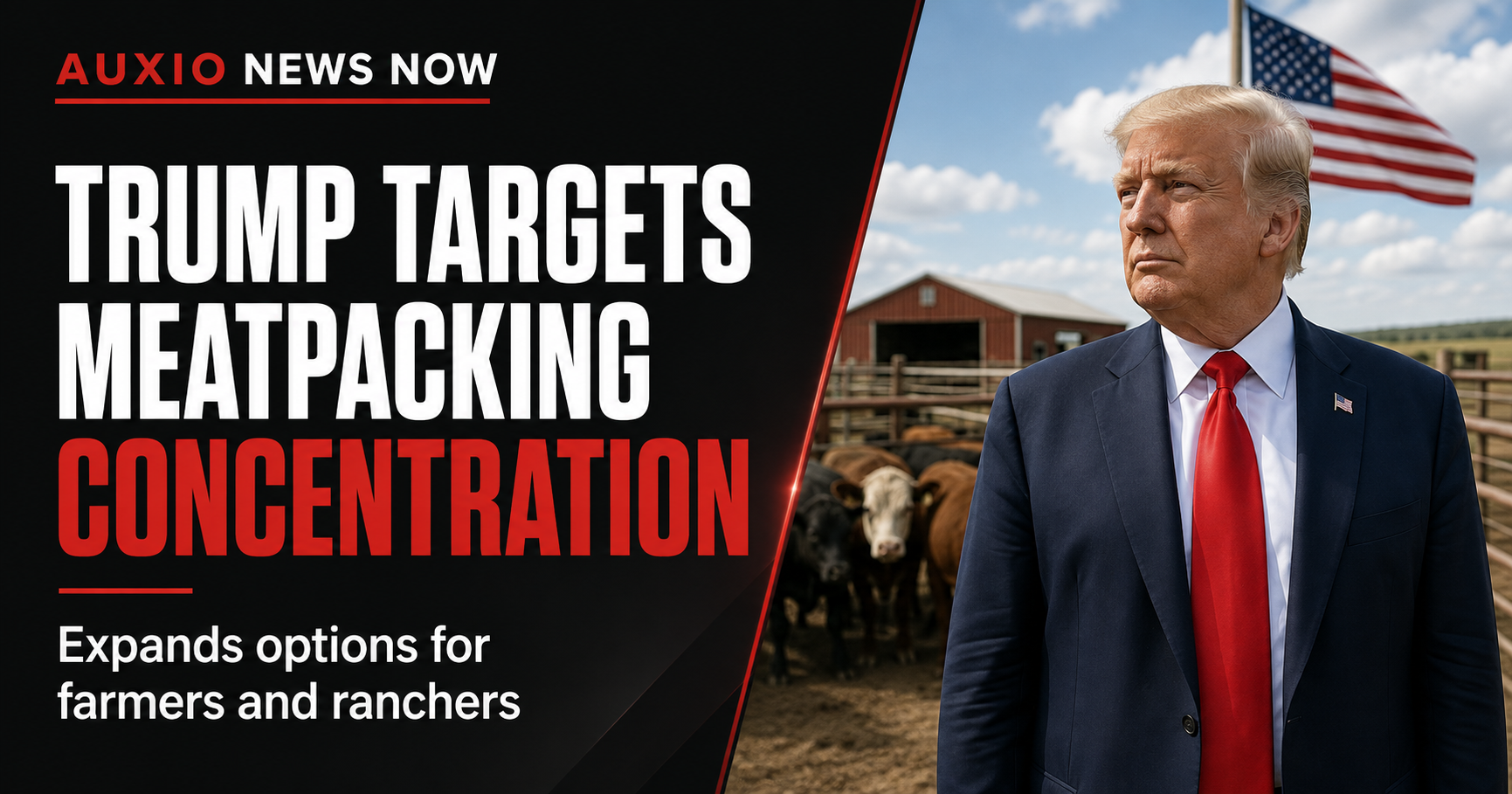
President Donald Trump is moving to loosen federal barriers that limit how farmers and ranchers can process and sell their own meat, framing the effort as a direct challenge to the handful of large companies that dominate the U.S. beef-processing industry.
In an August 28 post, Trump said he had authorized legal documents to be prepared that would give farmers and ranchers greater ability to process their own food. He described the major processors as a “nasty Monopoly” and argued that the current system leaves producers with too few options.
The announcement does not mean federal meat-inspection rules have already been eliminated.
Farmers can already slaughter animals for their own household use. The more consequential question is whether meat processed outside traditional federally inspected facilities can be sold more broadly to consumers, retailers and restaurants — especially across state lines. The administration has not yet released the full legal structure for how that would work.
Agriculture Secretary Brooke Rollins said additional changes are coming, including efforts to reduce processing regulations, expand interstate sales opportunities for ranchers, support smaller processors and address industry consolidation.
The policy debate comes against the backdrop of a highly concentrated beef-processing market.
Four companies — Tyson Foods, Cargill, JBS and National Beef — account for roughly 85 percent of U.S. beef processing. The Trump administration has also directed the Justice Department to investigate major meatpackers for possible collusion, price fixing and price manipulation.
The administration is already putting federal money behind smaller and regional processors.
USDA’s Strengthening Processing for U.S. Ranchers program, known as SPUR, is providing up to $500 million in temporary support for qualifying small and mid-sized beef slaughter facilities. The four largest beef processors are specifically excluded from receiving that funding.
USDA says the goal is to preserve independent slaughter capacity, increase competition, strengthen rural economies and give ranchers more outlets for their cattle.
There is also a legitimate food-safety debate.
Industry groups have warned that expanding processing options should not mean abandoning inspection standards. The National Cattlemen’s Beef Association has supported more competition and greater opportunities for small processors while cautioning against weakening federal food-safety protections.
That creates the central policy challenge.
If the administration can make it easier for independent processors and ranchers to compete without undermining inspection requirements, the result could be a more decentralized beef market with more bargaining power for producers.
If the changes simply bypass safeguards without creating meaningful new processing capacity, the economic effect could be limited.
The timing is important because beef prices remain elevated and the national cattle herd remains tight. The White House recently took separate action to temporarily increase lower-tariff imports of lean beef trimmings in an effort to ease consumer prices.
That means Trump is trying to address the same problem from two directions: increase short-term beef supply for consumers while also reducing the long-term dependence of American ranchers on a small group of dominant processors.
The details of the new processing rules will determine how significant the policy ultimately becomes.
But the direction is clear: the administration wants more competition between the ranch and the grocery store.
Auxio News Now | Auxio.tv News