SOUTHAMPTON, N.Y. — A longstanding Southampton tradition is getting a helping hand from the community as the Southampton 4th of July Parade Inc. prepares to host a Spaghetti and Meatball Dinner Fundraiser on Thursday, October 22, to support next year’s Independence Day celebration.
The fundraiser will take place from 4:30 to 7:30 p.m. at the Southampton Elks Lodge, located at 605 County Road 39A in Southampton.
All proceeds will benefit the 2027 Southampton Fourth of July Parade, helping organizers continue a patriotic tradition that has brought generations of residents together.
Keeping a Southampton Tradition Alive
With the nation celebrating its 250th anniversary in 2026, the fundraiser carries a patriotic theme that reflects Southampton’s longstanding commitment to honoring American history, community and service.
The Southampton Fourth of July Parade has been a centerpiece of local Independence Day celebrations for generations, bringing together veterans, families, civic organizations and neighbors.
The organization is highlighting 107 years of community tradition as it looks ahead to the 2027 parade.
Under the theme “Same Spirit, A Brighter Tomorrow,” organizers are encouraging residents to come together to help preserve the annual celebration for future generations.
Dinner, Fellowship and Community Support
The October 22 event will feature a spaghetti dinner with traditional meatballs and turkey meatballs. A gluten-free option will also be available, and takeout orders are welcome.
Tickets cost $35 per person when purchased in advance or $40 at the door. Children ages 10 and younger can attend free of charge.
Beyond raising money, the gathering offers an opportunity for neighbors to enjoy an evening together while supporting one of Southampton’s most recognizable community traditions.
How to Attend
The Spaghetti and Meatball Dinner Fundraiser is scheduled for Thursday, October 22, from 4:30 to 7:30 p.m. at Southampton Elks, 605 County Road 39A, Southampton, NY 11968.
Advance tickets are available for $35, with admission at the door costing $40. Children 10 and younger are free.
Residents seeking tickets or additional information can contact Thea Fry at 631-276-3435.
All proceeds will benefit the 2027 Southampton Fourth of July Parade.
For organizers and supporters, the message is simple: Keeping community traditions alive requires the continued participation of the people who make them meaningful.
And on October 22, a plate of spaghetti can help support another year of patriotic celebration in Southampton.
Collaboration and Courage: Lessons from the UJC Summit
By Blair Garner
I had the opportunity to attend the UJC Summit at The Shed, sponsored by Roc Nation. What I experienced was more than a conference. It was a powerful gathering of people committed to criminal justice reform, community healing, and creating better opportunities for those impacted by the justice system.
Blair &!Walter King Tutt Johnson
The summit brought together more than 40 vendors and featured eight informative and engaging panel discussions. Topics ranged from youth justice initiatives and college-in-prison programs to mental health in the Black community and the experiences of incarcerated women.
The room was filled with activists, advocates, students, educators, community workers, and organizations from across the country. There was a genuine sense of purpose and camaraderie. People were not simply showing up to talk about problems. They were sharing ideas, building relationships, and looking for ways to make a difference.
People Doing the Work
Several individuals and organizations stood out to me because of their passion, commitment, and sincerity. While I cannot give everyone the recognition they deserve in one article, I want to highlight a few who made an impression on me.
I had the pleasure of connecting with Mr. Walter “King Tut” Johnson, who shared his new book, Second Chance First Responsibility: How I Rebuilt My Life Inside and Outside of Prison. Our conversation was inspiring. His story is a reminder that a person’s past does not have to determine their future. It also reinforced my belief that we must continue creating opportunities for people to grow, rebuild, and reach their full potential.
I also connected with some emerging organizations doing meaningful work in their communities. The Family Systems Collective, led by Dr. Franchesca Capellan, has a mission that speaks for itself: “We keep families impacted by incarceration connected to resources.” When a family is affected by incarceration, the impact often extends far beyond the individual. Connecting those families to the support they need is an important part of helping communities heal.
Another group that caught my attention was T.R.U.C.3. Inc. I spent time with Vincent, Terrence, and Meshach, three mentors and youth justice advocates whose personal experiences with teen violence have helped shape their commitment to young people. They are using their experiences and wisdom to guide the next generation toward better choices and brighter futures.
Their work highlights something we should never overlook: the people who have lived through difficult experiences can become some of our most effective teachers, mentors, and advocates.
Collaboration Is the Key
As the summit began to wind down, I reconnected with an old friend, Leperry Fore of The Best Inc. We took the opportunity to discuss our next community collaboration.
That conversation brought me back to what I believe was the central message of the entire event: collaboration and courage.
The summit reportedly brought together approximately 50 organizations that tabled to promote their causes, along with 1,700 guests representing hundreds of other organizations and agencies from around the country. Think about that for a moment. So many people, from different backgrounds and organizations, came together around a shared commitment to justice, opportunity, and community improvement.
Yet, as important as these gatherings are, we must ask ourselves what happens after everyone goes home.
Do we follow up on the conversations? Do we share resources? Do we connect organizations that serve the same communities? Do we put our egos aside long enough to recognize that another organization’s success can also be a win for the people we serve?
Too often, organizations working toward similar goals operate separately. We may compete for funding, recognition, or attention when we could be combining our strengths to accomplish much more. The people and communities who depend on our work cannot afford for us to operate that way.
Collaboration does not mean that every organization must do the same thing. It means recognizing what each organization brings to the table and finding ways to work together toward a common goal.
Let That Sink In
In today’s climate, when communities are facing so many challenges and the need for meaningful solutions remains urgent, collaboration is not just a good idea. It is a responsibility.
We cannot talk about healing communities while refusing to build relationships with the people already doing the work. We cannot claim to be committed to change if we are unwilling to share knowledge, open doors, and support one another.
The UJC Summit reminded me that there are people across this country who are committed to making a difference. They are working with young people, supporting families, challenging injustice, educating communities, and helping individuals rebuild their lives.
Now, we must turn those connections into action.
As I continue my own work in the community, I remain committed to building partnerships that produce real results. Because at the end of the day, this work is bigger than any one person, organization, or title.
“If we truly want to move our communities forward, we must learn to move forward together.”
Let that sink in… especially in this climate.
This is Blair Garner, and this is Civically Engaged.
CHARLOTTE, N.C. — A proposed airline agreement involving Charlotte Douglas International Airport is returning to Charlotte City Council on Monday, raising questions about how quickly elected officials should approve a major agreement affecting one of the region’s most important economic assets.
A special City Council meeting is scheduled for 4 p.m. on October 19 to reconsider an October 12 motion establishing a review period and a November 23 decision date for the proposed agreement.
The discussion comes as Charlotte Douglas continues planning major infrastructure improvements through its CLT Beyond expansion program.
Why the Airport Agreement Matters
Charlotte Douglas is a major aviation hub and an important driver of economic activity across the Charlotte region.
The airport’s expansion plans include additional passenger gates, terminal improvements and other infrastructure projects intended to accommodate future demand.
Airline use and lease agreements establish important financial and operational arrangements between airports and the carriers serving them.
Those agreements can influence how airport operating expenses, facility costs and capital investments are allocated.
For Charlotte, the central question is whether council members have sufficient time and information to evaluate the proposed agreement before making a decision.
Council’s Review Timeline Under Examination
The October 19 special meeting is expected to address whether council should reaffirm its earlier motion establishing November 23 as the decision date.
The procedural dispute is significant because it concerns the level of review afforded to a long-term agreement involving city-owned infrastructure.
However, a vote on the review timeline should not be confused with a final decision on the entire airport expansion program.
The potential financial or construction consequences of maintaining or changing the deadline have not yet been established in the materials reviewed for this report.
Questions About Financial Oversight
The proposed agreement raises several questions deserving public examination.
How long would the new agreement remain in effect? What financial obligations would the city and participating airlines assume? Would delaying a decision affect project financing or construction schedules?
Those questions should be answered through the agreement itself, official financial presentations and statements from the airport and airlines.
Airport expansion can support regional growth, but public officials also have a responsibility to examine contractual commitments and financial risks.
What Happens Next?
Charlotte City Council is scheduled to meet at 4 p.m. Monday at the Charlotte-Mecklenburg Government Center, 600 East Fourth Street.
Council’s action could determine whether the November 23 review timeline remains in place.
Until the meeting concludes, the outcome remains uncertain.
NORTH CAROLINA NEWS NOW will follow the council’s decision and examine what the proposed agreement means for airport financing, expansion and public accountability.
WASHINGTON, D.C. — Conservative commentator Steven Crowder says he intends to pursue legal action against CNN, Jubilee Media and Texas Democratic U.S. Senate candidate James Talarico, accusing them of using his registered “Change My Mind” trademark during a nationally televised political town hall.
The dispute emerged following CNN and Jubilee’s October 14 event in Fort Worth, Texas, where Talarico answered questions from voters during a program moderated by CNN anchor Erin Burnett.
The broadcast included a segment identified as “Change My Mind,” a phrase Crowder has used for years in his popular political debate series.
Crowder responded publicly on October 15, declaring that he planned to sue all three parties.
A Registered Trademark at the Center of the Dispute
Crowder’s “Change My Mind” series became widely recognized through videos featuring the commentator seated at a table, inviting students and other participants to challenge his views on political and cultural issues.
The format also produced a widely circulated internet meme.
But Crowder’s objection goes beyond similarities between the two programs.
Federal trademark records show that “CHANGE MY MIND” is a registered trademark owned by LWC IP Assets LLC.
The trademark, registration number 5960565, was registered January 14, 2020, for entertainment-related services. Its listed first use in commerce dates to December 2017.
The registration provides a documented basis for Crowder’s intellectual-property complaint, although it does not automatically establish that CNN or its partners committed trademark infringement.
Crowder Accuses Larger Media Companies of Taking His Concept
Following the CNN broadcast, Crowder posted a statement identifying CNN, Jubilee and Talarico as the targets of his intended legal action.
“Change My Mind is a registered trademark,” he wrote.
Crowder also claimed that cable television executives had previously rejected his pitch for the concept before he independently developed it into an established program.
He argues that larger media organizations are now benefiting from a recognizable brand he spent years building.
The allegations raise questions about intellectual-property ownership in an increasingly competitive media environment, where independent digital creators frequently develop programming concepts that later resemble productions from major television networks.
CNN’s Broadcast Used the Same Phrase
CNN’s own October 14 programming referred to a segment called “Change My Mind,” confirming that the disputed wording appeared in connection with its coverage of Talarico.
CNN and Jubilee had announced their partnership in September, describing a town hall featuring direct interaction between the Senate candidate and voters.
The event was part of CNN’s coverage of the closely watched Texas Senate race.
Crowder contends that the use of his show’s name in a comparable political-discussion setting could improperly capitalize on an established media brand.
Whether that use amounts to infringement would depend on the specific presentation, the scope of the trademark and the likelihood that viewers could mistakenly associate CNN’s segment with Crowder.
Does Crowder Have a Legal Case?
Trademark law generally protects names and symbols that identify the source of particular goods or services.
However, ownership of a registered trademark does not give someone exclusive control over every ordinary use of the words involved.
A legal challenge would likely examine whether CNN and Jubilee used “Change My Mind” as a program identifier, whether their presentation created a likelihood of consumer confusion and what defenses might apply.
The distinction between a protected brand and a general discussion format could become central to the dispute.
Crowder’s registration is verifiable. His allegation that the defendants unlawfully used the trademark remains unproven.
Legal Filing Not Yet Confirmed
As of October 17, Crowder has publicly announced his intention to sue, but a filed lawsuit against CNN, Jubilee and Talarico has not been independently confirmed.
No court ruling establishing trademark infringement has been identified.
The dispute nevertheless highlights a growing question in the media industry: How much protection does an independent creator’s established brand receive when larger organizations adopt similar names or presentation styles?
For Crowder, the controversy centers on ownership and recognition of a brand he developed over several years.
For CNN and Jubilee, any future legal dispute could require examining how their televised segment was named, presented and distinguished from Crowder’s existing program.
Whether the disagreement ultimately reaches a courtroom remains to be seen.
SUFFOLK COUNTY, N.Y. — Suffolk County health officials are urging residents to remain vigilant after two additional mosquito samples tested positive for West Nile virus, bringing the county’s seasonal total to 149 positive samples.
The Suffolk County Department of Health Services announced the latest findings on October 14. The infected mosquitoes were collected September 30 in Dix Hills and Watch Hill on Fire Island.
Health officials also confirmed that seven Suffolk County adults have tested positive for West Nile virus during the 2026 season.
Virus Detected Across Suffolk
The latest detections come as county officials continue monitoring mosquito-borne illnesses throughout Suffolk.
In addition to the 149 West Nile-positive mosquito samples, the county has identified five mosquito samples carrying Jamestown Canyon virus and 10 positive for Potosi virus.
Two dead crows and one dead blue jay have also tested positive for West Nile virus.
The findings demonstrate that mosquito-borne viruses remain present in Suffolk County even as the region moves deeper into autumn.
Health Officials Urge Continued Precautions
West Nile virus is primarily transmitted through the bite of an infected mosquito.
Most people infected with the virus experience no symptoms or only mild illness. However, some individuals develop serious neurological complications that can include severe headaches, muscle weakness, confusion, paralysis and potentially life-threatening illness.
Adults over 50 and people with compromised immune systems face greater risks of severe disease.
Residents can reduce exposure by using insect repellent, wearing protective clothing when mosquitoes are active and eliminating standing water where mosquitoes reproduce.
Residents Asked to Report Dead Birds
County health officials are also encouraging residents to report dead birds, which can provide important information about the presence of West Nile virus in local communities.
Residents who discover dead birds on their property can contact the Suffolk County Department of Health Services Bureau of Public Health Protection at 631-852-5999, Monday through Friday, from 9 a.m. to 4 p.m.
Mosquito-related complaints can be directed to the county’s Division of Vector Control at 631-852-4270.
While colder weather will eventually reduce mosquito activity, health officials continue to emphasize prevention as surveillance identifies new positive samples.
The latest findings reinforce the importance of remaining aware of mosquito-borne disease risks throughout Suffolk County.
By Blair Garner | Suffolk News Now | October 16, 2026
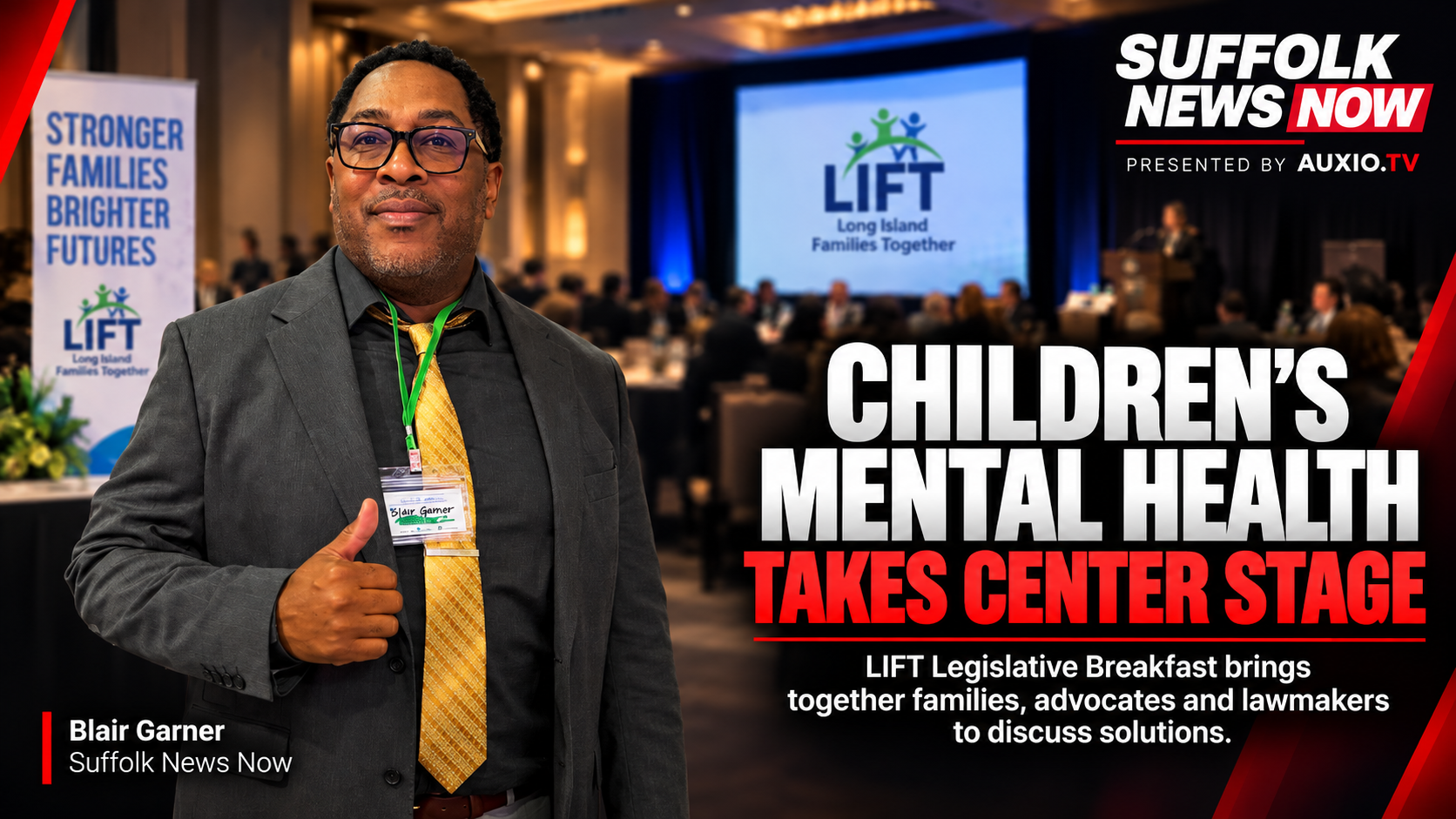
MELVILLE, N.Y. — I attended the annual Legislative Breakfast presented by Long Island Families Together (LIFT) on Friday, an event focused on raising awareness about children’s mental health, family support services and the challenges confronting young people throughout our communities.
The gathering at the Melville Marriott brought together families, advocates, service providers and elected officials to discuss how public policy can better serve children and families navigating behavioral health challenges.
I expected an informative morning. What I experienced exceeded those expectations.
The Stories Behind the Statistics
One of the most powerful portions of the program was the lived-experience panel, where speakers shared personal accounts of navigating mental health challenges and the systems intended to support them.
Their stories were deeply personal, and each one offered a reminder that discussions about mental health cannot be separated from the people living through these challenges.
The moment that resonated most with me came from Isaiah Santiago, a young Rochester school board member who was elected at just 19 years old.
Santiago spoke about experiencing homelessness and instability at home while navigating a school environment that, in his account, contributed to an already developing mental health crisis.
His experience challenged the assumption that schools automatically provide the stability and emotional protection young people need.
“Even though schools are supposed to be safe spaces, they can push you into isolation,” Santiago told those attending.
That observation stayed with me.
Schools are expected to educate and protect children, but policies intended to maintain order can sometimes have unintended consequences for students who are already struggling.
When a child is experiencing trauma, homelessness or emotional difficulties, the response from the adults and institutions around them can make a meaningful difference.
Legislators Discuss Possible Solutions
Following the lived-experience panel, state lawmakers, including Assemblyman Kwani O’Pharrow and Senator Monica Martinez, participated in a discussion about legislative opportunities to strengthen mental health and family support systems.
Among the issues discussed were reducing exclusionary school discipline, including proposals to eliminate suspensions for children in kindergarten through fifth grade, expanding support for students with mental health and developmental challenges, and improving resources for families.
These discussions highlighted an important question: Are our schools and support systems responding appropriately to the needs of children, particularly those facing difficulties outside the classroom?
Discipline and accountability remain important parts of education. But policymakers must also consider whether removing young children from school addresses the underlying behavior or simply creates additional obstacles for students and their families.
Greater access to mental health professionals, developmental services and family-centered resources could help schools intervene earlier and provide alternatives before problems escalate.
Listening Must Lead to Action
Long Island Families Together works to elevate the voices of young people and caregivers while advocating for improvements in children’s mental health services.
Events like this Legislative Breakfast provide an important opportunity for those directly affected by existing policies to speak with the lawmakers who have the authority to change them.
What made this gathering particularly meaningful was the connection between personal experiences and public policy.
The lived-experience panel demonstrated that the consequences of institutional decisions are not abstract. They affect children, parents and families trying to navigate difficult circumstances.
The legislative discussion offered an opportunity to examine how those experiences might inform better decisions.
I left the event encouraged by the willingness of participants to address difficult issues and impressed by the individuals willing to share their stories.
LIFT delivered an interesting, informative and thought-provoking program that exceeded the expectations I had going in.
The next step is ensuring that the conversations continue beyond the breakfast and contribute to meaningful improvements for the children and families who need these services most.
SHIRLEY, N.Y. — Suffolk County Executive Ed Romaine is calling for urgent federal assistance after severe coastal erosion stripped away protective dunes at Smith Point County Park, potentially placing the TWA Flight 800 Memorial and nearby park facilities at risk.
In an October 12 announcement, Romaine confirmed that Suffolk County formally requested assistance from the U.S. Army Corps of Engineers to address extensive shoreline damage at Smith Point Beach and along Dune Road near Shinnecock Inlet.
According to county officials, powerful storms in January and September 2026 caused significant beach erosion, flooding and damage to coastal infrastructure.
Protective Dunes Completely Washed Away
At Smith Point, the protective dune separating the Atlantic Ocean from the park pavilion and TWA Flight 800 Memorial was completely removed during the September 24–27 nor’easter.
Additional sections of the outer beach east of the main pavilion also suffered significant damage.
The memorial honors the 230 people killed when TWA Flight 800 crashed off Long Island in July 1996. The site marked the tragedy’s 30th anniversary earlier this year.
“We are asking the Corps to assist as quickly as possible to restore these beaches,” Romaine said. “It is a matter of public safety.”
Dune Road Also Facing Serious Damage
The county identified extensive erosion along Dune Road in Southampton, west of Shinnecock Inlet.
Officials reported that the protective beach berm has been severely diminished, with storm damage creating additional locations where ocean water can wash across vulnerable sections of the barrier beach.
The damage presents concerns beyond recreational beach access, potentially affecting nearby fishing docks, marinas, restaurants and other waterfront businesses.
Federal Response Awaited
Suffolk County’s request places the issue before federal engineers, but the October 12 announcement did not establish a restoration timetable or confirm that federal assistance had been approved.
For residents and local businesses, the stakes extend beyond replacing lost sand. Protective dunes serve as natural barriers against flooding and storm surge.
With the Atlantic hurricane season continuing through November, the county’s request underscores the importance of protecting vulnerable shorelines before additional storms arrive.
The next significant development will be whether the Army Corps agrees to assist and identifies an actionable restoration plan.
HAMPTON BAYS, N.Y. — Some restaurants become more than places to enjoy a good meal. Over time, they become part of the character of a community, creating memories that extend well beyond their dining rooms.
For me, 1 North Steakhouse was one of those places.
As an East Quogue resident, I’ve had the pleasure of dining at 1 North Steakhouse in neighboring Hampton Bays many times over the years. Learning that the Cariello family has sold the property at 322 West Montauk Highway and is closing this chapter of its business was certainly bittersweet.
What I will remember most about 1 North is something that every restaurant strives for but not all achieve: consistency.
Whether we were stopping in for one of our many enjoyable burger nights or sitting down for a steak dinner, the experience was consistently excellent.
I always appreciated a great steak, and 1 North certainly knew how to deliver one. Whether I ordered the New York strip or the filet mignon, I could count on an amazing meal.
There is something to be said for a restaurant where you know what to expect, not because the experience becomes routine, but because the quality remains dependable.
That kind of consistency doesn’t happen by accident.
It requires attention to detail, a commitment to quality and a team that takes pride in what it serves.
And over the years, that is precisely what I came to appreciate about 1 North Steakhouse.
The Value of a Great Local Restaurant
Independent restaurants are an important part of the East End’s identity. They provide more than employment and economic activity. They create gathering places where families, friends and neighbors can enjoy time together.
For those of us who live here year-round, having dependable local establishments matters.
A great restaurant doesn’t necessarily need to reinvent itself every time you walk through the door. Sometimes its greatest accomplishment is simply delivering an excellent experience, time after time.
That was always my experience at 1 North.
From the burger nights to the steaks, the food was a major reason we kept returning. Just as important was the hospitality that accompanied it.
Behind that experience were the efforts of the Cariello family and the employees who helped make the restaurant what it became.
Running a restaurant on Long Island is no easy undertaking. Rising expenses, staffing demands and the pressures of operating a hospitality business require tremendous dedication.
I have always respected the families willing to make that investment in our local communities.
A Thank You to the Cariello Family
In announcing the sale, the Cariello family expressed gratitude to its customers, employees and the Hampton Bays community.
Their message carried a particularly encouraging sentiment: while this chapter is ending, the family suggested that there may be new opportunities ahead.
I certainly hope so.
While I will miss the familiar experience of walking into 1 North Steakhouse and knowing that a great meal awaits, I am grateful for the many enjoyable evenings we spent there.
To the Cariello family and everyone who contributed to the success of 1 North Steakhouse, thank you.
Thank you for the great food, the consistency, the hospitality and the memories.
I wish you nothing but happiness and continued success in your future endeavors.
And whatever your next venture may be, I look forward to hearing about it.
Sometimes the greatest compliment you can give a restaurant is that you always knew you would have a good meal. For me, 1 North Steakhouse earned that compliment many times over.
Raheem Soto is the publisher of AUXIO.TV and a resident of East Quogue. This column is his personal experiences and opinions.
MEDFORD, N.Y. — Suffolk County Executive Ed Romaine is celebrating the completion of Medford Gardens, a new $40 million affordable senior housing development designed to provide stable housing and supportive services for older Long Islanders.
The development, located on Horseblock Road in Medford, brings 67 residential units to the Town of Brookhaven, including 33 apartments reserved for eligible residents who need additional support.
In a public statement welcoming the project, Romaine described Medford Gardens as an opportunity for residents age 55 and older to find affordable housing while remaining part of the Suffolk County community.
The development was built by WellLife Network, a nonprofit organization providing housing and human services throughout the region.
Apartments are intended for qualifying residents age 55 and older with household incomes at or below 60% of the area median income.
Thirty-three supportive apartments are reserved for eligible individuals facing housing instability and mental health challenges.
Residents receiving supportive services can access assistance that includes case management, healthcare coordination, crisis intervention, transportation and life-skills support.
Housing Designed for Aging in Place
Beyond affordability, Medford Gardens is designed to help older adults maintain independence.
The development includes an exercise room, community gathering spaces, walking paths and outdoor areas intended to encourage activity and social interaction.
The all-electric building also incorporates energy-efficient equipment and accessible housing features.
For older Suffolk residents dealing with rising housing costs, the project offers an alternative to maintaining a larger home or searching for an affordable apartment in one of the nation’s more expensive suburban housing markets.
State and Local Investment
Medford Gardens was developed through a combination of federal housing tax credits and New York State housing programs, including financing through Homes and Community Renewal and the Homeless Housing and Assistance Program.
Construction began in 2025 following a coordinated effort involving WellLife Network, state housing agencies and local government.
The project also received support from State Senator Dean Murray and Assemblyman Joe DeStefano, who welcomed the development when construction began.
At the groundbreaking, DeStefano described the housing as a welcome addition to Medford and said it would transform residents’ lives.
Murray similarly recognized the importance of housing that combines affordability with services for residents who need additional assistance.
The completion of Medford Gardens represents a new housing resource for older adults in Suffolk County, where affordability and the ability to remain near family, services and established communities continue to be significant concerns.
For Romaine, the development marks another opportunity to expand housing options for residents seeking financial stability and independence later in life.