
By Auxio News Now | Auxio.tv News
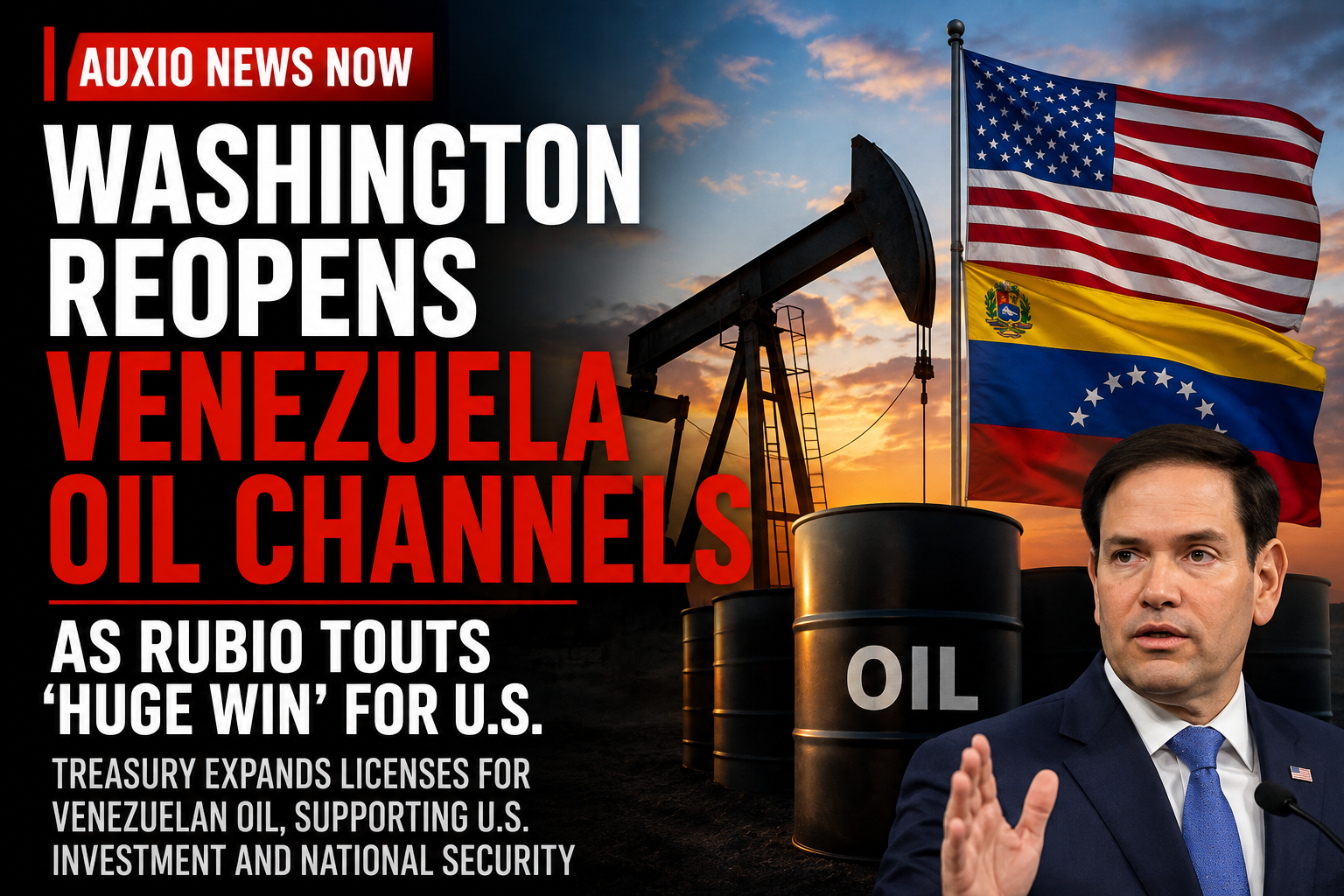
The United States is continuing to reopen commercial channels with Venezuela’s energy sector, marking a significant shift from the sanctions-heavy posture that defined Washington’s relationship with Caracas for years.
Secretary of State Marco Rubio recently described the developing U.S.-Venezuela oil arrangement as a “huge win” for both countries. The broader policy behind that statement is now visible in new Treasury Department actions.
On August 27, the Treasury Department’s Office of Foreign Assets Control amended a series of Venezuela-related general licenses covering oil, petrochemicals, U.S.-origin diluents, oil-and-gas operations, transactions involving Venezuela’s state oil company PdVSA, and other commercial activity.
The changes do not amount to a complete end to U.S. sanctions.
Instead, they create broader legal pathways for approved American companies to conduct business involving Venezuelan energy while maintaining restrictions on certain transactions and counterparties.
One of the most significant licenses authorizes established U.S. entities, subject to conditions, to engage in transactions involving PdVSA and its majority-owned subsidiaries. Those permitted activities can include buying, selling, transporting and marketing Venezuelan-origin oil as well as supplying goods, technology and services needed for oil and gas production.
Treasury is also allowing downstream trading of Venezuelan oil once the interests of blocked Venezuelan entities have been extinguished through an authorized transaction.
That gives the policy significance well beyond a single shipment or company.
It potentially creates a larger commercial route for Venezuelan crude to move through U.S.-authorized transactions and into global markets.
Treasury has been unusually direct about why Washington is making the change.
In guidance issued August 27, OFAC said it amended several licenses in response to investment-related reforms undertaken by the Venezuelan government since January. The agency also said the United States supports American businesses reinvesting in Venezuela as part of an effort to strengthen U.S. national security in the Western Hemisphere.
There are still guardrails.
Recent Venezuela licenses have included restrictions involving entities connected to Russia, Iran, North Korea, Cuba and China. Treasury has also required certain contracts with the Venezuelan government or blocked entities to provide for dispute-resolution proceedings in jurisdictions including the United States, United Kingdom, France or Singapore.
For Washington, the potential upside is straightforward.
Venezuela possesses some of the world’s largest petroleum reserves, while American refiners are capable of processing the heavy crude the country produces. Greater U.S. commercial involvement could also reduce the space available for strategic competitors such as China, Russia and Iran inside Venezuela’s energy sector.
For Caracas, renewed American investment could provide capital, equipment and expertise to an oil industry that has suffered from years of underinvestment and declining capacity.
That helps explain Rubio’s description of the arrangement as mutually beneficial.
But this is not simply a return to business as usual.
The United States is attempting to reopen economic ties while retaining enough control over sanctions relief to influence who participates, where money flows and which foreign governments benefit.
That makes the Venezuela policy as much a geopolitical strategy as an energy strategy.
After years in which Washington largely tried to isolate Venezuela economically, the current approach appears to be moving in a different direction: use American investment and access to U.S. markets as leverage while pulling Venezuela’s economy closer to the United States and farther from its adversaries.
Whether that strategy succeeds will depend on what reforms Caracas actually delivers and whether American companies believe the political and financial risks are worth taking.
But the direction is increasingly clear.
Washington is reopening the door to Venezuelan energy — and it wants American companies walking through it.
Auxio News Now | Auxio.tv News