
By East End Now | Auxio.tv News
For generations, bay scallops were part of the identity of the Peconic Bays.
They supported commercial baymen, showed up on local menus and became so closely associated with the East End that “Peconic Bay scallops” developed a reputation far beyond Long Island.
Today, they are increasingly hard to find.
New York’s latest species assessment says bay scallops remain present in the Peconic and Gardiners Bay system, but only in low abundance. That is a dramatic change from less than a decade ago, when restoration efforts had helped commercial landings climb back above 100,000 pounds.
Then came 2019.
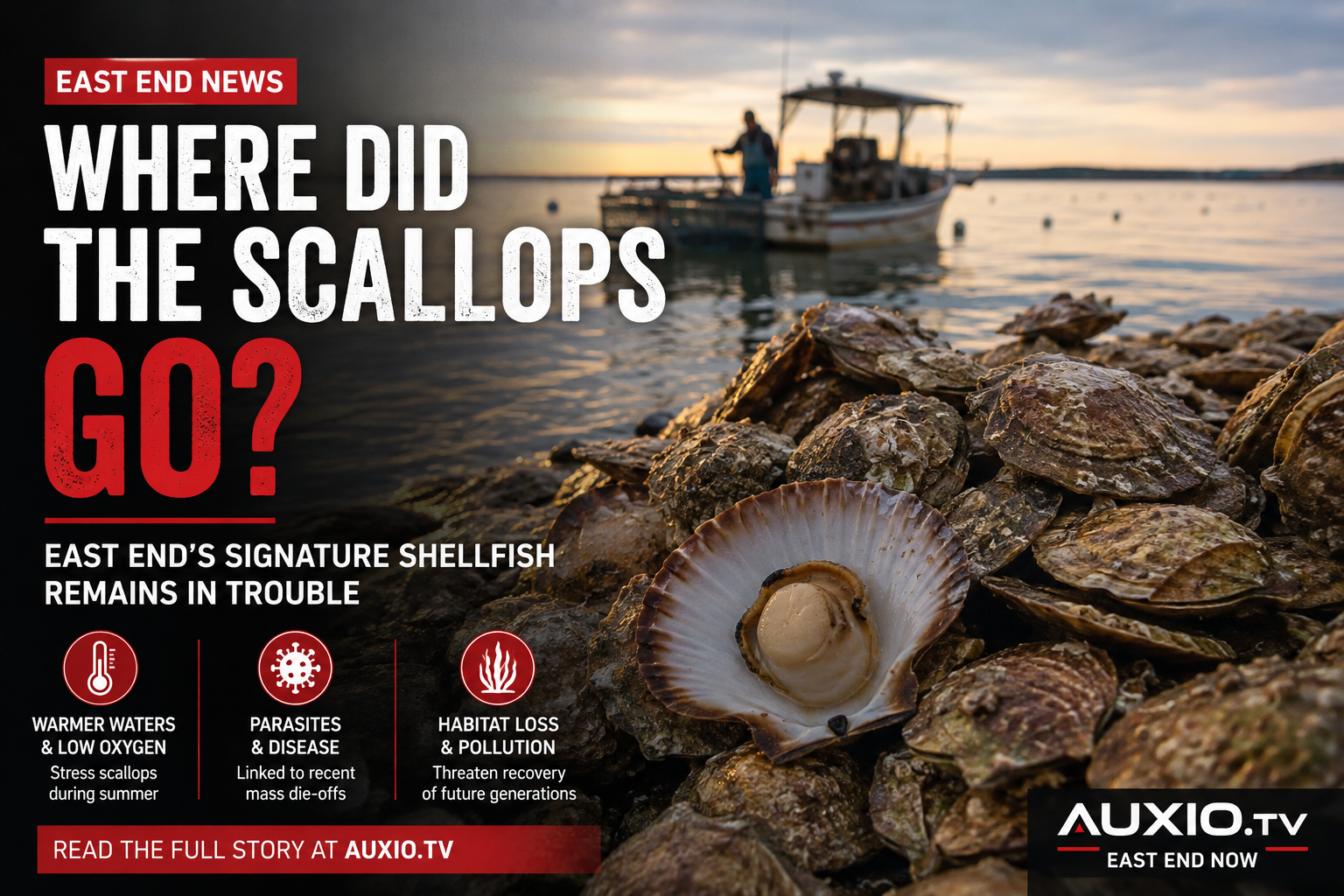
That summer, adult scallops in the Peconic Bays suffered a catastrophic die-off. Similar large-scale mortality events followed in 2020, 2021 and 2022. State scientists say the likely explanation is not one single cause, but a combination of stressors: unusually warm summer water, low dissolved oxygen and a parasite that attacks scallop tissue.
Researchers at Stony Brook University have been studying that parasite, known as bay scallop Marosporida, which has been repeatedly associated with the recent mortality events. The organism has been found in the kidneys and other tissues of infected scallops and has also been detected in Peconic Estuary water and sediment samples.
The result has been a fishery that has struggled to recover.
Stony Brook researchers described the 2019-to-2021 die-offs as involving almost complete mortality of adult scallops during the summer. Before that collapse, researchers said the rebuilt population had supported a multimillion-dollar local fishery.
The decline is especially striking because the Peconic scallop had already survived one major ecological collapse.
In 1985, brown tide spread across Long Island waters and devastated both scallops and eelgrass. Peconic Estuary Partnership records show annual commercial scallop landings fell from roughly 300,000 pounds to about 300 pounds within several years. A second major brown tide in 1995 drove the statewide commercial harvest down to just 53 pounds the following year.
Years of hatchery work and restoration eventually brought them back.
Beginning in the mid-2000s, scientists and shellfish programs placed millions of hatchery-raised scallops into the Peconic system. By 2014 and 2015, commercial landings had rebounded to 88,500 and 60,000 pounds respectively, and the fishery continued improving before the 2019 collapse.
Now researchers are effectively trying to rebuild it again.
One focus is developing scallops that may be more resistant to disease. Cornell Cooperative Extension and Stony Brook researchers have been studying different scallop populations and breeding strategies in hopes of producing animals better able to survive the conditions now found in the Peconic Bays.
Habitat remains another piece of the problem.
Bay scallops depend heavily on shallow-water vegetation, particularly eelgrass, where young scallops can attach themselves above the bottom and gain protection from predators. The Peconic Estuary Partnership says remaining eelgrass beds are concentrated around Shelter Island, Gardiners Bay and several smaller creeks and embayments.
Water quality matters too.
Excess nitrogen can contribute to harmful algal blooms and low-oxygen conditions. Suffolk County and state officials continue to invest in projects intended to reduce nitrogen pollution and improve habitat throughout the Peconic Estuary. County Executive Ed Romaine specifically cited the collapse of the bay scallop population while touring estuary restoration projects last year.
That makes the scallop decline more than a fisheries story.
It is a measure of what is happening beneath the surface of the East End’s bays.
The scallop’s brief lifespan makes the population particularly vulnerable. Most live only about 18 to 22 months, meaning a bad summer can wipe out much of the adult population before enough young scallops are produced to rebuild the next generation.
There are still scallops in East End waters.
But the days when baymen could reasonably expect a healthy Peconic harvest every fall have not returned.
For a shellfish once synonymous with the East End, that absence is becoming a story of its own.
East End Now — Your East End. Your News.