
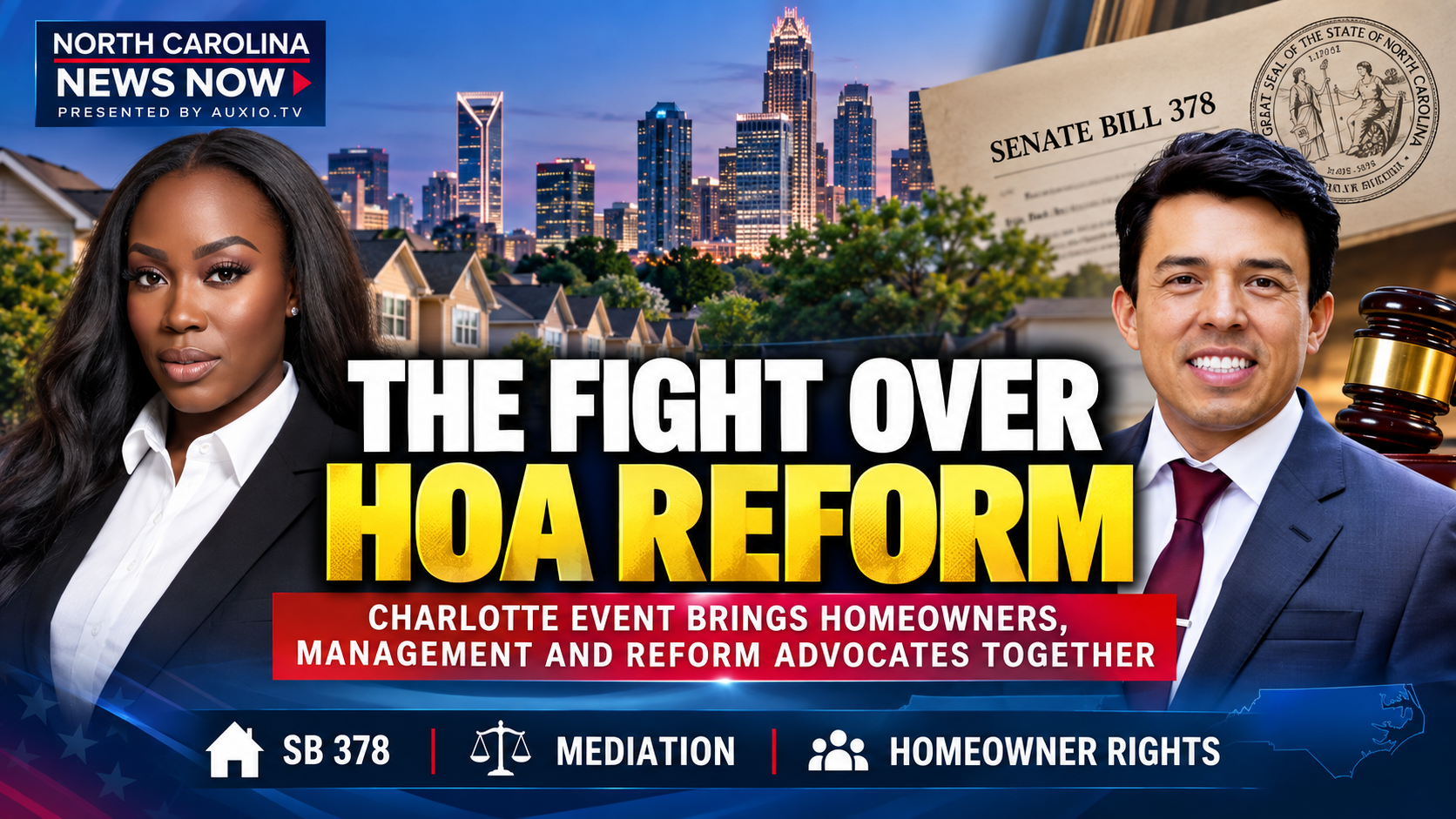
CHARLOTTE, N.C. — A Charlotte conference later this month will bring homeowners, HOA professionals and reform advocates together as North Carolina continues wrestling with how much power homeowners associations should have — and what protections property owners should receive when disputes escalate.
“The Missing Piece: How Mediation Connects Communities, Courts, and the Future of Justice” is scheduled for October 21 at SouthPark Church. An 11 a.m. HOA governance panel will feature HOA attorney Shira Hedgepeth, Neighborhood Cornerstone Partners founder Claudia Charles, HOA reform advocates Jeffrey C. Baldwin, Toni Emehel and Diane Krebs, according to the event announcement provided to AUXIO.
The gathering comes as HOA policy has become an increasingly significant issue in Raleigh.
SB 378 pushed HOA reform considerably further
North Carolina Senate Bill 378 began as an HOA-reform proposal that would change several aspects of association governance, including fines, liens, access to records and architectural-review procedures. It also called for pre-litigation mediation of certain disputes and for the North Carolina Department of Justice to collect HOA complaints and report their underlying issues to lawmakers.
The bill’s legislative journey became complicated. It passed the Senate 47-0 in May 2025 and later passed the House 61-47 in October after substantial changes. The Senate refused the House message because of procedural timing, and the General Assembly currently lists the measure as “Held by House Clerk” as of October 23, 2025.
That means the reform debate remains unfinished.
A separate proposal, House Bill 1174, the HOA Oversight Act, was introduced during the 2026 session and referred to the House Housing and Development Committee, with additional referrals if favorable.
Jeffrey Baldwin puts a face on the issue
For panelist Jeffrey C. Baldwin, HOA reform isn’t theoretical.
Baldwin became an advocate after his Charlotte HOA attempted to foreclose on his home in a dispute that reportedly originated with a $100 fine. The association eventually withdrew its foreclosure petition. Baldwin subsequently became involved with SAFERHOA and has argued for stronger accountability, transparency and restrictions on HOA foreclosure powers.
His experience illustrates why seemingly routine disagreements between homeowners and associations can become consequential disputes involving liens, attorneys and potentially a family’s home.
That also makes mediation particularly relevant. The original HOA provisions of SB 378 specifically contemplated mediation before litigation in certain disputes.
Claudia Charles is approaching the issue from inside HOA management
The other side of the reform conversation isn’t necessarily eliminating HOAs. It’s examining how they are managed.
That is where Charlotte entrepreneur Claudia Charles and Neighborhood Cornerstone Partners enter the story.
Charles founded Neighborhood Cornerstone Partners after serving as an HOA board president herself. According to the company’s account of its founding, Charles became involved after growing frustrated with problems in her own community and eventually concluded that HOA management could operate differently.
Her Charlotte-based company emphasizes transparency, financial and vendor oversight, homeowner communication, board support and dispute reduction while serving communities in North and South Carolina.
That makes Charles’s participation noteworthy because the October 21 panel brings together management, attorneys and homeowner advocates rather than treating HOA reform simply as a fight between homeowners and associations.
A broader question for North Carolina
The larger issue emerging in Raleigh and Charlotte is no longer simply whether HOAs are good or bad.
It’s how much authority they should possess, what due-process protections homeowners should receive, how transparent associations must be and whether disputes can be resolved before they become expensive legal battles.
The October 21 Charlotte discussion puts people who have experienced those questions from very different perspectives in the same room.
And with HOA legislation continuing to move through the General Assembly, the conversation could have implications well beyond Charlotte.
