Tag: Auxio_TV

  • FORMER CHARLOTTE COUNCILWOMAN TIAWANA BROWN SENTENCED TO 10 MONTHS IN FEDERAL PRISON

    FORMER CHARLOTTE COUNCILWOMAN TIAWANA BROWN SENTENCED TO 10 MONTHS IN FEDERAL PRISON

    CHARLOTTE, N.C. — Former Charlotte City Councilwoman Tiawana Brown has been sentenced to 10 months in federal prison following her guilty plea in a federal COVID-19 relief fraud case.

    Brown pleaded guilty to conspiracy to commit wire fraud. In the factual basis filed in U.S. District Court, Brown admitted that she knowingly joined a conspiracy with her daughters, Antionette Rouse and Tijema Brown, between April 2020 and September 2021 to obtain federal pandemic-relief money through fraudulent representations. 

    The case involved two programs administered by the Small Business Administration: the Paycheck Protection Program, or PPP, and Economic Injury Disaster Loan program, or EIDL.

    Federal prosecutors originally charged the three women in May 2025. According to the U.S. Attorney’s Office for the Western District of North Carolina, the indictment alleged they submitted at least 15 PPP or EIDL applications containing false information or documentation and obtained at least $124,165. 

    The indictment also detailed how some of the money was allegedly spent. Prosecutors said that approximately one month after Brown received $20,833 in PPP proceeds through a bank account associated with her nonprofit Beauty After The Bars, approximately $15,000 was spent on Brown’s birthday party. Court records listed expenses including a venue, catering, photography and video, decorations, a rented throne and a horse-drawn carriage. 

    Those allegations were made before Brown’s guilty plea. Her subsequent factual basis established that she admitted knowingly participating in the underlying conspiracy to defraud the federal relief programs. 

    Brown’s prosecution came while she was serving on the Charlotte City Council representing District 3. The conduct at issue, however, occurred between 2020 and 2021—before Brown was elected to the council. 

    The 10-month prison sentence means Brown will now serve federal time following the guilty plea.

    AUXIO.TV is continuing to review the federal court record for additional sentencing details, including restitution, supervised release and the judge’s reasoning for imposing the prison term.

    Sources: U.S. District Court for the Western District of North Carolina court filings and the U.S. Attorney’s Office for the Western District of North Carolina.

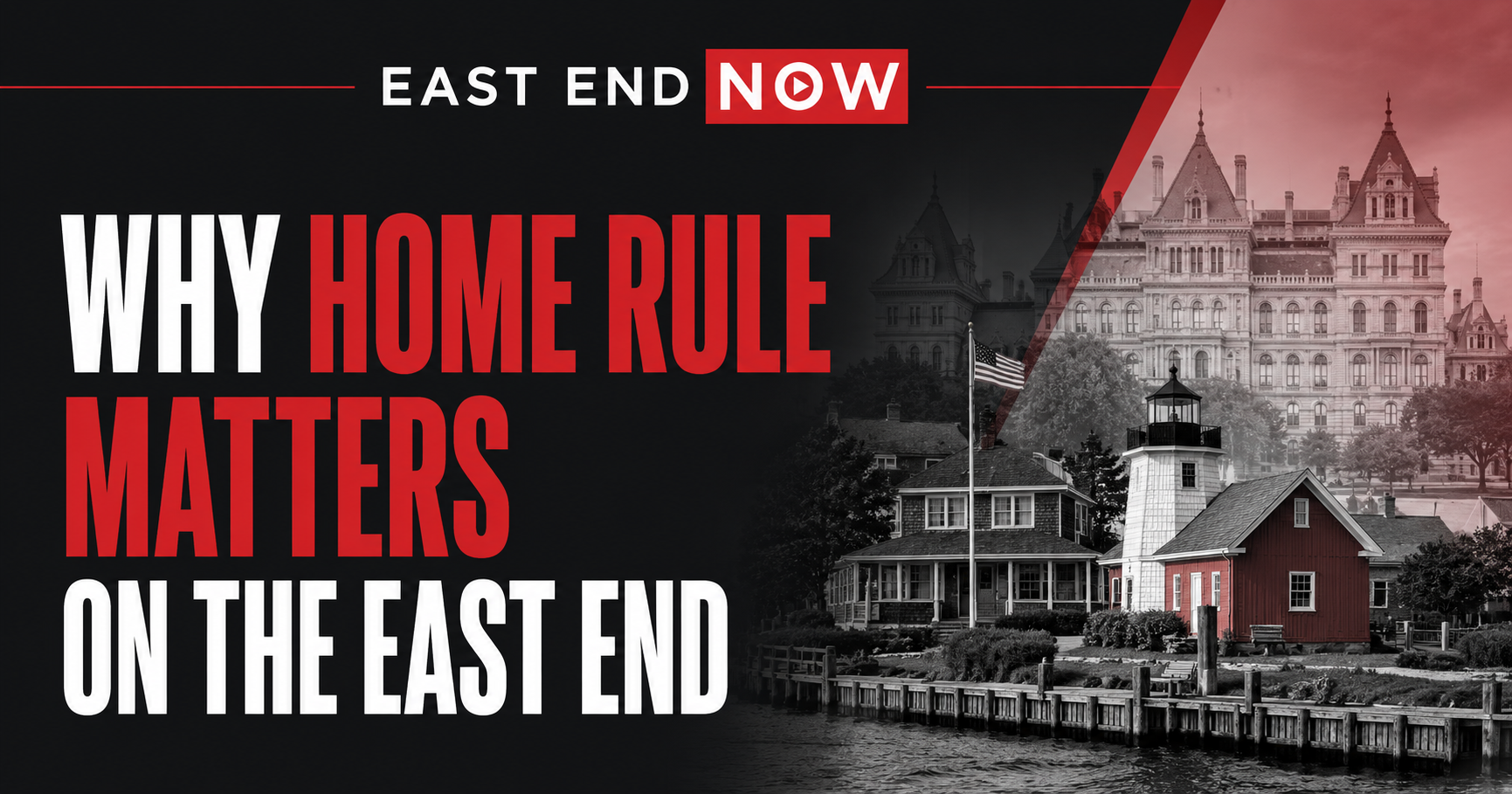
  • What “Home Rule” Means — and Why Albany’s Agenda Matters on the East End

    What “Home Rule” Means — and Why Albany’s Agenda Matters on the East End

    By East End Now | Auxio.tv News

    “Home rule” is one of those political terms that sounds abstract until a decision made in Albany changes what can be built next door.

    In New York, home rule is rooted in Article IX of the State Constitution and the Municipal Home Rule Law. In broad terms, it gives counties, towns, cities and villages authority over their own property, affairs and government, including the ability to adopt local laws in many areas. New York’s own Department of State describes local governments as having broad powers to regulate quality of life and provide services directly to residents. 

    But those powers are not absolute.

    Local laws generally cannot conflict with the State Constitution or with statewide laws. Albany can also limit local authority in areas it decides require a broader state policy. 

    That tension is increasingly important on the East End.

    Why home rule matters here

    Southampton, East Hampton, Riverhead and Southold do not face the same conditions as Buffalo, Albany or New York City.

    Housing demand is different. Water infrastructure is different. Septic capacity is different. Traffic patterns are different. Land values are different.

    That is the basic argument for home rule.

    The people closest to a problem usually have more direct knowledge of the consequences of a decision.

    A town board approving a housing development has to consider the roads leading to it, the groundwater beneath it and the emergency services around it.

    Albany can set a statewide goal.

    The town still has to absorb the result.

    Housing is becoming a major test

    New York’s housing shortage is real.

    The danger comes when a legitimate statewide problem becomes justification for weakening local decision-making everywhere.

    One active Assembly proposal, A.8834, would limit the authority of towns, villages and cities to adopt zoning rules that reduce allowable housing density. 

    Another proposal, A.2408, takes the opposite approach. It would amend the State Constitution to prohibit the governor, Legislature or state agencies from imposing residential zoning requirements on a local government without that government’s approval. 

    The fact that both proposals exist tells us something important.

    Albany itself is debating how much control local governments should retain.

    The downside of statewide mandates

    The case for statewide action is easy to understand.

    If every town can block new housing, restrict density or delay projects indefinitely, the statewide housing shortage can become worse.

    But centralized policy has its own costs.

    Housing units do not exist in isolation.

    They require roads, schools, water, wastewater capacity, police, fire protection and other services.

    A policy that increases housing density without requiring infrastructure to keep pace can make housing numbers look better while making local conditions worse.

    That is the kind of unintended consequence home rule is supposed to help prevent.

    The same principle applies beyond housing.

    Energy projects, battery-storage facilities and other large developments may advance statewide goals while concentrating the practical risk in one community.

    When the benefits are spread statewide but the costs are local, officials in Albany have different incentives from the residents who live next to the project.

    Home rule is not a license to say no to everything

    There is a downside to local control too.

    A town can misuse zoning to prevent reasonable development.

    Residents can oppose every project while still complaining that housing is too expensive.

    Local officials can protect existing homeowners at the expense of younger families and workers trying to enter the market.

    Home rule should not become a shield against every change.

    But the answer to bad local decisions is not automatically to move more decisions farther away from the people affected by them.

    The better standard is accountability.

    If a town refuses reasonable housing, voters should be able to hold local officials responsible.

    If Albany overrides local zoning and the result creates congestion, infrastructure problems or environmental consequences, responsibility becomes harder to assign.

    That matters because accountability weakens as decision-making moves farther from the consequences.

    The East End has reason to be cautious

    New York’s Constitution deliberately recognizes a role for local government.

    That does not mean Albany has no authority.

    It means state power and local knowledge are supposed to coexist.

    For the East End, that balance matters.

    A statewide housing target may be worthwhile.

    A statewide energy goal may be worthwhile.

    But neither eliminates the practical realities of groundwater, traffic, septic systems, emergency response and community character.

    Home rule is ultimately about a simple principle:

    The people who have to live with a government decision should have a meaningful voice in making it.

    Albany should set statewide priorities where statewide action is genuinely necessary.

    But when local governments are expected to carry the consequences, they should not be treated as merely administrative branches of the state.

    That is the real debate over home rule.

    And for the East End, it is likely to become more important, not less.

    East End Now — Your East End. Your News.

  • Auxio Special Report: OLA of Eastern Long Island — Coming Soon

    Auxio Special Report: OLA of Eastern Long Island — Coming Soon

    Should taxpayers be funding it?

    A new Auxio Special Report takes a closer look at OLA of Eastern Long Island, examining the organization’s government funding, public-policy advocacy, relationships with government, and its own public statements.

    Using IRS filings, government funding records, legislation, meeting records, and materials published by OLA itself, the report separates documented facts from analysis and opinion.

    Watch the trailer now. Full special report coming soon.

    The facts. The records. You decide.

  • Interior Sets New Colorado River Rules as West Faces Long-Term Water Pressure

    Interior Sets New Colorado River Rules as West Faces Long-Term Water Pressure

    By Auxio.tv News | August 29, 2026

    The U.S. Department of the Interior has finalized new operating rules for the Colorado River, setting the framework for how Lake Powell and Lake Mead will be managed through a period of historically low water levels.

    The new 2027–2028 Operating Guidelines also establish a broader 10-year decision framework for future river operations. Interior says the goal is to protect critical infrastructure, preserve water deliveries and give the seven Colorado River Basin states more flexibility to respond to worsening drought conditions. 

    The need is obvious.

    Interior says the combined contents of Lake Powell and Lake Mead are now at levels not seen since before Lake Powell began filling in the 1960s. The Colorado River serves more than 40 million people, supports 5.5 million acres of farmland, provides hydropower across seven states and remains vital to 30 tribes and two Mexican states. 

    Under the new rules, Lake Powell releases will be tied more closely to actual hydrology, with an effort to keep the reservoir at or above 3,510 feet to protect operations at Glen Canyon Dam.

    For 2027, Lake Mead deliveries to Lower Basin states are expected to be reduced by 1.25 million acre-feet. 

    That is where the tradeoff becomes clear.

    Water cannot be allocated by political preference alone when the river itself is producing less of it.

    Every gallon preserved in one reservoir is a gallon that cannot be used somewhere else at the same time.

    Agriculture, cities, tribes, hydropower and environmental needs are all competing for the same limited supply.

    Interior’s new framework does not eliminate that conflict.

    It creates a structure for managing it.

    The department is emphasizing voluntary agreements, conservation, coordinated reservoir operations and additional flexibility for storing and moving conserved water. It also leaves room for the Basin states to continue negotiating longer-term agreements during the next several years. 

    That may be the most important part of the policy.

    The federal government can set operating rules.

    It cannot create water that is not there.

    The success of the new framework will therefore depend on whether states, tribes and major water users can adapt faster than reservoir conditions deteriorate.

    For the West, the real issue is no longer whether shortages are coming.

    They are already here.

    The question is how those shortages will be divided — and whether the system can remain reliable while doing it.

    Auxio.tv News Now

  • Whatley Makes Border Security Central to North Carolina Senate Bid

    Whatley Makes Border Security Central to North Carolina Senate Bid

    By Auxio.tv News | August 28, 2026

    Michael Whatley is sharpening his U.S. Senate campaign around border security, public safety and support for President Donald Trump’s agenda as he works to close the gap against former Democratic Gov. Roy Cooper.

    Whatley, the Republican nominee for North Carolina’s open Senate seat, has made immigration enforcement a central part of his campaign message, arguing that Washington needs stronger border controls and tougher enforcement policies.

    That approach fits the broader strategy of his campaign: make the race a choice between continuing Trump-era policies on immigration, energy and public safety or returning North Carolina to Democratic leadership in the Senate.

    The political challenge for Whatley is straightforward.

    He is running against one of the best-known political figures in the state.

    An Elon University poll released August 12 found Cooper leading Whatley 53% to 42% among likely voters. The same poll also showed a major familiarity gap: 84% of registered voters said they had heard at least some about Cooper, compared with 53% for Whatley. 

    That means Whatley does not simply need to persuade voters.

    He also needs more voters to know who he is.

    Border security gives him an issue that is easy to understand, closely associated with Trump and likely to energize Republican voters.

    For Whatley, the argument is that immigration policy is not an abstract national debate. It affects crime, labor markets, public spending and confidence in whether government is enforcing its own laws.

    That message also gives him a clear contrast with Cooper without requiring voters to know every detail of the Senate race.

    Whatley has the money to compete

    The campaign also has meaningful financial resources.

    Federal Election Commission records show Whatley’s authorized committees reported roughly $11.27 million in receipts through June 30, with about $3.46 million cash on hand at the end of the reporting period. 

    That does not erase an 11-point polling deficit.

    But it gives Whatley the ability to advertise, organize and introduce himself to voters who may know Cooper far better.

    The Elon poll itself suggested that the race becomes significantly more competitive among voters who are already familiar with Whatley. 

    That may be the most important number for his campaign.

    If Whatley’s problem is partly one of name recognition rather than simple rejection, then a focused message on border security and the Trump agenda could give him a path to tighten the race.

    The election may come down to definition

    Cooper enters the general election with the advantage of statewide name recognition after serving as governor and attorney general.

    Whatley enters with something different: a national Republican profile, Trump’s backing and a campaign that can tie itself closely to issues already motivating the GOP base.

    The question is whether that is enough to expand beyond committed Republicans.

    A Senate candidate does not win North Carolina by appealing only to the party base.

    Independent voters matter.

    Suburban voters matter.

    Turnout matters.

    And the candidate who successfully defines the race usually gains an advantage before voters start paying close attention in the final weeks.

    Whatley is now trying to define it around security, enforcement and whether Washington has lost control of the border.

    That is a politically favorable battlefield for Republicans.

    The challenge is converting that issue advantage into enough support to overcome Cooper’s substantial head start in familiarity.

    With the general election approaching, Whatley’s strategy is becoming clearer:

    Make the race less about who voters already know — and more about what they believe Washington should do next.

    Auxio.tv News Now