Tag: government spending

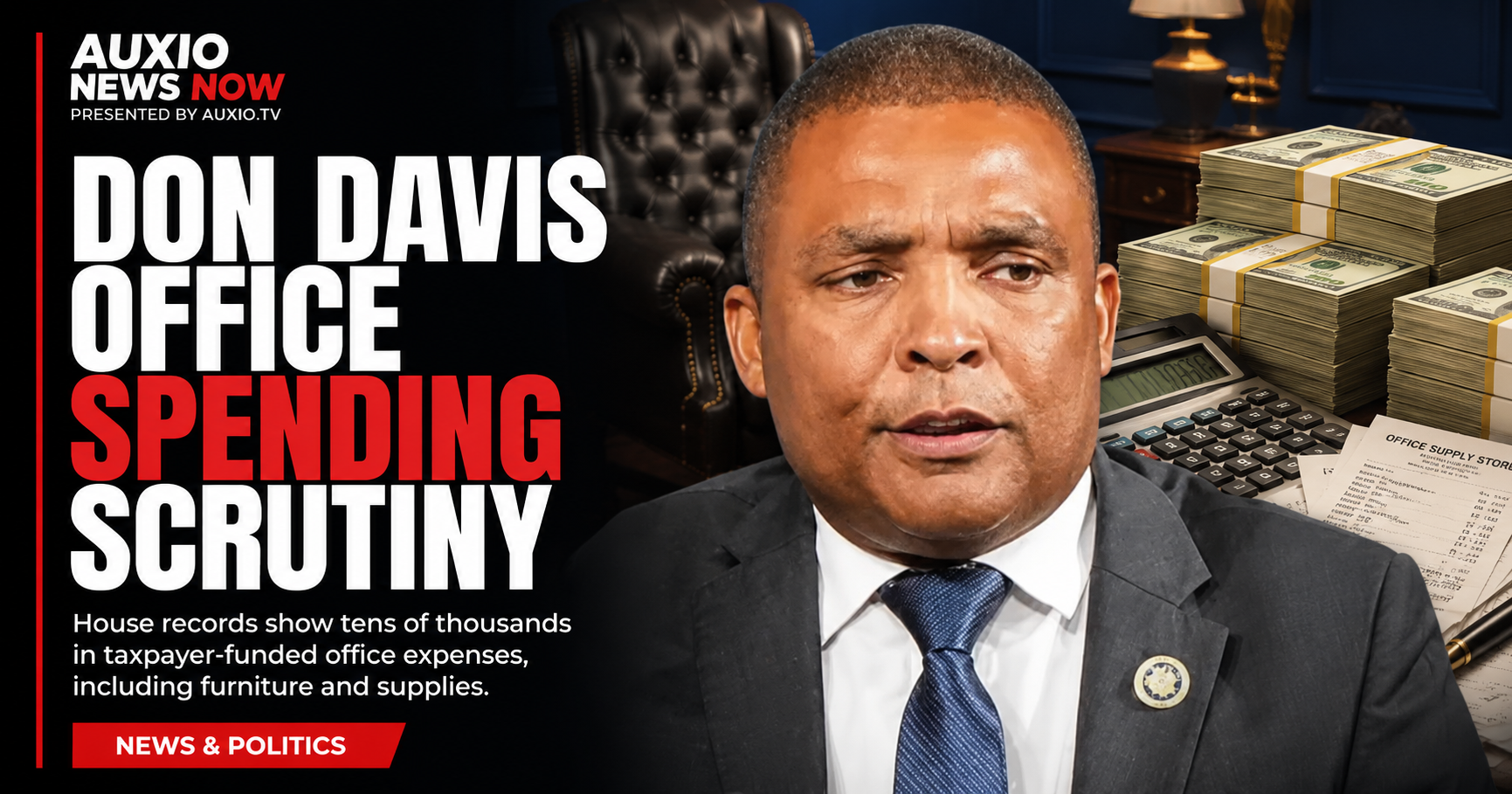
  • Don Davis Burned Through Tens of Thousands in Taxpayer-Funded Office Spending

    Don Davis Burned Through Tens of Thousands in Taxpayer-Funded Office Spending

    WASHINGTON — Rep. Don Davis’ first year in Congress came with a hefty taxpayer-funded office bill.

    Official House spending records show the North Carolina Democrat reported tens of thousands of dollars in office-related expenses in 2023, including substantial purchases categorized as habitation expenses, office supplies and furniture.

    The spending is drawing renewed scrutiny as Davis seeks to hold onto one of the most competitive congressional seats in the country.

    House records show that in the second quarter of 2023 alone, Davis’ office reported multiple large transactions with Taff Office, including $11,772.35 and $10,202 in “habitation expenses,” along with additional office-supply and furniture purchases. 

    The same disclosure shows furniture and fixture purchases of $3,588, $1,313 and $1,979, plus thousands more in office supplies. 

    The House defines a “habitation expense” as a category covering minor office decoration and lower-cost furniture items such as chairs and tables under $500. More expensive furniture is separately reported under furniture and fixtures. 

    That distinction matters because Davis’ records show spending in both categories, meaning the total office-related bill extended beyond small decorative purchases.

    The money came from Davis’ Members’ Representational Allowance, the taxpayer-funded budget each House member receives to operate congressional offices and perform official duties. The House says the allowance is intended to cover expenses such as equipment, supplies, subscriptions, technology and other official office costs. 

    Davis currently maintains offices in Washington, Elizabeth City, Rocky Mount and Goldsboro. 

    His office has defended the spending as part of the cost of establishing a new congressional operation and equipping multiple district offices.

    But the size of the purchases raises an obvious taxpayer question: how much office furnishing is reasonable for a first-term member of Congress?

    The issue is not whether members are legally permitted to furnish their offices. They are.

    The issue is whether spending tens of thousands of taxpayer dollars on furniture, decoration and supplies reflects the kind of fiscal restraint voters are entitled to expect from elected officials.

    For Davis, the optics are particularly difficult because the records do not describe a handful of incidental office purchases. They show multiple five-figure and four-figure transactions concentrated in the early months of his congressional tenure.

    The House disclosure system exists precisely so the public can scrutinize expenditures like these.

    And as Davis faces another high-profile election in North Carolina’s 1st Congressional District, those receipts provide opponents — and taxpayers — with a concrete record to examine.

    The Bottom Line

    Davis may argue the expenditures were necessary to establish congressional offices.

    But taxpayers can reasonably ask why setting up those offices required such a large bill for furnishings, supplies and expenses classified by the House as office “habitation.”

    The records themselves do not establish wrongdoing.

    They do, however, establish something much simpler:

    Congressman Don Davis spent a lot of taxpayer money outfitting his offices.

    And voters are entitled to decide whether they think they got their money’s worth.

  • New York’s $277 Billion Budget Raises a Bigger Question: Where Does the Spending Stop?

    New York’s $277 Billion Budget Raises a Bigger Question: Where Does the Spending Stop?

    Perspective | East End Now | Auxio.tv News

    New York’s latest state budget is estimated at $277 billion, up 7 percent from the previous year.

    That number alone does not prove waste. Government spends money on schools, Medicaid, childcare, infrastructure and other services people depend on.

    But the direction of travel is becoming harder to ignore.

    State Comptroller Thomas DiNapoli warned in July that New York’s financial plan now projects $31.8 billion in cumulative out-year budget gaps and expects spending to exceed receipts in each year of the plan. He also noted that state reserves were not increased despite the growing pressure. 

    The previous budget had already reached $254 billion, up 5.2 percent in a single year. State Operating Funds spending had grown at an average annual rate of 4.6 percent between 2019-20 and 2024-25, more than twice the pace of the preceding five-year period. Medicaid and school aid were among the biggest drivers. 

    That raises a legitimate policy question for taxpayers on Long Island:

    At what point does continued spending growth become structurally unsustainable?

    The issue is not simply partisan.

    New York has always been a high-spending state. But Democrats have controlled the governor’s office and both chambers of the Legislature since 2019, meaning there has been little institutional resistance in Albany when major spending packages move forward.

    One-party control does not automatically produce bad government. It does, however, reduce one of the traditional checks in a political system: the need to negotiate with an opposing legislative majority.

    That matters when spending is already rising faster than revenues over the long term.

    The contrast with Suffolk County is worth noting.

    Suffolk has had its own serious fiscal problems over the years. But in 2025, both Fitch and S&P assigned the County AA- ratings, citing stronger reserves, improved liquidity, conservative budgeting and better long-term financial management. Suffolk reported unrestricted general-fund reserves of about $276 million, while rating agencies also pointed to improved budgetary flexibility. 

    That does not mean Suffolk has solved every fiscal problem.

    It does show that governments can improve their financial position by building reserves, reducing reliance on one-time revenues and being more disciplined about long-term obligations.

    Albany faces a different challenge.

    The state is much larger, administers Medicaid and school aid on a scale counties do not, and remains highly exposed to federal funding decisions. Those differences matter.

    But they do not eliminate the underlying arithmetic.

    If spending consistently grows faster than recurring revenue, eventually government has only a few options: raise taxes, cut programs, borrow more, or find genuine efficiencies.

    For East End residents, that debate is not abstract.

    New York’s fiscal policy ultimately affects the tax environment in which families live, businesses operate and housing gets built. State mandates can also limit what counties and municipalities are able to change on their own.

    That is why the question is bigger than whether one particular program deserves funding.

    The question is whether Albany still has a working definition of enough.

    New York can make legitimate choices to spend heavily on public services.

    But every dollar government commits today becomes part of tomorrow’s baseline.

    And once spending becomes permanent, reducing it becomes politically much harder than increasing it in the first place.

    The state’s own Comptroller is now warning about long-term sustainability.

    That should be enough to make the issue worth taking seriously.

    East End Now — Your East End. Your News.