Tag: international_relations

  • HIPHOP 4EVA — Episode 1 | September 17, 2026

    HIPHOP 4EVA — Episode 1 | September 17, 2026

    HIPHOP 4EVA with Deb Carter makes its AUXIO.TV debut with a packed first episode featuring independent artists, DJs, freestyles and new music from across the hip-hop community.

    Episode 1 opens with “HH4EVA Back in 83” and the official theme by Lord Freedom The Chain Breaker, before Deb Carter takes listeners through this week’s lineup.

    Featured on the September 17 show:

    K. Davis the Hitman — “Freet”
    Ulysses Valor — New Release
    Million Dolla Smile — “Harlem”
    Kim Williams — “Injustice”
    Blackwell — “Curvy Season”
    Seize the Dai — “Donthegwop”
    DJ Last Exit — “14 DJs”
    Fatimah Patrice — Freestyle
    Lazaris Thetopdon — “Street Legends”
    DJ Lou Boogie — Mobb Deep Mix
    Focus631

    This episode also includes Heat of the Week, spotlighting artists connected to the Microphone Masters Showcase:

    Jamila Meter, Lonnie Lewis, Big Foot & Superstar Tommy, Just Cauz, ATM Bake, Johnnie Floss, BMC Smooth, Dubb Bankroll and Fatboy Izzo, brother of Fred the Godson.

    Dubb Bankroll was selected as the winner of the first annual Fred the Godson Award at the showcase.

    Press play below and hear the full episode.

    HIPHOP 4EVA
    Hosted by Deb Carter
    New episodes every Thursday at 5 PM
    AUXIO.TV/MUSIC

  • Blakeman Takes Local-Control Fight With Hochul Statewide

    Blakeman Takes Local-Control Fight With Hochul Statewide

    By Auxio News Now | Auxio.tv News

    Nassau County Executive Bruce Blakeman is taking a dispute over immigration enforcement and turning it into a broader argument about state power, public safety and local control.

    The immediate fight centers on New York’s move to block local law-enforcement agencies from maintaining certain formal cooperation agreements with U.S. Immigration and Customs Enforcement.

    Nassau County had participated in a federal 287(g) arrangement, which allows designated local officers to perform limited immigration-enforcement functions under federal supervision. After New York enacted restrictions on those agreements, Blakeman ended Nassau’s participation rather than defy state law.

    But he did not abandon the issue.

    Instead, Nassau has moved into the legal and political fight over whether Albany should be able to prevent counties from choosing that kind of cooperation with federal authorities.

    That gives Blakeman a useful campaign argument as he runs for governor.

    His case is straightforward: counties are responsible for public safety on the ground, yet Albany is increasingly setting limits on how those counties can work with federal law enforcement.

    Supporters of the state law see the issue differently.

    They argue local police should focus on criminal enforcement rather than civil immigration matters, and that close cooperation with ICE can discourage some immigrants from reporting crimes or cooperating with police.

    That is the policy divide.

    But Blakeman is trying to make the dispute about more than immigration.

    For him, the larger question is whether Albany should continue expanding its authority over decisions traditionally handled by counties and municipalities.

    That argument has resonance beyond Nassau County.

    Long Island officials regularly clash with the state over policing, housing, zoning, energy projects and other policies where local governments argue that statewide rules do not always reflect local conditions.

    Blakeman is positioning himself as the candidate willing to push back.

    His record in Nassau helps him make that case. He has emphasized police hiring, opposition to tax increases and a more aggressive approach to public safety while presenting county government as an alternative to Albany’s governing philosophy.

    The ICE dispute gives that message a specific example.

    Rather than simply arguing that New York’s immigration policy is too permissive, Blakeman can point to a situation in which a county chose one enforcement approach and the state government effectively took that option away.

    Whether the courts agree with that argument is a separate question.

    State government has broad authority to regulate municipalities, and home rule in New York has never meant that counties can disregard general state laws.

    Still, the political issue remains.

    How much discretion should local governments have when the people running those governments believe a statewide policy makes their communities less safe?

    Governor Kathy Hochul and Democratic lawmakers have taken the position that some rules should apply consistently across New York.

    Blakeman is arguing that greater local discretion is itself a form of accountability.

    If a county executive or sheriff makes the wrong call, local voters can respond.

    If the decision is made in Albany, responsibility becomes more distant.

    That is the contrast Blakeman is taking into the governor’s race.

    The fight may have started with ICE.

    It is becoming a much larger argument over who gets the final say in New York government.

    Auxio News Now | Auxio.tv News

  • Supreme Court Gives Trump Opening on California Mail Ballots — But the Legal Fight Is Far From Over

    Supreme Court Gives Trump Opening on California Mail Ballots — But the Legal Fight Is Far From Over

    The U.S. Supreme Court has given the Trump administration a significant procedural victory in its effort to impose new federal requirements on mail-in voting, including in California — but the Court did not decide that President Donald Trump’s policy is constitutional.

    That distinction matters.

    On August 24, the Supreme Court granted the administration’s request to temporarily lift a lower-court injunction that had blocked key portions of Trump’s election executive order from taking effect ahead of the 2026 midterm elections. (Supreme Court)

    The order stems from Trump’s March 31 executive action directing federal agencies to create new citizenship-verification procedures and requiring the U.S. Postal Service to develop nationwide standards for transmitting mail-in and absentee ballots. (The White House)

    Among other provisions, the order directed USPS to develop rules requiring official election-mail markings, unique tracking barcodes and state-specific lists identifying voters who would receive ballots through the mail. (The White House)

    For California, the stakes are substantial.

    Mail voting is not a minor part of the state’s election system. It is central to how California conducts elections, with active registered voters generally receiving ballots through the mail.

    California Attorney General Rob Bonta and a coalition of other states challenged Trump’s order, arguing that the Constitution gives states — subject to congressional authority — primary responsibility for administering federal elections.

    The Supreme Court’s August 24 decision did not resolve that argument.

    Instead, the Court concluded that the states’ earlier lawsuit was premature because the administration had not yet completed the steps necessary to implement the executive order when the case was brought. (California Attorney General)

    That is an important legal difference.

    The Court did not say Trump unquestionably possesses the authority to redesign the country’s mail-voting system.

    It said the challengers had gone to court too early.

    California immediately returned to court

    Once USPS issued its final rule implementing portions of Trump’s order, California and a coalition of other states filed a new lawsuit on August 26.

    The states argue that USPS is attempting to exercise powers Congress never gave it by requiring election officials to redesign ballot envelopes, submit voter information and comply with new federal procedures before ballots can move through the postal system. (California Attorney General)

    One day later, a federal district court temporarily blocked core portions of that rule for 14 days while it considers whether a longer preliminary injunction should be issued. (California Attorney General)

    So despite the Supreme Court victory for Trump earlier in the week, the practical status of the policy remains unsettled.

    That may sound contradictory.

    It is not.

    The Supreme Court addressed whether an earlier injunction should remain in place.

    The newest lawsuit challenges the actual USPS rule that now exists.

    Those are different legal questions.

    The larger issue is who controls elections

    The political debate is predictable.

    The Trump administration says the measures are designed to strengthen voter eligibility verification, improve ballot tracking and protect the integrity of federal elections. (The White House)

    California argues that the federal executive branch is attempting to take powers traditionally exercised by the states.

    The deeper constitutional question is not simply whether stricter election procedures are desirable.

    It is who has the lawful authority to impose them.

    The Constitution gives state legislatures responsibility for setting the “Times, Places and Manner” of congressional elections, while also giving Congress authority to alter those regulations.

    The President is not separately assigned that power.

    That is why this case matters beyond California.

    A policy can have an appealing objective and still raise legitimate questions about which branch of government has authority to accomplish it.

    Election integrity is important.

    So is constitutional structure.

    The two should not be confused.

    There is also a practical cost to changing election rules late

    Even if the administration ultimately prevails legally, another question remains: how quickly can a national election system be changed without creating new problems?

    California and other states are already deep into preparations for the November midterms.

    Changing envelope designs, voter-data procedures and postal requirements shortly before ballots are mailed can create administrative costs and potential voter confusion.

    On the other hand, the administration’s argument is that delaying security reforms simply because elections are approaching can become an excuse for never implementing them.

    Both concerns deserve to be measured by results.

    If new procedures improve ballot security while allowing eligible voters to cast ballots reliably, the administration will have strengthened its case.

    If the rules create widespread administrative disruption without producing measurable improvements in election integrity, the policy will be harder to defend.

    What the Supreme Court actually decided

    The most important point for voters is also the simplest:

    The Supreme Court has not ruled that Trump’s mail-ballot restrictions are constitutional.

    It allowed the administration to move forward after finding the states’ first challenge premature.

    California then challenged the actual USPS rule, and a federal court has temporarily blocked key parts of that rule while the case continues. (California Attorney General)

    The legal fight is therefore entering a new phase rather than ending.

    And as November approaches, the dispute may ultimately force the courts to answer a much larger question:

    How far can a president go in restructuring the mechanics of an election that the Constitution primarily places in the hands of states and Congress?

    That answer could matter long after the 2026 midterms are over.

    Auxio.tv News Now

  • LaLota Secures More Than $2 Million for Suffolk Law Enforcement

    LaLota Secures More Than $2 Million for Suffolk Law Enforcement

    Congressman Nick LaLota has secured more than $2 million in federal funding for Suffolk County law enforcement, directing new resources toward vehicle and fleet improvements for the Suffolk County Police Department and Suffolk County Sheriff’s Office.

    LaLota, who represents New York’s First Congressional District, announced that $2.025 million was included through the Fiscal Year 2026 federal appropriations process.

    The funding is expected to help local law enforcement replace and upgrade vehicles used for patrol, emergency response and other public-safety operations.

    For Suffolk County residents, the impact is practical.

    Police and sheriff’s vehicles are among the most heavily used pieces of equipment in local government. They accumulate significant mileage, operate under demanding conditions and require regular replacement.

    Federal funding for those vehicles can help modernize local fleets while reducing the amount that might otherwise have to be covered entirely by county taxpayers.

    LaLota has increasingly made that kind of district-level investment a central part of his work in Congress.

    Earlier this month, Suffolk County Executive Ed Romaine and LaLota announced progress on a new $20 million air traffic control tower at Francis S. Gabreski Airport in Westhampton Beach.

    Approximately $11 million in federal funding secured by LaLota is supporting that project.

    The new 146-foot tower will replace an aging structure dating back to 1943 and is expected to improve visibility, technology and reliability at one of the East End’s most important transportation facilities.

    Gabreski Airport supports more than 1,000 jobs and generates an estimated $116.1 million in regional economic activity, according to Suffolk County.

    Taken together, the law-enforcement funding and Gabreski investment highlight a broader pattern.

    LaLota has been focused on bringing federal dollars back to Suffolk County for projects with clear local impact — public safety, transportation, infrastructure and economic development.

    For a member of Congress, that is one of the most direct ways to demonstrate results.

    The politics of Washington can often feel distant from everyday life in Suffolk County.

    A new police vehicle, an upgraded sheriff’s fleet or a modernized airport tower is different.

    Residents can see it.

    Local agencies can use it.

    And the benefit remains in the district.

    For LaLota, the argument is straightforward: if Suffolk County taxpayers are sending money to Washington, he wants to make sure a meaningful share of those dollars comes back home.

    That is not an abstract policy debate.

    It is constituent service measured in infrastructure, equipment and public investment.

    And with more than $13 million in recent federal support tied to these projects alone, LaLota is building a record centered on delivering tangible resources to the First Congressional District.

    Auxio.tv News Now

  • Trump Declares National Emergency Over Foreign Threats to U.S. Power Grid

    Trump Declares National Emergency Over Foreign Threats to U.S. Power Grid

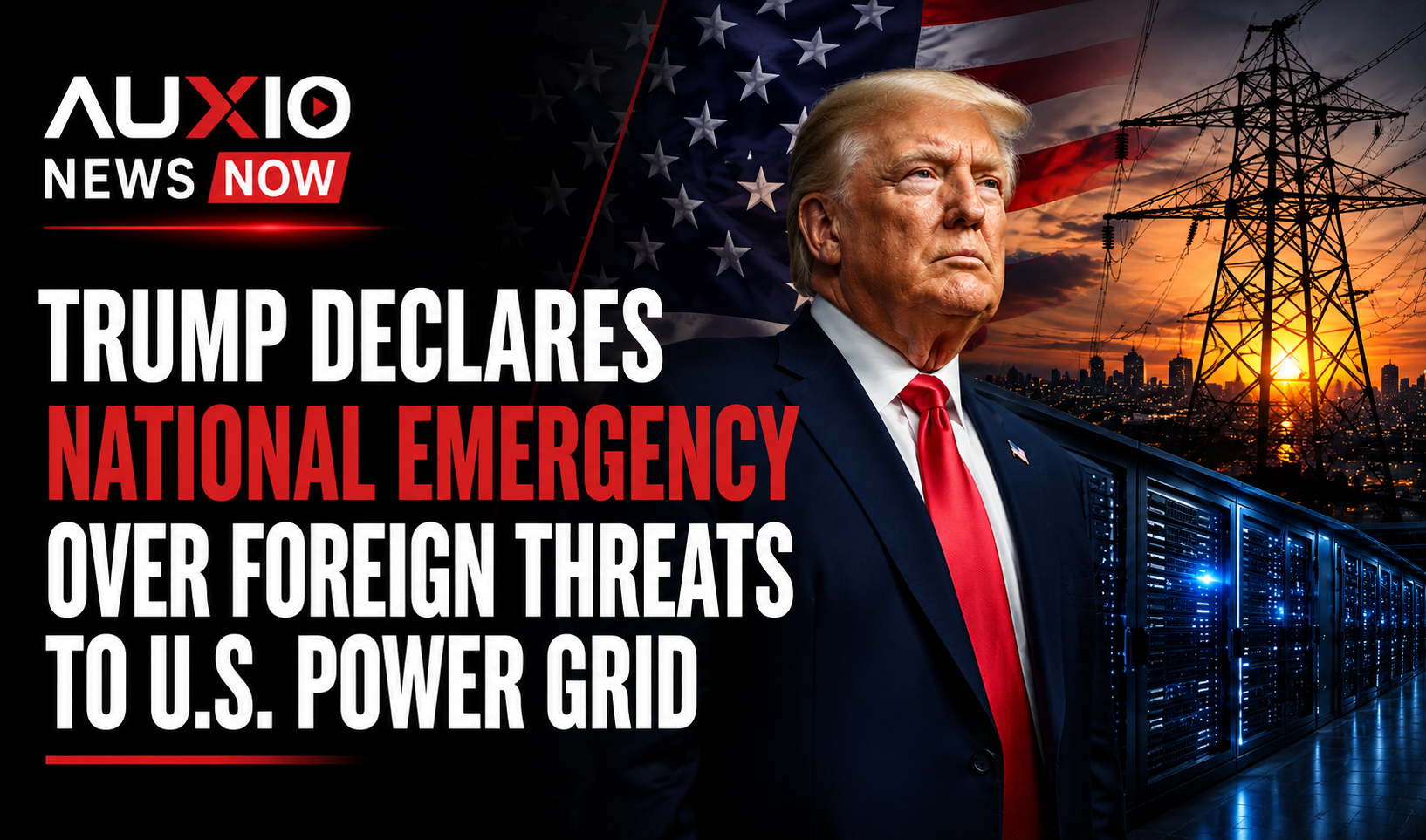
    President Donald Trump has declared a national emergency aimed at protecting the United States bulk-power system from foreign-produced equipment and technology that the White House says could create cybersecurity and operational vulnerabilities. Hi

    The executive order, signed Wednesday, authorizes restrictions on certain foreign-made equipment, software and digital capabilities used in the nation’s high-voltage electric grid when those products are determined to pose an unacceptable national-security risk. (The White House⁠)

    The White House says the concern is not hypothetical.

    The bulk-power system supports military installations, hospitals, emergency services, communications networks, financial systems, data centers and virtually every other part of the modern economy. A successful attack or remotely triggered disruption could therefore create consequences far beyond a temporary power outage. (The White House⁠)

    The issue is bigger than electricity

    Most Americans rarely think about where the equipment inside the electric grid was manufactured.

    Transformers, control systems, software and other components generally become visible to the public only when something fails.

    That invisibility can create a policy problem.

    A lower-cost foreign component may save money when it is purchased. But if that component creates a cybersecurity vulnerability, dependence on an adversarial supplier or an inability to obtain replacement parts during a crisis, the original purchase price did not capture the full cost.

    The Trump administration is effectively arguing that national-security risk must now be included in that calculation.

    Under the new order, the Secretary of Energy is directed to identify foreign-produced bulk-power equipment that could present security risks and determine when purchases, transfers or installations should be prohibited or subjected to additional conditions. (The White House⁠)

    A national-security strategy with an economic cost

    There is an obvious tradeoff.

    Restricting foreign equipment can strengthen domestic supply chains and reduce dependence on potentially hostile governments.

    It can also increase costs.

    If American utilities have fewer suppliers to choose from, certain transformers, electrical components and digital systems may become more expensive or take longer to obtain.

    That matters at a time when the electrical grid is already facing growing demand.

    The Department of Energy has warned separately that regions of the country face increasing reliability challenges as electricity consumption rises, with data centers and other large industrial users contributing to significant load growth. DOE has also cited supply-chain constraints involving critical equipment such as large transformers and natural-gas turbines. (The Department of Energy’s Energy.gov⁠)

    The policy question is therefore not whether protecting the grid has a cost.

    It does.

    The relevant question is whether paying more for secure infrastructure today reduces the probability of paying a much larger price later.

    The grid is becoming strategic infrastructure

    The administration’s decision reflects a broader change in how electricity infrastructure is viewed.

    For decades, the grid was primarily treated as an engineering and utility issue.

    Today, electricity is inseparable from national security.

    Artificial intelligence, cloud computing, military communications, advanced manufacturing, banking and telecommunications all depend on reliable power.

    And as more of the grid becomes digitally connected, physical infrastructure and cybersecurity increasingly become the same issue.

    Foreign access to software, control systems or critical components could potentially create vulnerabilities that did not exist when the electrical system was largely mechanical.

    Trump’s order is intended to reduce that exposure.

    The real test comes next

    Declaring an emergency is relatively straightforward.

    Replacing vulnerable equipment is not.

    Transformers and other grid components can be expensive, specialized and difficult to manufacture quickly. Building more domestic production capacity takes capital, skilled workers and time.

    If restrictions are imposed faster than alternative suppliers become available, utilities could face delays or higher costs.

    If restrictions move too slowly, the security vulnerabilities identified by the administration could remain in place.

    That is the balance policymakers now have to manage.

    The success of this policy will not ultimately be measured by how aggressively Washington describes the foreign threat.

    It will be measured by whether the United States ends up with a grid that is more secure, more reliable and less dependent on potentially hostile suppliers — without creating shortages that undermine the system the policy is intended to protect.

    In critical infrastructure, the cheapest component is not always the least expensive one.

    Sometimes the real cost only becomes visible when it fails.

    Auxio.tv News Now

  • CHARLOTTE TAKES HARDER LOOK AT DATA CENTER GROWTH

    CHARLOTTE TAKES HARDER LOOK AT DATA CENTER GROWTH

    Charlotte is taking a closer look at the rapid growth of data centers and the pressure those facilities can place on neighborhoods, infrastructure and public resources.

    The city has created a Data Centers Community Task Force that will meet seven times to develop policy recommendations intended to reduce community impacts and better align future data center development with residents’ daily lives. The group includes council-appointed community members along with technical and industry experts. (Charlotte NC Government⁠)

    The move comes as Charlotte operates under a temporary moratorium on new data centers.

    City Council approved the moratorium on June 8, setting aside 150 days for research, public input and possible policy changes. The first phase focused on studying the impacts of data centers and examining how other communities regulate them. The second phase, which began August 23, is focused on drafting potential code or policy changes that could go before City Council before the moratorium expires on November 5. (Charlotte NC Government⁠)

    Charlotte has also launched a public survey asking residents to rank their concerns and priorities surrounding data centers. The survey will remain open through October 2. (Charlotte NC Government⁠)

    A second task force meeting is scheduled for August 27 at the Charlotte-Mecklenburg Government Center. Residents can attend, and recordings of the meetings are being made available by the city. (Charlotte NC Government⁠)

    Why the issue matters

    Data centers are often discussed as economic development projects.

    They bring investment, construction activity and demand for specialized infrastructure.

    But they also consume substantial amounts of electricity, require significant utility capacity and can create conflicts over land use, water, noise, transportation and neighborhood compatibility.

    Charlotte officials have already identified concerns around grid capacity, supply chains, labor availability and community impact as the city studies the issue. (Charlotte NC Government⁠)

    That creates a familiar policy tradeoff.

    A city can benefit from new investment while still asking whether the long-term infrastructure costs are being properly accounted for.

    The presence of private capital does not automatically mean the public cost is zero.

    If a large industrial user requires new transmission capacity, road improvements, utility upgrades or other public infrastructure, the relevant question is not simply how much money is being invested.

    It is also who ultimately pays for the infrastructure required to support that investment.

    Charlotte is trying to answer that question before growth accelerates

    The city says the task force will prepare recommendations designed to reduce the impact of data centers on the community.

    Charlotte is also planning broader public-engagement sessions in September before any draft policy moves toward a formal hearing and City Council vote. (Charlotte NC Government⁠)

    That is a more important development than the creation of another advisory committee might initially suggest.

    Data centers are becoming a central part of the modern economy. Artificial intelligence, cloud computing, streaming, financial services and countless other digital products depend on them.

    Cities therefore have an incentive to attract them.

    But economic development is not simply a contest to see which city can approve the most projects.

    The quality of a development strategy depends on whether the benefits exceed the costs.

    Charlotte’s challenge is to create rules that allow productive investment without forcing surrounding communities to absorb disproportionate infrastructure or quality-of-life impacts.

    Too much regulation could discourage investment.

    Too little could leave taxpayers and neighborhoods carrying costs that were never adequately considered when projects were approved.

    The task force now has to find the line between those two outcomes.

    For Charlotte, the real question is not whether data centers are good or bad.

    It is whether the city can capture their economic benefits while making sure the costs they create are visible, measurable and appropriately assigned.

    That is the debate now underway.

    Auxio.tv News Now

  • TRUMP–CANADA TRADE FIGHT ESCALATES — BUT WHO ACTUALLY PAYS?

    TRUMP–CANADA TRADE FIGHT ESCALATES — BUT WHO ACTUALLY PAYS?

    The trade dispute between the United States and Canada has entered a more serious phase.

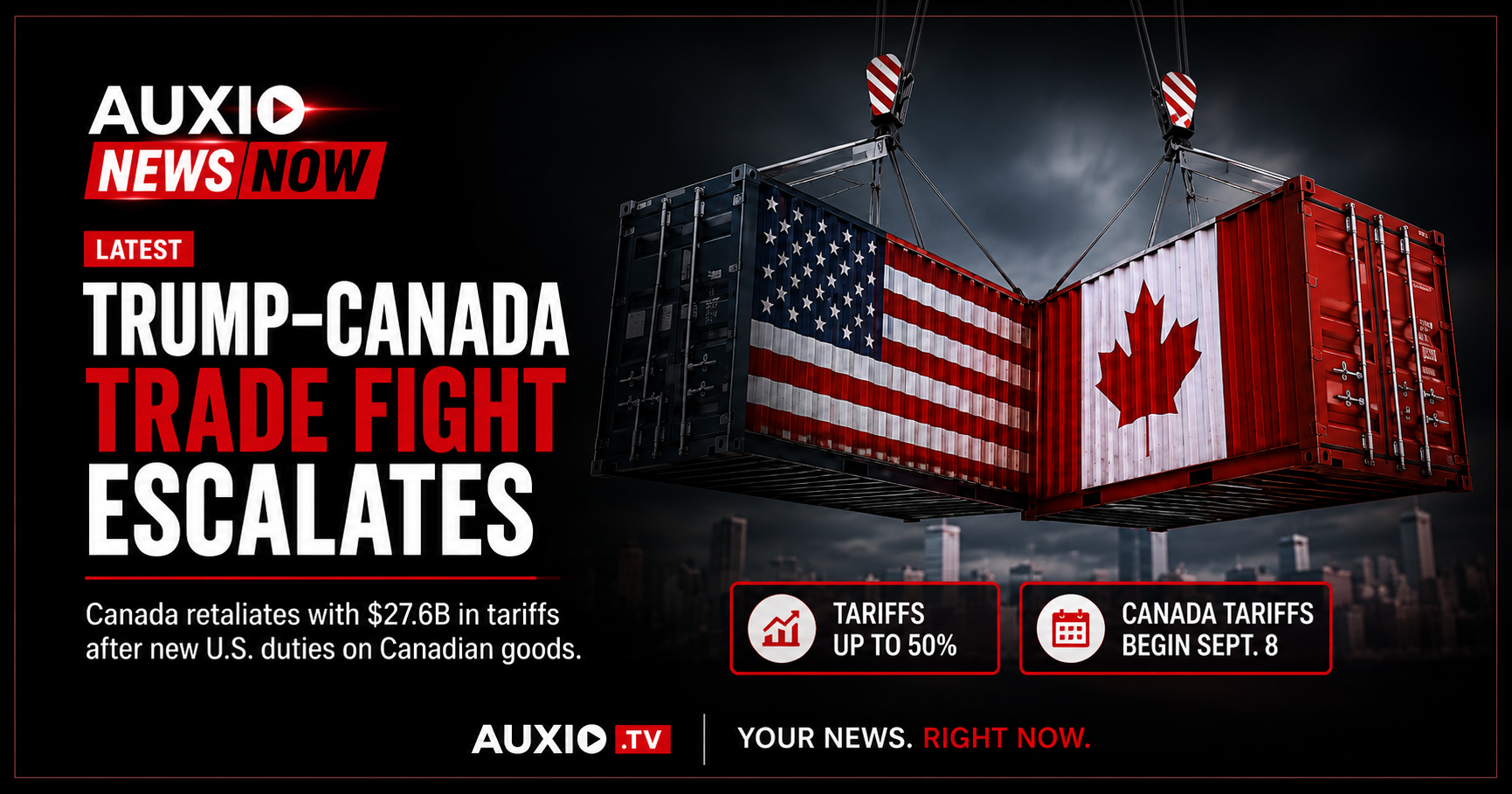
    President Donald Trump’s administration has imposed additional tariffs of up to 50% on certain Canadian goods, arguing that Canada has imposed discriminatory trade barriers against American products, including dairy and motor vehicles. The White House says the tariffs are intended to offset what it considers unfair treatment of U.S. commerce and create greater opportunities for American producers. (The White House)

    Canada responded Tuesday by announcing that it will impose its own tariffs on $27.6 billion worth of U.S. goods, matching the new American measures dollar for dollar.

    Beginning September 8, Canada says it will apply tariffs of 15%, 25% and 50% to products including steel, dairy, appliances, agricultural equipment, pulp and paper, and electronics. (Canada)

    The political argument is straightforward.

    The Trump administration says Canada has enjoyed favorable access to the American market while maintaining barriers that disadvantage U.S. businesses. The White House argues that higher tariffs give the United States leverage to force a more balanced trading relationship. (The White House)

    Canada sees the dispute differently.

    The Canadian government says negotiations broke down after the United States demanded terms Ottawa considered unacceptable. Rather than agree, Canada suspended negotiations and chose retaliation. (Canada)

    But beneath the political language is a more important economic question:

    Who actually pays?

    A tariff is imposed on an imported product when it enters a country.

    That means the immediate cost is paid by the importer.

    What happens next depends on the market.

    A business can absorb the added expense. It can seek a cheaper supplier. It can reduce another cost. Or it can raise the price charged to customers.

    That distinction matters because tariffs are often discussed as though the exporting country simply sends money to the government imposing them.

    The actual economics are more complicated.

    The Trump administration is betting that access to the enormous U.S. consumer market gives Washington enough leverage to force Canada to change its policies.

    That strategy could work.

    If Canadian companies cannot easily replace American customers, the pressure may eventually become strong enough to produce concessions.

    But there is another side to the equation.

    American companies that rely on Canadian materials or products may also face higher costs.

    And now that Canada is retaliating, American exporters could face the same problem when attempting to sell into the Canadian market.

    Canada’s response illustrates that trade conflicts rarely remain confined to the industries governments initially intend to protect.

    Steel producers may benefit from less foreign competition while companies that use steel face more expensive inputs.

    A domestic dairy producer may gain protection from Canadian competition while another American business loses access to Canadian customers because of retaliation.

    Both outcomes can occur simultaneously.

    That is why the success of the Trump strategy cannot ultimately be measured by the size of the tariff itself.

    It has to be measured by what the United States receives in return.

    If the pressure produces better access for American producers, greater domestic investment and meaningful changes in Canadian trade policy, the administration will have a strong case that the short-term disruption produced a long-term economic benefit.

    If the result is simply higher costs on both sides of the border and a prolonged cycle of retaliation, then the appearance of economic toughness will matter considerably less.

    Canada’s own actions demonstrate that it expects the dispute to carry domestic costs. Ottawa has announced billions of dollars in support for Canadian workers and businesses affected by the trade confrontation. (Canada)

    That is an important reminder.

    Governments can impose tariffs.

    They cannot eliminate the economic consequences of doing so.

    The real test of Trump’s Canada strategy is therefore not whether the policy sounds tough.

    It is whether the eventual benefits exceed the costs required to obtain them.

    That answer will come from results, not rhetoric.