Tag: community_safety

  • Interior Sets New Colorado River Rules as West Faces Long-Term Water Pressure

    Interior Sets New Colorado River Rules as West Faces Long-Term Water Pressure

    By Auxio.tv News | August 29, 2026

    The U.S. Department of the Interior has finalized new operating rules for the Colorado River, setting the framework for how Lake Powell and Lake Mead will be managed through a period of historically low water levels.

    The new 2027–2028 Operating Guidelines also establish a broader 10-year decision framework for future river operations. Interior says the goal is to protect critical infrastructure, preserve water deliveries and give the seven Colorado River Basin states more flexibility to respond to worsening drought conditions. 

    The need is obvious.

    Interior says the combined contents of Lake Powell and Lake Mead are now at levels not seen since before Lake Powell began filling in the 1960s. The Colorado River serves more than 40 million people, supports 5.5 million acres of farmland, provides hydropower across seven states and remains vital to 30 tribes and two Mexican states. 

    Under the new rules, Lake Powell releases will be tied more closely to actual hydrology, with an effort to keep the reservoir at or above 3,510 feet to protect operations at Glen Canyon Dam.

    For 2027, Lake Mead deliveries to Lower Basin states are expected to be reduced by 1.25 million acre-feet. 

    That is where the tradeoff becomes clear.

    Water cannot be allocated by political preference alone when the river itself is producing less of it.

    Every gallon preserved in one reservoir is a gallon that cannot be used somewhere else at the same time.

    Agriculture, cities, tribes, hydropower and environmental needs are all competing for the same limited supply.

    Interior’s new framework does not eliminate that conflict.

    It creates a structure for managing it.

    The department is emphasizing voluntary agreements, conservation, coordinated reservoir operations and additional flexibility for storing and moving conserved water. It also leaves room for the Basin states to continue negotiating longer-term agreements during the next several years. 

    That may be the most important part of the policy.

    The federal government can set operating rules.

    It cannot create water that is not there.

    The success of the new framework will therefore depend on whether states, tribes and major water users can adapt faster than reservoir conditions deteriorate.

    For the West, the real issue is no longer whether shortages are coming.

    They are already here.

    The question is how those shortages will be divided — and whether the system can remain reliable while doing it.

    Auxio.tv News Now

  • New York Sheriffs Take Hochul to Court Over ICE Cooperation Ban

    New York Sheriffs Take Hochul to Court Over ICE Cooperation Ban

    By Auxio.tv News | August 29, 2026

    Fifteen New York county sheriffs are challenging a new state law that blocks local law-enforcement agencies from maintaining formal 287(g) agreements with U.S. Immigration and Customs Enforcement.

    The law, known as the Local Cops, Local Crimes Act, was signed by Gov. Kathy Hochul in May. It prohibits state and local agencies from entering into or remaining in agreements that allow local officers to perform certain federal civil immigration-enforcement functions. Existing agreements had to be terminated by August 25. 

    The sheriffs filed suit on August 25, arguing that Albany should not be able to prevent locally elected law-enforcement officials from cooperating with federal immigration authorities. Hochul and Attorney General Letitia James have defended the law and say local police resources should remain focused on local crime rather than federal civil immigration enforcement. 

    That disagreement gets to a larger issue than immigration alone.

    The question is who gets to decide how local law enforcement uses its authority.

    Sheriffs are elected locally. Albany writes state law. Immigration enforcement is primarily a federal responsibility.

    When those three levels of government disagree, the dispute quickly becomes one of institutional power.

    New York has already begun enforcing the law. On August 27, James and Hochul sued the Rensselaer County Sheriff’s Office, saying it failed to terminate its 287(g) agreement by the deadline. The state says Rensselaer was the only one of the 12 agencies with preexisting agreements that had not indicated it would comply. 

    The state also won an early court victory earlier this month. On August 3, a federal judge declined to issue a preliminary injunction blocking New York’s 287(g) ban in a separate challenge brought by the federal government. 

    That does not end the current sheriffs’ lawsuit.

    It does show that the legal fight has already moved beyond political rhetoric.

    For Hochul, the argument is that local police should not be diverted into federal immigration work.

    For the sheriffs, the issue is whether the state can prevent elected local law-enforcement officials from voluntarily assisting federal authorities.

    Both sides are now asking the courts to decide where that authority begins and ends.

    The practical question is just as important as the constitutional one:

    If local agencies believe cooperation with ICE makes their communities safer, should Albany be able to stop them?

    Or does allowing each county to set its own immigration-enforcement policy create a patchwork the state has a legitimate interest in controlling?

    That is the dispute now moving through the courts.

    Auxio.tv News Now

  • Missing Paddleboarder Found Safe After Multi-Agency Search on Peconic Bay

    Missing Paddleboarder Found Safe After Multi-Agency Search on Peconic Bay

    A paddleboarder reported missing after leaving South Jamesport Beach was found safe following a large multi-agency search on Peconic Bay.

    According to information released by the Riverhead Police Department, authorities received a 911 call at approximately 3:56 p.m. on August 26 reporting that a paddleboarder had gone out from South Jamesport Beach and had not returned.

    The Riverhead Police Department Dive/Rescue Team responded, and multiple agencies joined the search.

    Those agencies included the U.S. Coast Guard, Suffolk County Police Aviation, New York State Police Marine Unit, Southampton Town Police, Southold Town Police, Riverhead Police, local fire departments and the Riverhead Volunteer Ambulance Company.

    The paddleboarder was ultimately located near Peconic Bay Boulevard and Wendy Drive and was reported to be in good health.

    Authorities did not release additional details about what caused the paddleboarder to become separated from the original launch location.

    The incident demonstrates the scale of coordination that can occur when someone is reported missing on East End waters.

    Marine units, aviation resources, police departments and volunteer emergency services from several jurisdictions were mobilized during the search.

    In this case, that coordinated response ended with the outcome everyone hoped for: the missing person was located safely.

    East End Now — Your East End. Your News.

  • Supreme Court Gives Trump Opening on California Mail Ballots — But the Legal Fight Is Far From Over

    Supreme Court Gives Trump Opening on California Mail Ballots — But the Legal Fight Is Far From Over

    The U.S. Supreme Court has given the Trump administration a significant procedural victory in its effort to impose new federal requirements on mail-in voting, including in California — but the Court did not decide that President Donald Trump’s policy is constitutional.

    That distinction matters.

    On August 24, the Supreme Court granted the administration’s request to temporarily lift a lower-court injunction that had blocked key portions of Trump’s election executive order from taking effect ahead of the 2026 midterm elections. (Supreme Court)

    The order stems from Trump’s March 31 executive action directing federal agencies to create new citizenship-verification procedures and requiring the U.S. Postal Service to develop nationwide standards for transmitting mail-in and absentee ballots. (The White House)

    Among other provisions, the order directed USPS to develop rules requiring official election-mail markings, unique tracking barcodes and state-specific lists identifying voters who would receive ballots through the mail. (The White House)

    For California, the stakes are substantial.

    Mail voting is not a minor part of the state’s election system. It is central to how California conducts elections, with active registered voters generally receiving ballots through the mail.

    California Attorney General Rob Bonta and a coalition of other states challenged Trump’s order, arguing that the Constitution gives states — subject to congressional authority — primary responsibility for administering federal elections.

    The Supreme Court’s August 24 decision did not resolve that argument.

    Instead, the Court concluded that the states’ earlier lawsuit was premature because the administration had not yet completed the steps necessary to implement the executive order when the case was brought. (California Attorney General)

    That is an important legal difference.

    The Court did not say Trump unquestionably possesses the authority to redesign the country’s mail-voting system.

    It said the challengers had gone to court too early.

    California immediately returned to court

    Once USPS issued its final rule implementing portions of Trump’s order, California and a coalition of other states filed a new lawsuit on August 26.

    The states argue that USPS is attempting to exercise powers Congress never gave it by requiring election officials to redesign ballot envelopes, submit voter information and comply with new federal procedures before ballots can move through the postal system. (California Attorney General)

    One day later, a federal district court temporarily blocked core portions of that rule for 14 days while it considers whether a longer preliminary injunction should be issued. (California Attorney General)

    So despite the Supreme Court victory for Trump earlier in the week, the practical status of the policy remains unsettled.

    That may sound contradictory.

    It is not.

    The Supreme Court addressed whether an earlier injunction should remain in place.

    The newest lawsuit challenges the actual USPS rule that now exists.

    Those are different legal questions.

    The larger issue is who controls elections

    The political debate is predictable.

    The Trump administration says the measures are designed to strengthen voter eligibility verification, improve ballot tracking and protect the integrity of federal elections. (The White House)

    California argues that the federal executive branch is attempting to take powers traditionally exercised by the states.

    The deeper constitutional question is not simply whether stricter election procedures are desirable.

    It is who has the lawful authority to impose them.

    The Constitution gives state legislatures responsibility for setting the “Times, Places and Manner” of congressional elections, while also giving Congress authority to alter those regulations.

    The President is not separately assigned that power.

    That is why this case matters beyond California.

    A policy can have an appealing objective and still raise legitimate questions about which branch of government has authority to accomplish it.

    Election integrity is important.

    So is constitutional structure.

    The two should not be confused.

    There is also a practical cost to changing election rules late

    Even if the administration ultimately prevails legally, another question remains: how quickly can a national election system be changed without creating new problems?

    California and other states are already deep into preparations for the November midterms.

    Changing envelope designs, voter-data procedures and postal requirements shortly before ballots are mailed can create administrative costs and potential voter confusion.

    On the other hand, the administration’s argument is that delaying security reforms simply because elections are approaching can become an excuse for never implementing them.

    Both concerns deserve to be measured by results.

    If new procedures improve ballot security while allowing eligible voters to cast ballots reliably, the administration will have strengthened its case.

    If the rules create widespread administrative disruption without producing measurable improvements in election integrity, the policy will be harder to defend.

    What the Supreme Court actually decided

    The most important point for voters is also the simplest:

    The Supreme Court has not ruled that Trump’s mail-ballot restrictions are constitutional.

    It allowed the administration to move forward after finding the states’ first challenge premature.

    California then challenged the actual USPS rule, and a federal court has temporarily blocked key parts of that rule while the case continues. (California Attorney General)

    The legal fight is therefore entering a new phase rather than ending.

    And as November approaches, the dispute may ultimately force the courts to answer a much larger question:

    How far can a president go in restructuring the mechanics of an election that the Constitution primarily places in the hands of states and Congress?

    That answer could matter long after the 2026 midterms are over.

    Auxio.tv News Now

  • LaLota Secures More Than $2 Million for Suffolk Law Enforcement

    LaLota Secures More Than $2 Million for Suffolk Law Enforcement

    Congressman Nick LaLota has secured more than $2 million in federal funding for Suffolk County law enforcement, directing new resources toward vehicle and fleet improvements for the Suffolk County Police Department and Suffolk County Sheriff’s Office.

    LaLota, who represents New York’s First Congressional District, announced that $2.025 million was included through the Fiscal Year 2026 federal appropriations process.

    The funding is expected to help local law enforcement replace and upgrade vehicles used for patrol, emergency response and other public-safety operations.

    For Suffolk County residents, the impact is practical.

    Police and sheriff’s vehicles are among the most heavily used pieces of equipment in local government. They accumulate significant mileage, operate under demanding conditions and require regular replacement.

    Federal funding for those vehicles can help modernize local fleets while reducing the amount that might otherwise have to be covered entirely by county taxpayers.

    LaLota has increasingly made that kind of district-level investment a central part of his work in Congress.

    Earlier this month, Suffolk County Executive Ed Romaine and LaLota announced progress on a new $20 million air traffic control tower at Francis S. Gabreski Airport in Westhampton Beach.

    Approximately $11 million in federal funding secured by LaLota is supporting that project.

    The new 146-foot tower will replace an aging structure dating back to 1943 and is expected to improve visibility, technology and reliability at one of the East End’s most important transportation facilities.

    Gabreski Airport supports more than 1,000 jobs and generates an estimated $116.1 million in regional economic activity, according to Suffolk County.

    Taken together, the law-enforcement funding and Gabreski investment highlight a broader pattern.

    LaLota has been focused on bringing federal dollars back to Suffolk County for projects with clear local impact — public safety, transportation, infrastructure and economic development.

    For a member of Congress, that is one of the most direct ways to demonstrate results.

    The politics of Washington can often feel distant from everyday life in Suffolk County.

    A new police vehicle, an upgraded sheriff’s fleet or a modernized airport tower is different.

    Residents can see it.

    Local agencies can use it.

    And the benefit remains in the district.

    For LaLota, the argument is straightforward: if Suffolk County taxpayers are sending money to Washington, he wants to make sure a meaningful share of those dollars comes back home.

    That is not an abstract policy debate.

    It is constituent service measured in infrastructure, equipment and public investment.

    And with more than $13 million in recent federal support tied to these projects alone, LaLota is building a record centered on delivering tangible resources to the First Congressional District.

    Auxio.tv News Now

  • Riverhead Man Charged With DWI After Southampton Police Stop in Flanders

    Riverhead Man Charged With DWI After Southampton Police Stop in Flanders

    Southampton Town Police arrested a Riverhead man Monday after officers say he was driving while intoxicated in Flanders.

    Police identified the driver as Carlos Putulcoc, 40, of Riverhead.

    According to an amended Southampton Town Police Department release, a patrol officer stopped Putulcoc’s vehicle near Temple Avenue in the hamlet of Flanders after observing multiple alleged violations of New York State Vehicle and Traffic Law. (Southampton Town⁠)

    Police say the subsequent investigation determined that Putulcoc was operating the vehicle while intoxicated by alcohol.

    He was arrested and charged with Driving While Intoxicated, a misdemeanor, along with multiple traffic violations. (Southampton Town⁠)

    Putulcoc was processed at Southampton Town Police Headquarters and held for morning arraignment.

    The department did not provide additional details in the release about what specific traffic violations prompted the stop or Putulcoc’s alleged blood-alcohol level.

    The arrest comes as Southampton Town Police continue traffic enforcement across the East End during the busy summer season.

    A DWI charge is an allegation. Putulcoc is presumed innocent unless and until proven guilty in court.

    East End Now — Your East End. Your News.

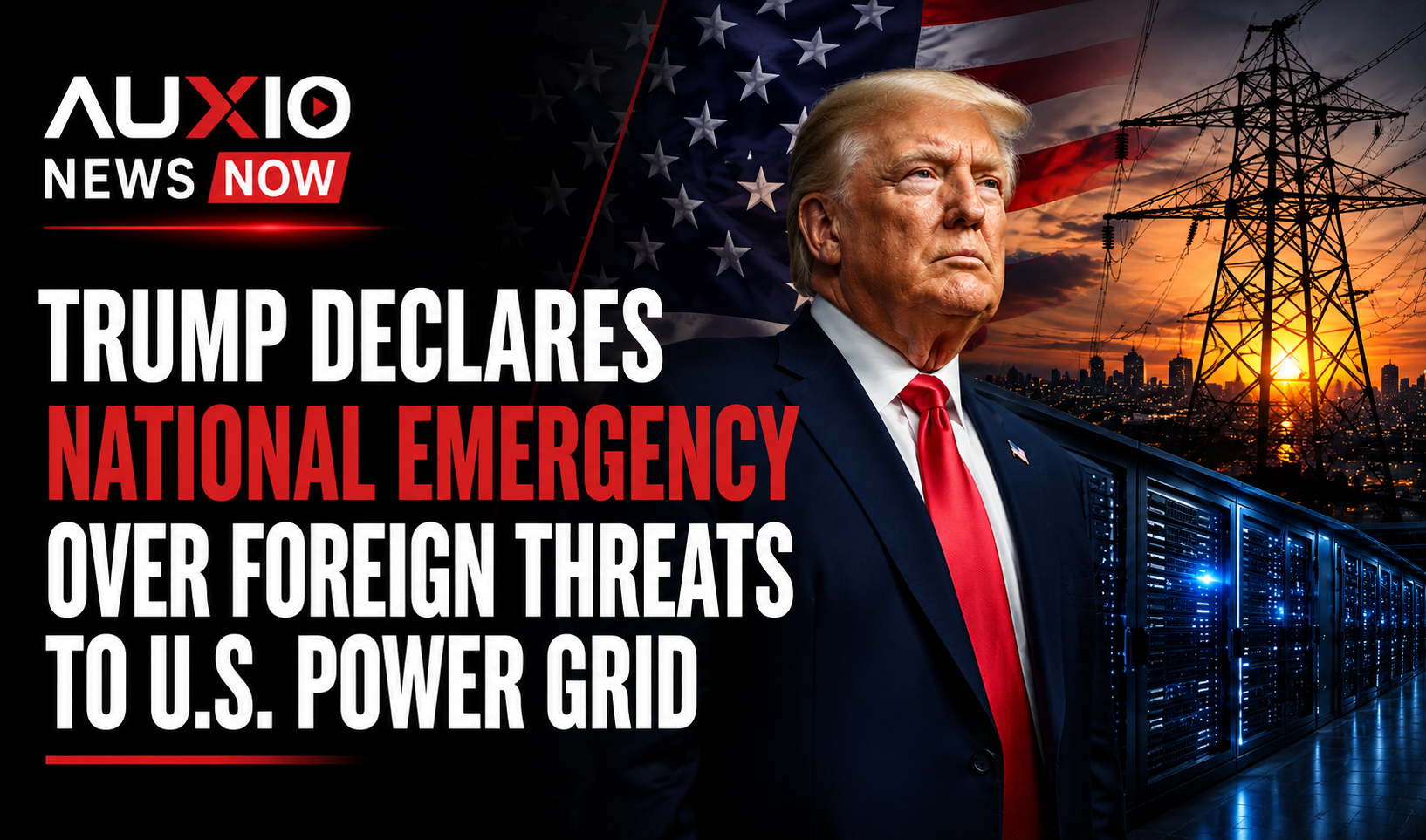
  • Trump Declares National Emergency Over Foreign Threats to U.S. Power Grid

    Trump Declares National Emergency Over Foreign Threats to U.S. Power Grid

    President Donald Trump has declared a national emergency aimed at protecting the United States bulk-power system from foreign-produced equipment and technology that the White House says could create cybersecurity and operational vulnerabilities. Hi

    The executive order, signed Wednesday, authorizes restrictions on certain foreign-made equipment, software and digital capabilities used in the nation’s high-voltage electric grid when those products are determined to pose an unacceptable national-security risk. (The White House⁠)

    The White House says the concern is not hypothetical.

    The bulk-power system supports military installations, hospitals, emergency services, communications networks, financial systems, data centers and virtually every other part of the modern economy. A successful attack or remotely triggered disruption could therefore create consequences far beyond a temporary power outage. (The White House⁠)

    The issue is bigger than electricity

    Most Americans rarely think about where the equipment inside the electric grid was manufactured.

    Transformers, control systems, software and other components generally become visible to the public only when something fails.

    That invisibility can create a policy problem.

    A lower-cost foreign component may save money when it is purchased. But if that component creates a cybersecurity vulnerability, dependence on an adversarial supplier or an inability to obtain replacement parts during a crisis, the original purchase price did not capture the full cost.

    The Trump administration is effectively arguing that national-security risk must now be included in that calculation.

    Under the new order, the Secretary of Energy is directed to identify foreign-produced bulk-power equipment that could present security risks and determine when purchases, transfers or installations should be prohibited or subjected to additional conditions. (The White House⁠)

    A national-security strategy with an economic cost

    There is an obvious tradeoff.

    Restricting foreign equipment can strengthen domestic supply chains and reduce dependence on potentially hostile governments.

    It can also increase costs.

    If American utilities have fewer suppliers to choose from, certain transformers, electrical components and digital systems may become more expensive or take longer to obtain.

    That matters at a time when the electrical grid is already facing growing demand.

    The Department of Energy has warned separately that regions of the country face increasing reliability challenges as electricity consumption rises, with data centers and other large industrial users contributing to significant load growth. DOE has also cited supply-chain constraints involving critical equipment such as large transformers and natural-gas turbines. (The Department of Energy’s Energy.gov⁠)

    The policy question is therefore not whether protecting the grid has a cost.

    It does.

    The relevant question is whether paying more for secure infrastructure today reduces the probability of paying a much larger price later.

    The grid is becoming strategic infrastructure

    The administration’s decision reflects a broader change in how electricity infrastructure is viewed.

    For decades, the grid was primarily treated as an engineering and utility issue.

    Today, electricity is inseparable from national security.

    Artificial intelligence, cloud computing, military communications, advanced manufacturing, banking and telecommunications all depend on reliable power.

    And as more of the grid becomes digitally connected, physical infrastructure and cybersecurity increasingly become the same issue.

    Foreign access to software, control systems or critical components could potentially create vulnerabilities that did not exist when the electrical system was largely mechanical.

    Trump’s order is intended to reduce that exposure.

    The real test comes next

    Declaring an emergency is relatively straightforward.

    Replacing vulnerable equipment is not.

    Transformers and other grid components can be expensive, specialized and difficult to manufacture quickly. Building more domestic production capacity takes capital, skilled workers and time.

    If restrictions are imposed faster than alternative suppliers become available, utilities could face delays or higher costs.

    If restrictions move too slowly, the security vulnerabilities identified by the administration could remain in place.

    That is the balance policymakers now have to manage.

    The success of this policy will not ultimately be measured by how aggressively Washington describes the foreign threat.

    It will be measured by whether the United States ends up with a grid that is more secure, more reliable and less dependent on potentially hostile suppliers — without creating shortages that undermine the system the policy is intended to protect.

    In critical infrastructure, the cheapest component is not always the least expensive one.

    Sometimes the real cost only becomes visible when it fails.

    Auxio.tv News Now

  • Suffolk Taxi Driver Arrested After Police Say He Was Driving With 37 License Suspensions

    Suffolk Taxi Driver Arrested After Police Say He Was Driving With 37 License Suspensions

    A Suffolk County taxi driver was arrested in Brentwood after police say officers discovered he was operating a vehicle despite having 37 license suspensions.

    According to the Suffolk County Police Department, Third Precinct officers Peter Leonello and Anthony Reyes-Torres were conducting directed traffic enforcement at high-crash locations on Monday morning when they stopped a 2016 Toyota Camry operating as a taxi on Suffolk Avenue.

    Police say the vehicle was stopped after the driver allegedly failed to stop at a stop sign.

    A records check then revealed that the driver, identified by police as Dwight Douglas, 51, of Brentwood, had 37 license suspensions. Police said Douglas was working for Crown Cars Service at the time of the stop. (Suffolk County Police Department⁠)

    Douglas was arrested and charged with Aggravated Unlicensed Operation of a Motor Vehicle and was also issued several vehicle and traffic law violations.

    He is expected to be arraigned at a later date. (Suffolk County Police Department⁠)

    The arrest raises an obvious public-safety question: how does a driver accumulate dozens of license suspensions and still end up behind the wheel of a vehicle carrying passengers?

    The police release does not detail when the suspensions were issued, why they were imposed, or whether Crown Cars Service knew about Douglas’ driving record.

    Those are separate questions that may require additional review.

    What the official record does establish is that police say Douglas was actively operating a taxi when officers discovered the 37 suspensions.

    For passengers, transportation companies and regulators, the case is a reminder that licensing requirements are not merely paperwork. They exist because commercial drivers are entrusted with the safety of people who may know nothing about the person behind the wheel.

    The effectiveness of any licensing system ultimately depends on whether suspensions are enforced before a driver is stopped again on the road.

    A criminal charge is an accusation. Douglas is presumed innocent unless and until proven guilty in court.

    Suffolk Now — Your County. Your News.