Category: Business

Explore entrepreneurship, innovation, leadership, and the ideas shaping tomorrow’s economy. Only on Auxio.tv. Content Amplified.

  • Smithtown Town Board to Consider Overriding Property Tax Cap for 2027

    Smithtown Town Board to Consider Overriding Property Tax Cap for 2027

    SMITHTOWN, N.Y. — The Smithtown Town Board is moving toward a public hearing on a proposed local law that would authorize the Town to override New York’s property-tax cap for the 2027 fiscal year.

    The Town posted notice on Oct. 6 that a hearing on Proposed Local Law #16-2026 will be held Thursday, Oct. 22 at 2 p.m. at Patrick R. Vecchio Town Hall. The proposed law is titled “A Local Law to Override the Tax Cap Established in General Municipal Law Section 3-c for Fiscal Year 2027.” 

    An override authorization does not necessarily mean the Town will ultimately raise taxes above the state cap. Municipalities sometimes adopt an override as a procedural safeguard while finalizing budgets, but the public hearing gives residents an opportunity to weigh in before the Town Board acts.

    The issue is especially relevant as local governments prepare their 2027 spending plans and residents continue to focus on property-tax costs across Long Island.

    The Town Board’s next scheduled meeting is also Oct. 22, when the hearing is set to take place. 

    SUFFOLK NEWS NOW | Presented by AUXIO.TV

  • Trump Orders Federal Government to Replace “AI” With “Super Intelligence”

    Trump Orders Federal Government to Replace “AI” With “Super Intelligence”

    WASHINGTON — President Donald Trump has signed an executive order directing the federal government to replace the terms “Artificial Intelligence” and “AI” with “Super Intelligence” and “SI” in official executive-branch communications and policy documents. 

    The Sept. 29 order says the administration believes current frontier systems have moved beyond simply automating or imitating human intelligence and that “Super Intelligence” better reflects their expanding capabilities. 

    Under the order, federal departments and agencies are directed to use the new terminology in official correspondence, websites, reports and other non-statutory documents. Previously issued regulations, contracts and historical documents do not have to be rewritten. 

    The order also directs the Assistant to the President for Science and Technology to submit proposed legislative language within 60 days creating a federal definition of “Super Intelligence.” 

    The White House says the change is part of a broader effort to accelerate U.S. leadership in advanced computing technologies, including federal investments and the administration’s existing technology policy framework. 

    The move comes alongside another executive order launching America.gov, which the White House says will use Super Intelligence to help Americans access federal information and government services through a single digital entry point. 

    AUXIO NEWS NOW | Presented by AUXIO.TV

  • College Athletes Are Finally Getting Paid. So Why Are Their Earnings the Part We Want to Control?

    College Athletes Are Finally Getting Paid. So Why Are Their Earnings the Part We Want to Control?

    For decades, college sports operated on a strange economic premise.

    Universities, television networks, conferences, coaches and administrators could make enormous amounts of money from college athletics. The athletes generating the product were told their scholarship was compensation enough.

    That model was never going to survive indefinitely.

    The Senate has now passed the Protect College Sports Act of 2026 by a bipartisan 77–22 vote. The legislation would create national rules for NIL compensation, scholarships, athlete protections and other parts of college sports. It still must pass the House before becoming law. 

    There is much in the bill worth supporting.

    But there is also an economic inconsistency worth examining.

    According to the Congressional Budget Office, the legislation would require certain schools and related entities to keep athlete compensation within a revenue-sharing cap and would effectively extend that cap beyond the current House v. NCAA settlement period. 

    Now consider the other side of the ledger.

    The same CBO analysis says the legislation does not cap coaching salaries. In fact, top college football coaches already earn more than $10 million annually. 

    That raises a simple question:

    Why is the athlete’s compensation the part of this market Congress believes requires a ceiling?

    The usual answer is competitive balance. Without limits, wealthy programs could simply outbid everyone else.

    Perhaps.

    But economic incentives do not disappear because lawmakers regulate one category of spending.

    Schools still compete for coaches. They compete for facilities. They compete for administrators, recruiting operations and television exposure.

    If spending on athletes is restricted while spending elsewhere remains comparatively unconstrained, money doesn’t disappear.

    It moves.

    That is the unintended consequence policymakers should be examining.

    There is also a broader question about bargaining power. If college athletes are increasingly treated as economic participants in a multibillion-dollar industry, then eventually the debate cannot simply be about how much institutions are willing to allow them to earn.

    It must also be about who gets to negotiate the rules.

    Protecting college sports is a legitimate objective.

    But protecting a system and protecting the institutions that profit from that system are not necessarily the same thing.

    And whenever government places restrictions on one participant in a marketplace, the important question is not merely what lawmakers intended.

    It is who benefits from the restriction once it takes effect.

  • DeStefano Keeps Affordability Front and Center for Working Families

    DeStefano Keeps Affordability Front and Center for Working Families

    ALBANY, N.Y. — Assemblyman Joe DeStefano has spent much of the 2026 legislative session pressing an affordability agenda focused on the everyday costs facing working families — from taxes and utility bills to health care.

    One of the clearest examples is his continued support for expanding New York’s Earned Income Tax Credit.

    DeStefano is a co-sponsor of Assembly Bill A.5661, which would increase the state Earned Income Tax Credit from 30 percent to 45 percent of the federal credit for taxable years beginning in 2026. The measure remains in the Assembly Ways and Means Committee and has not become law. 

    His support for the idea is not new. In 2019, DeStefano backed an earlier version of the proposal, A.4177, and argued that expanding the credit could provide meaningful relief for lower-income working families. At the time, his Assembly office cited research estimating that a larger EITC could reduce poverty and increase employment among single mothers. 

    That consistency gives DeStefano a long-running record on the issue: rather than introducing the idea only in the current session, he has supported a larger state EITC across multiple legislative cycles.

    His affordability push has also extended beyond taxes.

    In March, DeStefano joined other state lawmakers in raising concerns about rising residential electricity costs and arguing that New York should put greater emphasis on energy affordability and grid reliability. His office cited a 47.1 percent increase in residential electricity prices since 2019 while criticizing state energy policies he believes are contributing to higher costs. 

    He returned to the issue in May, calling for immediate action to lower utility costs for families and small businesses. DeStefano argued that households are being squeezed by the cost of heating, electricity and other day-to-day expenses. 

    Health-care affordability has been another part of that message. In May, DeStefano voted against the state Health and Mental Hygiene budget bill, saying it did not go far enough to help families facing high insurance, prescription and basic-care costs. He also raised concerns that changes to the Managed Care Organization provider tax could create additional financial pressure. 

    At the start of the 2026 session, DeStefano framed those issues around a broader theme: government should respond to the pressure families feel from housing, groceries, commuting and utilities rather than adding to it. 

    The important distinction is that many of these measures remain policy positions and legislative proposals rather than enacted DeStefano-sponsored family-relief laws. But the record does show a sustained emphasis on affordability, particularly for working households dealing with rising everyday expenses.

    For DeStefano, the policy through-line is straightforward: expand tax relief where possible, push back on rising household costs and keep affordability at the center of the state’s economic debate.

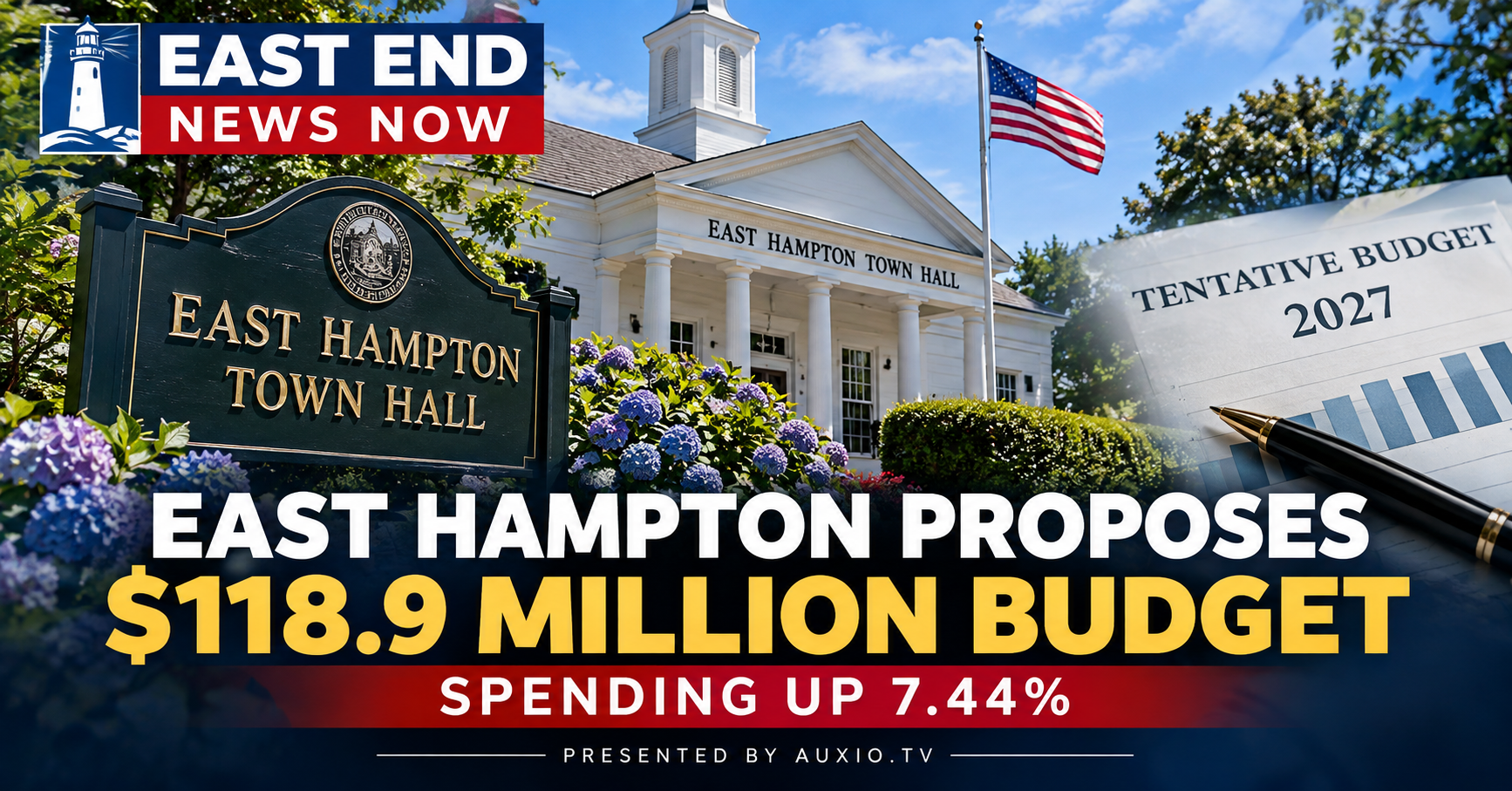
  • East Hampton Proposes $118.9 Million 2027 Budget as Costs and Service Demands Rise

    East Hampton Proposes $118.9 Million 2027 Budget as Costs and Service Demands Rise

    EAST HAMPTON, N.Y. — East Hampton Town Supervisor Kathee Burke-Gonzalez has released a proposed $118.9 million budget for 2027, laying out increased spending across Town services while acknowledging that the plan would exceed New York State’s property-tax levy cap.

    The tentative budget totals $118,910,330, a 7.44% increase over the Town’s adopted 2026 budget. Under the proposal, the Town tax rate is projected to increase 6.27% outside incorporated villages and 7.04% inside the villages. (East Hampton⁠)

    For a home with an estimated market value of approximately $1.33 million, Town officials estimate the annual Town tax increase at about $97 outside the incorporated villages and $46 within the villages. (East Hampton⁠)

    Burke-Gonzalez said the spending increase reflects growing demand for Town services as well as higher operating costs. According to the Town, East Hampton’s year-round population has increased approximately 37% since 2010, while expenses including health insurance, utilities, fuel, insurance and materials have continued to climb. (East Hampton⁠)

    A significant share of the proposed budget would continue going toward personnel. Salaries and employee benefits account for roughly $73 million, or 61.4% of the operating budget. Town employees represented by CSEA are scheduled to receive a 5% contractual wage increase in 2027, the final year of the current agreement. (East Hampton⁠)

    One of the larger departmental increases is directed toward the Building Department. Funding would rise from approximately $1.8 million to $2.5 million, an increase of roughly $730,000. The Town says the department has expanded from 10 employees in 2025 to 19 authorized positions. (East Hampton⁠)

    Public safety would receive approximately $29.37 million across the Police Department, Marine Patrol, Juvenile Aid Bureau and public-safety communications system. Another $6.75 million is proposed for beaches, parks and recreation. (East Hampton⁠)

    The proposal also includes more than $2.3 million for senior nutrition, transportation, in-home services and Programs for the Aging. Housing and Community Development funding from the General Fund would increase from roughly $438,000 to $606,000. (East Hampton⁠)

    Environmental spending remains another substantial component. Approximately $2.62 million is proposed for Natural Resources, Aquaculture, Land Management and the Town Trustees. Separate Community Preservation Fund spending includes $3.5 million for septic-system rebates and $2.5 million for water-quality improvement grants. (East Hampton⁠)

    The proposal comes as East Hampton continues dealing with an ongoing drinking-water investigation involving PFPrA and other PFAS compounds near the Buckskill Road wellfield. The Town says three of four affected Suffolk County Water Authority wells were removed from service, while state and county agencies continue investigating the source and extent of the contamination. (East Hampton⁠)

    The budget remains tentative and must go through the Town’s budget process before becoming the final 2027 spending plan.

  • Charlotte HOA Event Puts Homeowner Rights, Mediation and Reform in the Spotlight

    Charlotte HOA Event Puts Homeowner Rights, Mediation and Reform in the Spotlight

    CHARLOTTE, N.C. — A Charlotte conference later this month will bring homeowners, HOA professionals and reform advocates together as North Carolina continues wrestling with how much power homeowners associations should have — and what protections property owners should receive when disputes escalate.

    “The Missing Piece: How Mediation Connects Communities, Courts, and the Future of Justice” is scheduled for October 21 at SouthPark Church. An 11 a.m. HOA governance panel will feature HOA attorney Shira Hedgepeth, Neighborhood Cornerstone Partners founder Claudia Charles, HOA reform advocates Jeffrey C. Baldwin, Toni Emehel and Diane Krebs, according to the event announcement provided to AUXIO.

    The gathering comes as HOA policy has become an increasingly significant issue in Raleigh.

    SB 378 pushed HOA reform considerably further

    North Carolina Senate Bill 378 began as an HOA-reform proposal that would change several aspects of association governance, including fines, liens, access to records and architectural-review procedures. It also called for pre-litigation mediation of certain disputes and for the North Carolina Department of Justice to collect HOA complaints and report their underlying issues to lawmakers. 

    The bill’s legislative journey became complicated. It passed the Senate 47-0 in May 2025 and later passed the House 61-47 in October after substantial changes. The Senate refused the House message because of procedural timing, and the General Assembly currently lists the measure as “Held by House Clerk” as of October 23, 2025. 

    That means the reform debate remains unfinished.

    A separate proposal, House Bill 1174, the HOA Oversight Act, was introduced during the 2026 session and referred to the House Housing and Development Committee, with additional referrals if favorable. 

    Jeffrey Baldwin puts a face on the issue

    For panelist Jeffrey C. Baldwin, HOA reform isn’t theoretical.

    Baldwin became an advocate after his Charlotte HOA attempted to foreclose on his home in a dispute that reportedly originated with a $100 fine. The association eventually withdrew its foreclosure petition. Baldwin subsequently became involved with SAFERHOA and has argued for stronger accountability, transparency and restrictions on HOA foreclosure powers. 

    His experience illustrates why seemingly routine disagreements between homeowners and associations can become consequential disputes involving liens, attorneys and potentially a family’s home.

    That also makes mediation particularly relevant. The original HOA provisions of SB 378 specifically contemplated mediation before litigation in certain disputes. 

    Claudia Charles is approaching the issue from inside HOA management

    The other side of the reform conversation isn’t necessarily eliminating HOAs. It’s examining how they are managed.

    That is where Charlotte entrepreneur Claudia Charles and Neighborhood Cornerstone Partners⁠ enter the story.

    Charles founded Neighborhood Cornerstone Partners after serving as an HOA board president herself. According to the company’s account of its founding, Charles became involved after growing frustrated with problems in her own community and eventually concluded that HOA management could operate differently. 

    Her Charlotte-based company emphasizes transparency, financial and vendor oversight, homeowner communication, board support and dispute reduction while serving communities in North and South Carolina. 

    That makes Charles’s participation noteworthy because the October 21 panel brings together management, attorneys and homeowner advocates rather than treating HOA reform simply as a fight between homeowners and associations.

    A broader question for North Carolina

    The larger issue emerging in Raleigh and Charlotte is no longer simply whether HOAs are good or bad.

    It’s how much authority they should possess, what due-process protections homeowners should receive, how transparent associations must be and whether disputes can be resolved before they become expensive legal battles.

    The October 21 Charlotte discussion puts people who have experienced those questions from very different perspectives in the same room.

    And with HOA legislation continuing to move through the General Assembly, the conversation could have implications well beyond Charlotte.

  • The Game’s Company Sues UMG and Virgin Music Over ‘Drillmatic’ Promotion

    The Game’s Company Sues UMG and Virgin Music Over ‘Drillmatic’ Promotion

    AUXIO ENTERTAINMENT NEWS — The company behind rapper The Game has filed a lawsuit against Universal Music Group and Virgin Music, alleging the labels failed to spend most of a promised $500,000 marketing and promotion budget for his 2022 album Drillmatic — Heart vs. Mind.

    According to the complaint, The Game’s company, 100 Entertainment Inc., says the parties approved a detailed promotional budget shortly before the album’s release, including money for music videos, digital advertising, international promotion and $125,000 for radio. 

    The lawsuit alleges only about $179,000 of the $500,000 budget was actually spent, leaving more than $320,000 unused. It further claims none of the $125,000 earmarked for radio promotion was spent. 

    100 Entertainment also alleges that money which was spent on promotion was later recouped from The Game’s royalties, and that the company had to use some of its own funds to keep the album rollout moving. 

    The company argues that the reduced promotional support hurt Drillmatic during its critical release window and contributed to weaker sales and streaming performance.

    The album debuted at No. 12 on the Billboard 200 in 2022 and reportedly moved about 25,000 equivalent album units in its first week. 

    100 Entertainment is seeking at least $500,000 in damages for alleged breach of contract and what it describes as diminished commercial performance. 

    According to reporting on the complaint, UMG and Virgin have previously denied that they breached the agreement. 

    The lawsuit adds another business dispute to the long-running debate in hip-hop over label marketing commitments, recoupment and how much promotional support artists actually receive after a release is delivered.

    AUXIO ENTERTAINMENT NEWS | Presented by AUXIO.TV

  • Sen. Dean Murray Welcomes Fine Fare Supermarket to Bellport, Bringing 40+ Jobs

    Sen. Dean Murray Welcomes Fine Fare Supermarket to Bellport, Bringing 40+ Jobs

    BELLPORT, N.Y. — A new supermarket is preparing to open its doors in Bellport, bringing a fresh grocery option and more than 40 jobs to the community.

    State Sen. Dean Murray announced on Facebook that Fine Fare Supermarket will hold a soft opening on Friday, Oct. 2, after months of preparation at the former IGA location in Bellport Village.

    Murray said he recently met with owner William Lukeman as staff prepared the store for opening day.

    According to Murray, Lukeman said the extended preparation period was intentional because he wanted to “get it right and give the community what it wants and needs.”

    The new store is taking over the former IGA space on Main Street, a location Fine Fare first announced plans for late last year. Public reporting at the time noted the store’s emphasis on easy parking and its central Bellport location. 

    Murray praised the condition of the new supermarket, describing it as bright and clean with a wide variety of products.

    He also said the store is expected to employ more than 40 people, adding a notable local jobs component to the opening.

    The arrival of Fine Fare fills a long-vacant grocery location and returns a full-service supermarket to a familiar Bellport storefront.

    For Bellport residents, the opening represents more than a new place to shop — it brings new jobs, another locally accessible food option and renewed activity to a prominent village location.

    SUFFOLK NEWS NOW | Presented by AUXIO.TV

  • Pioneering Editor Belinda James Relaunches Blown Woofer Magazine With AUXIO.TV

    Pioneering Editor Belinda James Relaunches Blown Woofer Magazine With AUXIO.TV

    AUXIO NEWS NOW — Pioneering editor, author and media entrepreneur Belinda James is relaunching and rebranding Blown Woofer Magazine in collaboration with AUXIO.TV, bringing the publication back as a premium media brand focused on the intersection of car audio, custom vehicles and music culture.

    James brings more than three decades of experience in urban entertainment publishing. Through her work with Media Queen Publishing, she has been associated with titles including Word Up!, Rap Masters, 2 Hype, Hype Hair and other entertainment and lifestyle publications, building a career around artists, executives, entertainers and emerging cultural trends.

    For James, the new venture is about taking that publishing experience and adapting it for a new generation of readers.

    “Blown Woofer has always been about culture, sound and personality,” James said. “This relaunch gives us the opportunity to bring that same energy into a format that works for audiences today.”

    The new Blown Woofer Magazine will combine digital publishing with a quarterly four-page premium print edition distributed in select markets.

    The print edition is being designed as a highly visual, curated publication rather than a traditional long-form magazine, giving readers a compact mix of automotive culture, music, personalities and premium advertising.

    “I still believe print has value when it feels special,” James said. “The goal is not to print just for the sake of printing. We want each edition to feel collectible, visual and worth picking up.”

    Working with AUXIO.TV, the relaunch will extend well beyond print.

    Blown Woofer will be supported by digital articles, social media, video content and targeted advertising, allowing stories and advertisers appearing in the publication to reach audiences beyond the physical copies.

    The editorial direction will center on four core areas:

    Car Audio — sound systems, equipment, installations and the technology behind high-performance audio.

    Custom Builds — standout vehicles and the builders, installers and owners creating them.

    Music Culture — artists, releases and the music driving automotive culture.

    Celebrity Rides — vehicles, customization and automotive tastes connected to entertainers and other recognizable personalities.

    The concept reflects the longstanding relationship between music and automobiles, particularly within hip-hop and urban culture, where the car has often served as both a personal statement and a listening room on wheels.

    James said the partnership with AUXIO.TV allows the magazine to build on that culture while expanding how the content reaches people.

    “AUXIO gives us the ability to take a story beyond the page,” she said. “Someone may discover Blown Woofer in print, online, through video or through social media. That gives the publication a much bigger life than a traditional magazine ever had.”

    Instead of choosing between print and digital, Blown Woofer is being built to use both — a premium quarterly print product in targeted markets backed by continuous digital coverage through AUXIO.TV.

    For James, that combination is central to the magazine’s next chapter.

    “The mission is simple: celebrate the people, the cars, the sound and the music that make this culture what it is,” she said. “We want Blown Woofer to become a place where all of those worlds connect.”

    BLOWN WOOFER MAGAZINE x AUXIO.TV

  • Ruff Ryders Global Launches Rideout Energy Drink

    Ruff Ryders Global Launches Rideout Energy Drink

    YONKERS, N.Y. — Ruff Ryders Global is expanding its brand with the launch of Rideout Energy Drink, a new product aimed at riders, athletes and consumers looking for energy, focus and hydration support.

    The company says Rideout was developed around the culture and identity of Ruff Ryders, positioning the drink as part performance product and part lifestyle brand.

    According to Ruff Ryders Global, the drink contains a natural caffeine blend, B vitamins, nootropics, electrolytes and amino acids. The company markets the formula as providing sustained energy, mental focus and hydration support while maintaining a low-sugar profile.

    Rideout is being promoted toward a broad audience that includes motorcycle riders, gym users, runners and other active consumers.

    The branding leans heavily into the Ruff Ryders legacy, with the company describing the product as being built around discipline, hustle and movement.

    The launch also represents another expansion for Ruff Ryders Global, which operates from Yonkers and is continuing to develop projects across entertainment, lifestyle and consumer products.

    Rideout Energy Drink is currently being promoted through the company’s website, with Ruff Ryders Global also inviting inquiries regarding investment opportunities and future projects.

    AUXIO NEWS NOW | Presented by AUXIO.TV