
Category: Business

Explore entrepreneurship, innovation, leadership, and the ideas shaping tomorrow’s economy. Only on Auxio.tv. Content Amplified.

  • The Wealth of Southampton Is Not the Wealth of Its Residents

    The Wealth of Southampton Is Not the Wealth of Its Residents

    By Raheem Soto | Opinion
    SOUTHAMPTON, N.Y. — One of the great mistakes in public finance is confusing the value of a community’s property with the financial capacity of the people who live there.
    Southampton Town provides an excellent example.
    Supervisor Maria Moore’s proposed 2027 budget calls for approximately $153.9 million in spending, an increase of more than $10 million, accompanied by a proposed 9.38% increase in the property-tax levy.
    The immediate debate will undoubtedly center on percentages, spending priorities and whether the additional expenditures are justified.
    But there is a more important economic question: Who ultimately bears the cost, and how long can that burden continue to increase?
    Southampton is not an ordinary housing market. Seasonal residences, multimillion-dollar estates and second homes contribute substantially to the town’s property wealth. Yet the people who live here throughout the year operate within a very different economy.
    Approximately one-quarter of Southampton residents are 65 or older. Many longtime homeowners purchased their properties decades before today’s extraordinary real estate valuations.
    Their homes may be worth considerably more than they once were. Their incomes, however, may not be.
    A retired couple living on Social Security and a modest pension cannot pay a property-tax bill with an increase in their home’s estimated market value.
    That is the fundamental distinction between wealth on paper and the ability to pay.
    The problem with government spending.
    In the private economy, rising costs impose constraints. Businesses must increase productivity, find efficiencies, raise prices or risk losing customers.
    Government operates under different incentives.
    When municipal expenditures increase, officials can seek additional revenue from a tax base whose members cannot simply choose another provider of local government.
    This does not mean every increase in government spending is unnecessary. Police protection, road maintenance and essential infrastructure carry real costs.
    But it does mean that government must confront a discipline often absent from budget discussions: An expenditure can be worthwhile without being affordable at every proposed level.
    Southampton’s property-tax levy has increased from approximately $73.6 million in 2022 to a proposed $104.3 million in 2027.
    That represents roughly 42% growth in five years.
    The question is whether household incomes, particularly those of retirees and middle-income year-round residents, have experienced anything approaching that increase.
    There is little reason to assume they have.

    The hidden cost of an aging population.
    The U.S. Census Bureau estimates that approximately 25% of Southampton’s residents are age 65 or older.
    That matters because retirees often lack the ability to increase their earnings in response to rising expenses.
    Property taxes are imposed on the assessed value of property, not on the homeowner’s ability to pay.
    A seasonal homeowner with substantial investment income may view an additional few hundred dollars as an inconvenience. A year-round resident balancing a pension, Social Security and rising healthcare costs may view that same increase very differently.
    Neither resident is exempt from paying the tax. But the economic burden is not necessarily equal.
    And we should not pretend that all seasonal homeowners are wealthy or that all permanent residents are struggling. The point is more fundamental: The same tax can impose very different sacrifices on different households.
    The limits of a wealthy tax base
    Southampton’s substantial seasonal housing market may allow the town to raise revenue that many communities simply cannot.
    But the existence of taxable wealth does not eliminate the economic consequences of extracting more of it.
    Nor does it establish that annual spending increases are sustainable indefinitely.
    Consider what happens when a government expands permanent staffing, compensation and benefit obligations. These commitments generally continue into future budgets.
    A road improvement may be completed this year. A new position can generate salary, insurance and retirement obligations for decades.
    That does not make new employees unnecessary. It means the long-term cost must be considered alongside the immediate benefit.
    There is also a distinction between the town government’s capacity to sustain spending and a resident’s capacity to sustain the taxes required to finance it.
    A municipality can maintain strong reserves and excellent credit while some of its longtime residents become increasingly unable to afford living there.
    The question Southampton should be asking.
    The proposed 9.38% levy increase does not mean every property owner’s tax bill will increase by that percentage. Assessments, exemptions and tax districts influence individual bills.
    And Southampton’s fiscal strength deserves acknowledgment. Strong reserves and a valuable property base provide flexibility that many municipalities lack.
    But those facts do not eliminate the underlying economic question.
    How rapidly can government spending grow before it begins changing who can afford to remain in the community?
    A town that becomes increasingly dependent on the taxable value of expensive property may appear prosperous in its financial statements even as middle-income families, younger residents and retirees struggle with the cost of remaining there.
    Eventually, the distinction between a wealthy community and a community of wealthy people becomes difficult to ignore.
    Southampton’s Town Board should explain not merely how the proposed expenditures will be financed, but how its multiyear spending plans compare with the financial circumstances of permanent residents.
    Government’s ability to raise revenue is not the same as taxpayers’ ability to absorb repeated increases.
    Southampton may be rich in property. That does not mean every Southampton resident is rich in income. And a responsible budget should recognize the difference.

    Raheem Soto is the publisher of AUXIO.TV. This column reflects the author’s analysis and opinion.
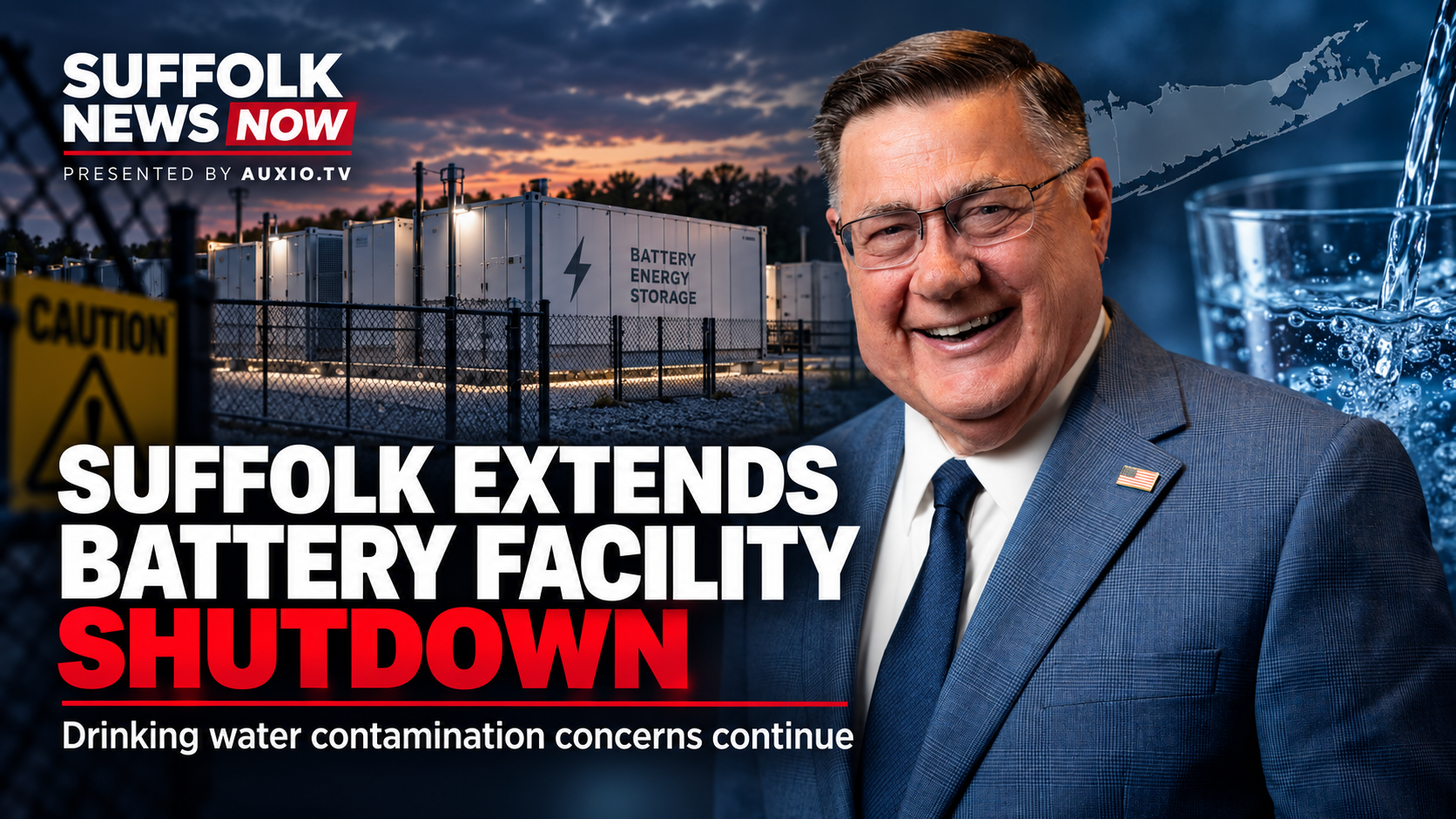
  • Suffolk County Extends Shutdown of Two Battery Storage Facilities Amid Drinking Water Contamination Concerns

    Suffolk County Extends Shutdown of Two Battery Storage Facilities Amid Drinking Water Contamination Concerns

    SUFFOLK COUNTY, N.Y. — Two battery energy storage facilities on Long Island’s East End will remain shut down as Suffolk County officials continue investigating groundwater contamination linked to a 2023 fire at an East Hampton facility.
    On October 9, County Executive Ed Romaine announced that NextEra Energy had agreed to extend the suspension of operations at its Cove Hollow Road facility in East Hampton and a second facility near Fort Pond in Montauk.
    Both facilities are jointly owned by NextEra Energy and National Grid.
    The announcement follows concerns about chemicals detected in drinking water near the East Hampton location.
    According to Suffolk County, the New York State Department of Environmental Conservation determined that water applied during a May 2023 fire mixed with Novec 1230, a fire-suppression chemical, and broke down into perfluoropropionic acid (PFPrA), a short-chain PFAS chemical.
    PFAS compounds are often called “forever chemicals” because many persist in the environment.
    The county reports that PFPrA has since been detected in drinking water around the facility, prompting the Suffolk County Water Authority to take two wells offline.
    The extended suspension will remain in place while the companies implement planned changes, including removal of the Novec 1230 fire-suppression agent from both facilities.
    Romaine said the county is awaiting remediation plans for state environmental review while continuing groundwater testing.
    The Suffolk County Water Authority has also pursued litigation against NextEra over the contamination, an action supported by the county.
    For residents, the unresolved questions involve how far the contamination has spread, what remediation will be required and when the facilities may safely resume operations.
    County officials say testing will continue as environmental regulators review the next steps.

  • Letitia James’s Cornell 7 Appointment Raises Questions About Prosecutorial Impartiality

    Letitia James’s Cornell 7 Appointment Raises Questions About Prosecutorial Impartiality

    ALBANY, N.Y. — New York Attorney General Letitia James has taken responsibility for a renewed investigation into sexual assault allegations at Cornell University, placing questions about prosecutorial impartiality and due process at the center of an increasingly scrutinized case.
    On October 1, Governor Kathy Hochul signed an executive order assigning the Attorney General’s Office to investigate an alleged sexual assault that occurred at Cornell in October 2024.
    James confirmed the appointment in an official statement, emphasizing her office’s responsibility to conduct a fair investigation.
    “Every New Yorker deserves to know that when they report a crime, it will be investigated fully and fairly.”
    James also pledged to lead an investigation guided by the facts and the law.
    The appointment follows renewed attention to allegations involving several former Cornell fraternity members. The underlying allegations remain contested, and an investigation does not establish criminal guilt.
    The case has also generated questions concerning public comments James made before receiving the special-prosecutor assignment.
    Those questions are relevant because New York’s Rules of Professional Conduct establish responsibilities for prosecutors, including restrictions on certain public statements that could prejudice legal proceedings.
    Rule 3.6 addresses trial publicity, while Rule 3.8 establishes additional responsibilities for prosecutors and other government attorneys. Both provisions are included in New York’s official professional conduct rules.
    However, expressing support for someone who reports an alleged crime does not automatically demonstrate bias or constitute professional misconduct. Whether a prosecutor’s statements create a legal conflict depends on the specific language, circumstances and applicable legal standards.
    For James, the question is whether her office can conduct an investigation that protects the rights of the complainant while preserving the presumption of innocence and procedural protections owed to those accused.
    Her office has publicly committed to doing so.
    As the Cornell investigation proceeds, the Attorney General’s Office will face scrutiny over both the substance of its findings and the fairness of the process used to reach them.
    The central issue is whether all parties can have confidence that the investigation will be decided by evidence rather than assumptions made before the investigation began.

  • America’s Technology Future Should Not Depend on Foreign Labor

    America’s Technology Future Should Not Depend on Foreign Labor

    By Addul Ali | AUXIO NEWS NOW | Opinion

    India’s stock market has endured weeks of significant losses, and its technology industry is facing mounting pressure from artificial intelligence, economic uncertainty, and changes in American immigration policy.

    The developments should prompt an important discussion in the United States about the H-1B visa program and the future of American technology employment.

    Why are American companies so dependent on international labor markets when our nation’s most critical technology systems require a strong, reliable domestic workforce?

    The H-1B visa program allows employers to recruit foreign professionals for specialized occupations. Its supporters credit it with helping American companies attract expertise and compete globally. Critics question whether some employers have used the program to hold down wages or avoid investing in American workers.

    Those questions deserve a serious examination, particularly when the jobs involve national security, sensitive information, and essential infrastructure.

    India’s Market Troubles Expose Economic Dependencies

    On October 8, India’s benchmark Sensex fell to a 32-month low following weeks of market losses. Rising oil prices, foreign investor withdrawals, and monetary pressures contributed to the decline.

    The market rebounded on October 9, demonstrating why it would be inaccurate to attribute India’s broader financial difficulties entirely to American visa restrictions.

    Nevertheless, India’s technology sector faces additional uncertainty following the Trump administration’s decision to suspend certain companies from the federal Permanent Labor Certification process, known as PERM.

    That process is associated with employment-based permanent residency and is separate from the H-1B temporary worker program.

    The affected companies include major technology employers and service providers with substantial American operations.

    The developments illustrate how deeply interconnected American immigration policy and the international technology industry have become.

    For the United States, they also raise questions about whether our domestic technology workforce is sufficiently developed to meet our long-term needs.

    Are American Workers Being Given a Fair Opportunity?

    America has universities, community colleges, technical training programs, and military veterans capable of contributing to its technology economy.

    The Bureau of Labor Statistics projects substantial growth in software development and cybersecurity occupations over the coming decade.

    Yet employers continue to describe shortages of qualified workers.

    Some shortages reflect genuine demand for highly specialized expertise. Others raise questions about whether companies are offering competitive compensation, recruiting domestically, or investing enough in training.

    Are American graduates receiving meaningful entry-level opportunities?

    Are employers recruiting from historically Black colleges and universities, community colleges, and military transition programs?

    Are companies developing American talent, or relying too heavily on workers who have already received their training elsewhere?

    These questions should be answered with transparent hiring and compensation data.

    Critical Infrastructure Is a National Security Responsibility

    Technology professionals help maintain America’s electrical grid, financial institutions, telecommunications networks, defense systems, hospitals, and government databases.

    The integrity of those systems is fundamental to national security.

    The issue is not whether an engineer born in India or another country can be capable, trustworthy, or committed to America. Foreign-born professionals have made important contributions to American innovation.

    The issue is whether the United States is building enough domestic expertise to operate its most sensitive systems under any circumstances.

    Security clearances, citizenship requirements where applicable, background investigations, and strict access controls remain essential. No individual’s nationality alone establishes whether that person presents a security risk.

    But workforce resilience also matters.

    America needs a sufficiently deep domestic talent pool to ensure continuity when international labor markets, diplomatic relationships, or immigration policies change.

    Congress Should Examine the H-1B Program

    Congress should examine whether the H-1B program’s wage protections, recruitment practices, and oversight mechanisms adequately protect American workers.

    That examination should include the experiences of American technology professionals, recent graduates, and workers who believe they have been displaced.

    It should also consider evidence from employers that rely on specialized international talent and maintain that such hiring supports innovation and domestic employment.

    Federal contractors responsible for particularly sensitive systems warrant additional scrutiny of their workforce continuity, cybersecurity, and security-clearance requirements.

    Policymakers should also examine ways to expand technical apprenticeships, veteran training programs, university partnerships, and pathways into high-demand technology occupations.

    The goal should be measurable domestic capability rather than assumptions about workers based on where they were born.

    America’s Technology Future Must Be Built on American Capability

    India’s financial-market difficulties cannot be reduced to a single American immigration program.

    But the pressure facing its technology industry highlights how international policy decisions can affect globally connected businesses.

    For America, the broader lesson concerns workforce resilience.

    The United States can benefit from exceptional international talent while also expecting employers and government agencies to invest seriously in American workers.

    A technologically independent nation requires more than advanced equipment and successful corporations.

    It requires a workforce with the education, training, experience, and opportunity to build and protect the systems on which the country depends.

    America’s technology future must be built on American capability, American opportunity, and a commitment to developing the people who will protect our most critical infrastructure.

    Addul Ali is a North Carolina businessman, U.S. Army veteran, and political commentator. The opinions expressed are his own.

  • Long Island Basketball History Youth League Launches Winter Season in Bellport

    Long Island Basketball History Youth League Launches Winter Season in Bellport

    BELLPORT, N.Y. — A new youth basketball league is preparing to launch on Long Island this December, bringing together community-based teams while emphasizing player development, teamwork and local pride.
    The Long Island Basketball History Youth League will begin its inaugural winter season during the first week of December, with games hosted at Bellport Middle School and Bellport High School.
    The league will feature two divisions for third- and fourth-grade players and fifth- and sixth-grade players, offering young athletes an opportunity to compete alongside teammates from their own communities.
    Tristan Smith, commissioner of the Long Island Basketball History Youth League, said the program is designed to develop young players while strengthening connections between communities.
    “We’re looking forward to creating an environment where young athletes can develop, compete, and grow while representing their communities. This league is about more than basketball. It’s about bringing people together and helping prepare the next generation.”
    Smith also expressed appreciation for the coaches, parents and community members supporting the league’s development, emphasizing its guiding message: “Let’s build.”
    Rich Brown, league director and Bellport High School varsity boys basketball head coach, believes the community-based model will complement Long Island’s established travel basketball programs.
    “To develop and build with the teammates you will be playing with in school is essential for the future of Long Island basketball.”
    Brown said the addition of community-based programs will help provide developmental opportunities for players at different skill levels while supporting the continued growth of basketball across the Island.
    The league is currently inviting community-based teams to register for the winter season.
    Interested coaches and organizers can contact Tristan Smith at info@libasketballfoundation.org or scan the registration QR code on the league’s promotional flyer.

  • LIRR Service Suspended Between Speonk and Patchogue Following Reported Shooting On Train Near Bellport

    LIRR Service Suspended Between Speonk and Patchogue Following Reported Shooting On Train Near Bellport

    SUFFOLK COUNTY, N.Y. — Long Island Rail Road service on the Montauk Branch was suspended Friday morning, October 9, between Speonk and Patchogue during a police investigation in the Mastic-Shirley area.
    According to information provided by a direct LIRR source, the investigation involves a reported shooting near Bellport involving a train. The circumstances of the reported incident, including whether anyone was injured, have not yet been publicly confirmed.
    The disruption affected morning commuters, with several trains canceled, delayed or operating on modified schedules.
    The affected section of the Montauk Branch includes Bellport and Mastic-Shirley, creating travel interruptions for passengers heading west toward Patchogue and Babylon or east toward Speonk and the Hamptons.
    Authorities have not yet released additional details about the reported shooting or identified anyone involved.
    SUFFOLK NEWS NOW will continue following developments as information becomes available.

  • Mecklenburg County Weighs Taking Over Discovery Place Nature Amid $14.7 Million Debt Dispute

    Mecklenburg County Weighs Taking Over Discovery Place Nature Amid $14.7 Million Debt Dispute

    CHARLOTTE, N.C. — Mecklenburg County commissioners are examining their financial agreement with Discovery Place after county officials reported that the nonprofit museum organization owes the county $14.7 million.

    The dispute has raised questions about the approval and repayment terms associated with the new Discovery Place Nature museum near Freedom Park.

    At their October 6 meeting, commissioners received an update on the outstanding financial obligation and discussed potential responses, including declaring Discovery Place in default and assuming operations of the new nature museum.

    Another option would allow Discovery Place to repay the county over time.

    Rather than immediately choosing either course, commissioners approved the creation of an ad hoc committee to review the financial relationship, outstanding obligations and possible next steps.

    Questions About the Original Agreement

    The county’s October 8 public update specifically acknowledged commissioners’ questions about how the original funding and reimbursement agreement was approved.

    That raises an important accountability issue: What financial protections were established when public funding was committed, and how will the county enforce those protections?

    The county has publicly identified the $14.7 million obligation, but the summary reviewed by AUXIO.TV does not establish the precise repayment schedule, the circumstances under which default may be declared or whether any payments are currently overdue.

    Those distinctions matter. An outstanding obligation is not necessarily a delinquent payment, and consideration of default does not mean default has already been declared.

    A Major Public Investment

    The new Discovery Place Nature museum represents a substantial investment in Charlotte’s educational and cultural infrastructure.

    According to Mecklenburg County’s official project information, the museum’s total projected cost was approximately $62.3 million as of January 2024.

    The project is intended to replace the former nature museum with a larger educational destination featuring exhibits focused on the Piedmont region, native wildlife, outdoor learning and environmental stewardship.

    Discovery Place’s published plans include an elevated tree-canopy walk, river otter habitats, interactive exhibits and public outdoor spaces connecting the museum with Freedom Park.

    The public benefits of the project are an important part of the story. So is the responsibility to account for taxpayer-supported financing.

    Could Mecklenburg County Operate the Museum?

    One option identified by county officials would allow Mecklenburg County to declare Discovery Place in default and assume operations of the new facility.

    That possibility raises questions extending beyond the outstanding debt.

    If the county assumed operations, officials would need to determine how the museum would be staffed, how educational programming would continue and what financial responsibilities Mecklenburg County would inherit.

    The county has not announced a takeover, and the committee’s findings have not yet been released.

    What Happens Next?

    The newly approved committee is expected to examine the agreement and potential paths forward.

    The central questions are whether Discovery Place can meet its financial obligations, whether repayment terms should be revised and what course best protects the county’s financial interests while preserving the museum’s intended public services.

    Discovery Place’s position on the repayment options and the possibility of a county takeover should be obtained before the story is treated as a complete account of the dispute.

    For Mecklenburg County residents, the issue is larger than one museum.

    It concerns how major public investments are approved, monitored and enforced — and who bears the financial risk when a publicly supported project faces questions over repayment.

    AUXIO.TV will continue examining the original agreement, county financial records and the commissioner’s committee review.

  • Business Spotlight: R.E.A.D. With Us Services Brings Eyewear Care Directly to Long Islanders

    Business Spotlight: R.E.A.D. With Us Services Brings Eyewear Care Directly to Long Islanders

    SUFFOLK COUNTY, N.Y. — R.E.A.D. With Us Services is bringing a more convenient approach to eyewear care across Long Island by taking professional optical services directly to customers.

    Led by CEO Erica Jimenez, the mobile eyewear business offers personalized fittings, adjustments, repairs and prescription analysis without requiring customers to visit a traditional optical shop.

    Jimenez is a licensed optician with more than 20 years of experience in eyewear and optical services, bringing both technical knowledge and a personalized approach to each appointment.

    R.E.A.D. With Us Services also helps customers select frames, improve fit and comfort, make repairs and coordinate prescription needs with their optometrist when necessary.

    The company’s model is built around convenience and one-on-one service, giving customers the ability to receive professional eyewear assistance at a location that works for them.

    For appointments, R.E.A.D. With Us Services can be reached at 631-260-1146.

    SUFFOLK NEWS NOW | Presented by AUXIO.TV

  • Former Suffolk DSS Examiner Arrested in Alleged $78K SNAP Fraud Scheme

    Former Suffolk DSS Examiner Arrested in Alleged $78K SNAP Fraud Scheme

    SUFFOLK COUNTY, N.Y. — A former Suffolk County Department of Social Services examiner has been arrested for allegedly stealing more than $78,000 in SNAP benefits, according to Suffolk County District Attorney Raymond Tierney’s office.

    Prosecutors say the defendant was responsible for reviewing existing SNAP cases to determine whether recipients remained eligible for benefits.

    According to the DA’s office, an internal audit found that he allegedly opened seven SNAP cases for individuals who had neither applied for benefits nor requested public assistance.

    Tierney’s office alleges those fraudulent cases were then used to direct tens of thousands of dollars in unauthorized SNAP benefits.

    “This defendant was entrusted with protecting the integrity of our public assistance system,” Tierney said in a statement, adding that the defendant instead allegedly abused that trust by creating fraudulent cases and directing unauthorized benefits.

    Tierney also credited Suffolk County Executive Ed Romaine’s office for referring the matter to prosecutors after county officials uncovered the suspected misconduct.

    The case remains an allegation, and the defendant is presumed innocent unless and until proven guilty.

    SUFFOLK NEWS NOW | Presented by AUXIO.TV

  • Business Spotlight: VERN Brings a Full October Lineup to West Babylon

    Business Spotlight: VERN Brings a Full October Lineup to West Babylon

    WEST BABYLON, N.Y. — VERN Restaurant and Bar is giving Suffolk County diners several reasons to stop in this October, with a month of food-themed events and a Halloween celebration planned at its waterfront West Babylon location.

    Located at 301 Bergen Avenue, VERN serves Caribbean-inspired cuisine, seafood, cocktails and more, with views overlooking the water. The restaurant also offers catering, private parties and live entertainment. 

    October’s upcoming events include National Dessert Day on Oct. 14, National Pasta Day on Oct. 17, National Chocolate Day on Oct. 28, and a Halloween celebration on Oct. 31, when guests are encouraged to come in costume. 

    The restaurant’s October schedule gives local residents a mix of casual dining and themed nights as the fall season gets underway.

    SUFFOLK NEWS NOW | Presented by AUXIO.TV